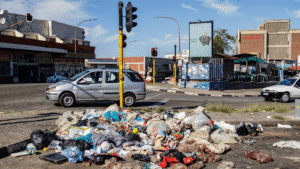
South Africa’s long road to economic growth


About a 10th of the targeted measures South Africa requires to tackle anemic economic growth have been fully implemented over the past 18 months, a new tracker showed.
The gauge, developed by research firm Krutham for Business Leadership South Africa, reflects a “good news” story, with 26 reform deliverables reported as complete out of about 240 that were required, the lobby group’s Chief Executive Officer, Busi Mavuso, said in a foreword to the Reform Momentum Indicator.
“We were very deliberate, we were very intentional as the business community that for us to have a step change in our economy, we need to implement reforms,” Mavuso told a briefing on the tracker in Johannesburg on Thursday.
“This is going to be an important intervention to ensure that we grow our economy and so that we can attract the much-needed investment.”
Africa’s largest economy has expanded by less than 1% a year for more than a decade, constrained by graft, underinvestment in infrastructure, logistics snarls, and insufficient energy supply.
President Cyril Ramaphosa has previously estimated that the country needs as much as R1.6 trillion in public-sector infrastructure investment and a further R3.2 trillion from the private sector by 2030.
The tracker in part assesses the work done by Operation Vulindlela, a unit within the presidency Ramaphosa set up in October 2020 to fast track reforms to fire up the economy.
In May, Ramaphosa unveiled a second phase of the program that is focused on overhauling dysfunctional municipalities, driving the adoption of digital technologies and addressing apartheid-era spatial planning.
The “tracker will strengthen the culture of delivery that we need to embed into government,” Deputy Finance Minister Ashor Sarupen said.
“The reforms that we are working on now will define our economic trajectory in the next 10 to 15 years.”
The quarterly index seeks to track and compare progress in various areas including economic management, governance and the criminal-justice sector. It also indicated that progress had been made in easing energy and logistics constraints.
BLSA said more work still needs to be done.
“South Africa is in a situation where, despite a still healthy appetite from the private sector to develop renewable-energy power plants, there is insufficient transmission capacity to accommodate the demand,” the lobby group said.
About 14,000 kilometres of new transmission lines are needed to expand grid capacity, and the National Transmission Company South Africa has announced plans to spend R112 billion over five years to connect as much as 30 gigawatts of generation capacity, it added.
In the transport and logistics sector, “implementation remains patchy, with institutional progress overshadowed by persistent operational failures that continue to constrain exports and economic growth,” BLSA said.