The government programme keeping unemployment high


The Sector Education and Authorities (SETAs) system was introduced to address South Africa’s severe skills shortage.
However, over two decades later, the programme has had the unintended effect of increasing unemployment in the country as South Africa continues to face a serious shortage of skills.
By increasing the cost of employment, the SETA system has also inadvertently contributed to higher unemployment in the country.
This is feedback from the Bureau for Economic Research’s Robert Botha, Roy Havemann and Claire Bisseker, who outlined the issues with the SETA system in a recent research note.
This research note, titled ‘Time for a skills rethink – A review of the SETA system’, detailed how this system has done very little to foster skills development in the country.
The researchers explained that South Africa’s persistent skills shortage remains a critical barrier to the country’s economic growth, particularly in sectors like manufacturing.
In 1998, the SETA system was created to solve this problem, with the state-led intervention designed to catalyse a “skills revolution” and remedy the structural skills deficit inherited from the pre-1994 era.
The primary rationale behind this system was to solve market failures in skills training, such as underinvestment in skills development, by compelling firms to contribute to the collective cost of training through a mandatory levy.
“However, more than two decades after its inception, South Africa continues to face a serious skills shortage that damages long-run economic growth,” the researchers said.
“This persistent challenge calls into question the efficacy and impact of the SETA system.”
One of the biggest problems with this system is that, despite its primary mandate, it has been ineffective with systemic underperformance.
The researchers explained that, while the SETA system operates at a significant scale, its performance is undermined by deep-rooted inefficiencies.
In addition, the system struggles with a “leaky pipeline” where a substantial number of learners exit programmes without certification.
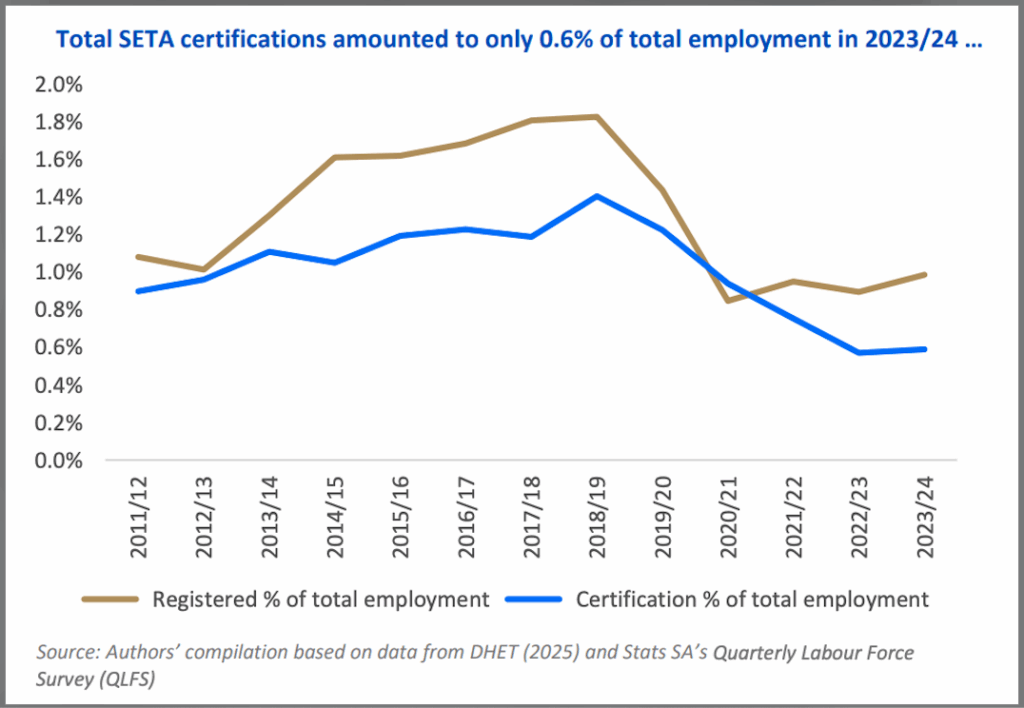
Between 2011/12 and 2023/24, the system registered 2.6 million individuals across its various programmes, with 2 million completions.
“However, these headline figures mask critical weaknesses, as over 630,000 registrations did not lead to a successful certification,” they said.
“This leakage is most severe in the programmes designed to address deep skills and facilitate workforce entry.”
The total number of SETA skills programme registrations in 2023/24 was only 1% of the employed and 0.7% of the labour force.
Financial troubles
Aside from the lack of consistent skills development, the researchers explained that the SETA system is plagued by poor financial management.
“The build-up and hoarding of surpluses and cash reserves point to significant financial inefficiency and chronic mismanagement,” they said.
“The SETA system commands significant financial resources but is defined by inefficiency and a failure to spend its budget on its core mandate.”
Over the research note’s review period, R164 billion was disbursed from the Skills Development Levy (SDL) fund to SETAs.
However, SETA’s total revenue has consistently exceeded expenditure, leading to large net surpluses, which stood at R6.7 billion at the end of 2023/24.
At the same time, cash and cash equivalents held by SETAs grew from R8.9 billion in 2011/12 to R27.1 billion in 2023/24 in nominal terms.
After adjusting for inflation, they grew by 78%. The researchers said this represents a massive opportunity cost, with billions of rands intended for skills development sitting idle in bank accounts.
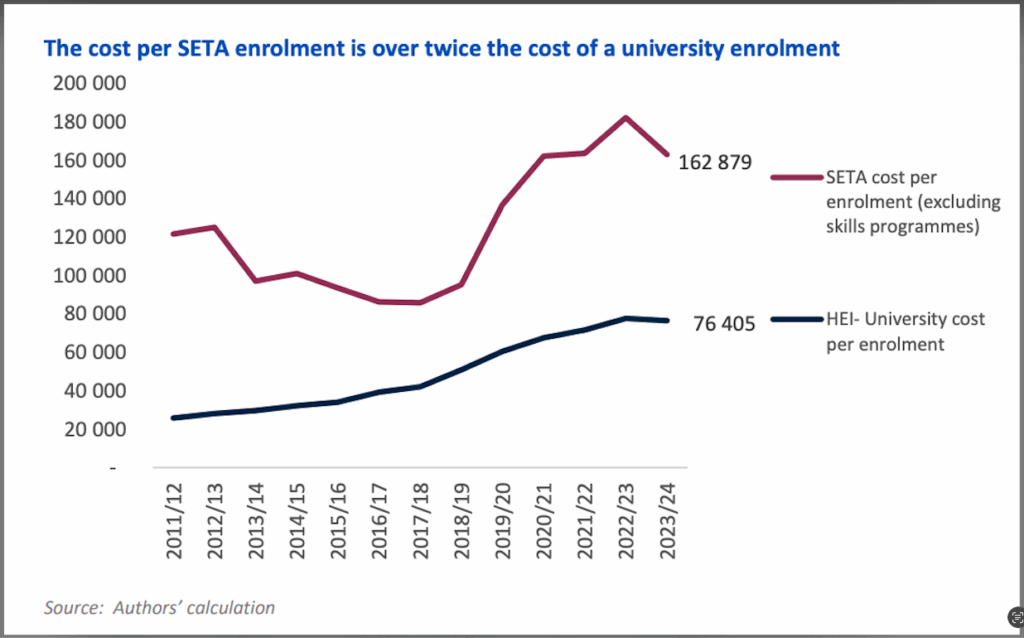
This is despite the fact that the SETA system is very costly, as shown in cost comparisons per beneficiary.
The researchers found that, in 2023/24, the cost per SETA certification was R181,269. This is significantly higher than the cost per university enrolment (R76,405), NSFAS funding per university student (R73,829), and TVET college funding per student (R34,230).
Even excluding the low-cost, high-volume skills programmes, the SETA cost per certification skyrockets to R388,052.
This is even higher than the cost per university graduate at R370,923, even though universities also have research mandates
The researchers further pointed out that the SETA levy is significant relative to other tax and budget sources in South Africa.
In the 2025/26 budget, the SETA allocations from the SDL is approximately R20.8 billion, more than the net revenue the National Treasury’s blocked VAT increase would have raised.
The estimated allocation to SETAs also exceeds the transfers to TVET colleges and is approximately 44% of the subsidies to universities.
One proposed solution
The researchers also provided four options to potentially reform the SETA system and address the country’s skills shortage.
The most radical reform option is to phase out the SETAs entirely, including the levy, which the researchers claim would have several advantages.
The first is that the SETAs are funded through a 1% payroll tax, which increases the cost of employment by 1%.
“Given that there is almost certainly a negative wage elasticity of employment, this increases unemployment,” they said.
“If the SETAs create skills, then this effect is outweighed. However, the paltry performance of skills development (barely 0.5% of the labour force obtains a certification per year) suggests that the effect is overwhelmingly negative.”
“In short, it is likely that SETAs increase unemployment on a net basis and phasing them out is likely to increase employment.”
The researchers said that even if firms do not increase employees significantly, firm profits and thus corporate tax will rise.
 Loading ...





Comments