Zero prosecutions for foreign bribery in South Africa since 2007


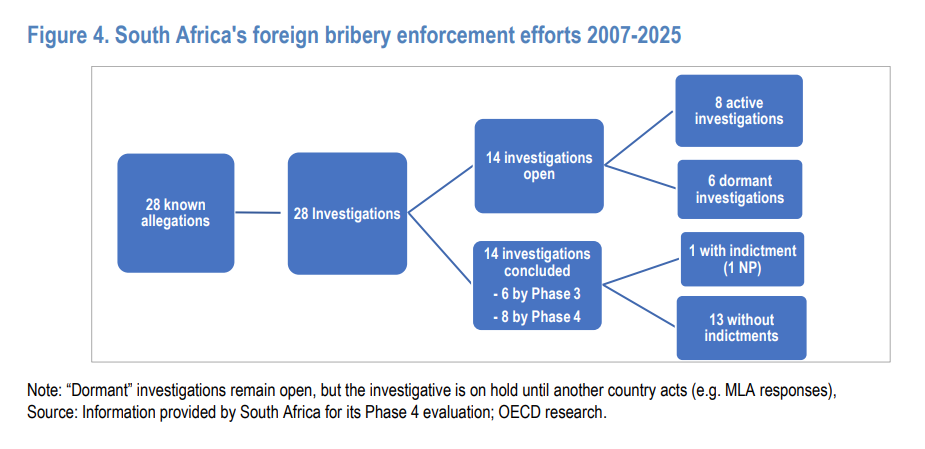
South Africa has yet to secure any convictions or sanctions for foreign bribery in the country, despite opening 28 investigations into the crime since 2007.
Currently, there are eight active investigations and six dormant investigations. Thirteen have been concluded without indictment.
This has led to significant concerns from international institutions and is partly the reason why South Africa has remained on the Financial Action Task Force’s greylist for longer than expected.
A particular decline in the willingness and capacity to prosecute this crime was noticed over the past decade, when the country was racked by corruption during the era of state capture.
This is feedback from the Organisation for Economic Cooperation and Development’s (OECD) Working Group on Bribery, which recently released its report into South Africa’s anti-bribery efforts.
The report focused on foreign bribery and analysed South Africa’s efforts to combat the crime over the past 18 years through various site visits to the country and an analysis of ongoing investigations.
Since 2007, the OECD said that South Africa has opened several cases into foreign bribery allegations, but little progress has been made in securing convictions or sanctions for the crime.
Overall, the Working Group expressed significant concerns regarding the low number of investigations and the “lack of significant investigative efforts” in these cases.
In addition, South Africa has made little effort to secure legal assistance to investigate and prosecute these international crimes.
Though the exact reasons for the lack of enforcement could not be ascertained, the Working Group expressed concerns about the possibility that political and economic considerations may have influenced the country’s foreign bribery investigations.
At the time of the latest Phase 4 report from the OECD’s Working Group, South Africa has still not secured a conviction or imposed sanctions for foreign bribery.
It has, however, formally or preliminarily investigated all 18 of the known foreign bribery allegations that have arisen since Phase 3, as well as the four legacy matters that were still ongoing in Phase 3.
The only case to have made it to court was relating to allegations that MTN bribed senior Iranian officials to obtain a licence to operate in the country.
The company allegedly paid the bribes through an intermediary who was South Africa’s Ambassador to Iran at the time.
After years of investigation and the use of a whistleblower, the South African authorities concluded that they lacked sufficient evidence to charge the company or any of its officers or employees.
The graphic below shows where South Africa’s 28 investigations into foreign bribery have ended up, with 14 remaining open.
South Africa is making progress
The OECD Working Group said that after the end of the era of state capture, some notable progress has been made in enhancing South Africa’s enforcement capacity.
South African authorities, in particular the Hawks, have made a more concerted effort to investigate foreign bribery in the country.
These authorities have finally begun to use extensive investigative techniques, such as subpoenaed financial and telecommunications records, electronic services, and gathering information from other agencies.
According to the data South Africa provided for its Phase 3 and Phase 4 evaluations, there has been a marked increase in the use of investigative techniques when comparing cases detected before or after Phase 3.
For example, the South African authorities have more routinely subpoenaed or otherwise obtained bank records, other financial transaction records, corporate records, and cell phone and travel records.
They have also been more inclined to interview witnesses and suspects on the record instead of inviting target companies to clarify the situation.
This indicates a drastic shift in the approach to investigating foreign bribery in the country, which should lead to improved outcomes in the future, the Working Group said.
However, despite these efforts, the Working Group said that few of the 22 foreign bribery investigations conducted over the past decade appear likely to result in sanctions or convictions.
Around seven investigations are known to have been closed without any charges being laid, with another six laying dormant while South Africa waits for developments in other countries.
One major area of progress has been South Africa’s cooperation with its international counterparts to aid investigations in other countries relating to corruption during the state capture period.
By cooperating with Working Group counterparts, South African authorities have secured major corporate resolutions for domestic corruption during this period.
For example, in December 2022, South Africa, Switzerland, and the United States concluded coordinated resolutions with ABB, a Swiss technology company, for a corruption scheme involving Eskom.
As a result, ABB agreed to pay South Africa R2.5 billion as “punitive reparations” under a non-trial resolution concluded with the National Prosecuting Authority (NPA).


Comments