New mafia taking over South Africa


The so-called ‘tanker mafia’ is becoming entrenched in municipalities nationwide as individuals leverage ongoing water supply issues to score tenders or drive up demand for their water tankers.
This mafia first appeared in KwaZulu-Natal in 2024 but has since spread to other areas of South Africa that have experienced water shortages. Gauteng is particularly attractive to it as sporadic water shortages hit the province.
The spread of this mafia has become a pressing issue for the government, with President Cyril Ramaphosa saying these criminal syndicates sabotage infrastructure and leave communities stranded.
Rampahosa made these comments at the National Water and Sanitation Indaba, which was held at the end of March to discuss solutions to South Africa’s ongoing water crisis.
“We are still very much a long way off from achieving clean water and sanitation for all,” Ramaphosa said. This is despite significant progress in improving access to clean water in the past three decades.
“Last year’s Water Summit identified ageing and poorly-maintained infrastructure, vandalism of water infrastructure, illegal connections, and organised crime in the water sector as some of the challenges facing service delivery.”
Ramaphosa said that local governments are plagued by financial mismanagement, insufficient revenue collection systems, and high water losses.
Deputy Minister of Water and Sanitation Isaac Seithlolo outlined the role corruption has played in exacerbating South Africa’s water crisis at the Indaba.
Seithlolo explained that water tankering has become an extremely lucrative business in the past few years, and criminal syndicates have emerged to benefit from it.
He pointed specifically to how some municipal officials and politicians were involved in shutting off water valves to create artificial demand for water tankers, which were then supplied at inflated costs.
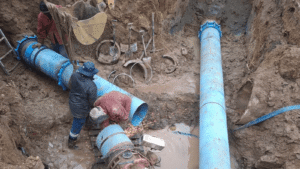
In some cases, individuals steal parts that could be used to repair broken infrastructure to extend contracts for water tankers.
Criminal syndicates also target electrical cables and equipment to ensure that pumping stations cannot function for extended periods of time.
Going beyond water tankers

Department of Water and Sanitation DG, Dr Sean Phillips, explained that the water tanker mafia sometimes does not even have to steal or break municipal water infrastructure as it steals water from the supply system.
He explained that, in some cases, the water tanker mafia would illegally connect to water supply systems to fill its tankers up for free and then sell this water in other areas at exorbitant prices.
In one such case, a water tanker company sold a 5,000-litre tanker for between R600 and R800. From the municipality, it would only cost R40 to R120 to fill such a tanker.
This reveals one of the easiest ways to catch the water tanker mafia. Phillips explained that it should be relatively easy to spot when they are overpaying for a service by looking through municipalities’ financials.
Phillips said the only long-term solution to the water tanker mafia is to ensure that criminal elements are prosecuted and punished harshly.
Late last year, water scientist Anthony Turton said that the tanker mafia is no longer only looking to win contracts to supply water tankers but is also embedding itself in other parts of the water system.
“From my perspective, this problem is getting bigger and bigger by the day. It is not only about drinking water anymore,” Turton told Newzroom Afrika.
“It is also about the wastewater system. I am aware of deliberate attempts to sabotage wastewater systems in order to land contracts to pump sewage out of commercial buildings.”
South Africa’s wastewater infrastructure is deteriorating rapidly and is on the brink of collapse, with 46% of the country’s water regarded as unsafe for human consumption.
The country produces around 7 billion litres of wastewater per day. If this is not treated properly, large amounts of untreated wastewater have to be expelled into South Africa’s river systems.
These systems feed into the catchment areas for South Africa’s largest water boards, which then process the water before distributing it to municipalities.
If large amounts of wastewater are expelled into these catchment areas, the amount of bacteria greatly rises and increasingly reaches the end user.
As a result, there have been numerous outbreaks of cholera and E. coli in parts of South Africa, from Hammanskraal in Gauteng to Durban.


Comments