South Africa’s richest province in R32.3 billion hole


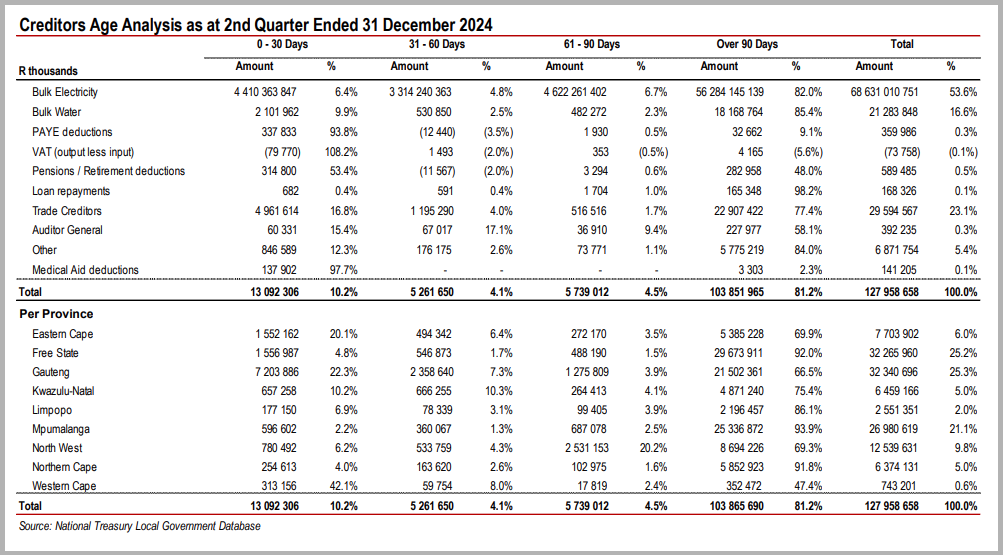
South Africa’s municipalities owe creditors a total R127.96 billion, with Gauteng alone failing to pay suppliers to the tune of R32.3 billion.
This was revealed by the National Treasury in its report on local government and expenditure for the second quarter of the 2024/25 financial year.
The National Treasury’s report covers the performance against the adopted budgets of local government for the second quarter of the municipal financial year ending on 31 December 2024.
This report also includes spending against conditional grant allocations for the same time frame, showing how they spend the money given to them by the Treasury.
Municipal spending is vital in South Africa as it is the main touchpoint for many citizens with the government and is where most service delivery occurs.
The financial health, and subsequently the service delivery, of South Africa’s municipalities has been steadily declining in recent years due to mismanagement.
A central part of this mismanagement has been the failure of municipalities to pay suppliers timeously and in full.
The debt that municipalities owe to Eskom has been well publicised, but a significant share of the money they owe is to small businesses that desperately need the cash to survive.
National Treasury’s latest report showed that municipalities owe creditors a total of R127.96 billion, with the vast majority being for bulk electricity services at R68.6 billion.
Municipalities owe R21.3 billion for bulk water services and R29.6 billion to trade creditors.
Worryingly, the majority of the funds owed to creditors are to suppliers that have not been paid over 90 days since serving a municipality with an invoice.
R103.87 billion worth of goods and services have not been paid for in over 90 days since invoiced. R13 billion has not been paid within 30 days.
The worst provincial culprit is South Africa’s richest province, with Gauteng owing R32.3 billion to suppliers. It is closely followed by the Free State which owes R32.2 billion.
In contrast, municipalities in the Western Cape only owe suppliers R743.2 million, and over 40% of the total has not been paid in the past thirty days.
The amount municipalities in South Africa’s nine provinces owe to creditors can be seen in the table below, courtesy of the National Treasury.
The financial decline of South Africa’s municipalities is not confined to the non-payment of suppliers but also basic bookkeeping.
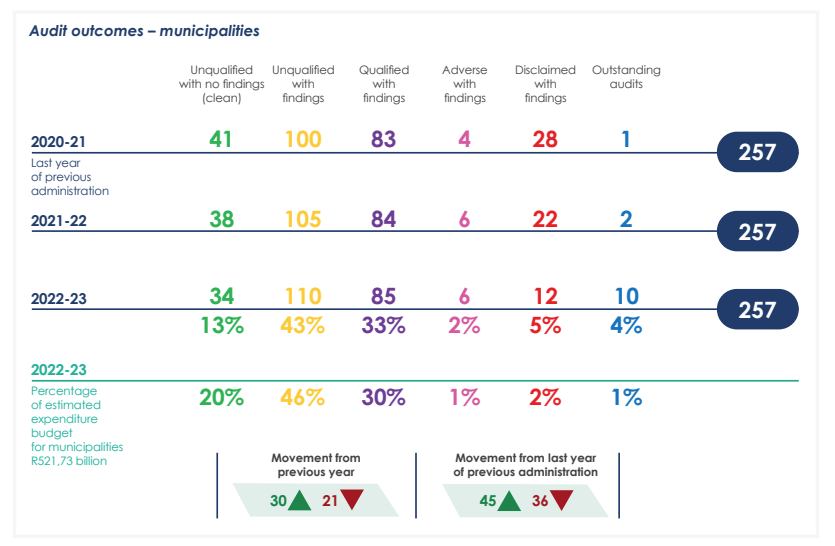
Over the past decade, the Auditor-General revealed that South Africa has gone from having 163 municipalities with a clean audit to only 34.
Auditor-General Tsakani Maluleke said local government is instrumental in providing communities with basic services, often being the authority responsible for the delivery of clean water, sanitation, electricity, and waste management.
“After years of service delivery failures, council and administrative instability, financial mismanagement, and disregard for the law, this sphere of government faces greater demands than ever before to regain the trust of South Africans,” she said.
In her latest report on municipal finances, Maluleke revealed that only 34 (13%) municipalities received a clean audit for the 2022-23 financial year. This is a sharp decline from the 163 (59%) of municipalities in 2014-15.
“The lack of transparency, accountability and institutional integrity not only leads to non-delivery of services but also harms the people these municipalities are intended to serve,” Maluleke said.
“My call is for urgent action and is again directed to the political leadership of municipalities. There is limited time left in their term to leave a legacy of improved governance and delivery.”
This is a far cry from a decade ago when only 29 municipalities received a disclaimed audit opinion on their financial statements in 2010/11.
The Auditor-General at the time, Kimi Makwetu, said the improvements were driven by the government’s Operation Clean Audit, launched in 2009.
This initiative outlined clear steps to ensure that all municipalities received unqualified audits.
While it failed to reach its target of 75% of municipalities having clean audits, Makwetu said it significantly impacted municipalities’ ability to produce financial statements on time and improve their audit opinions.
Makwetu highlighted some of the issues that would come to plague municipalities. His warnings were not heeded.
“Continued reliance on the auditors to identify corrections to be made to the financial statements to obtain an unqualified audit opinion is not a sustainable practice,” he said.
“The over-reliance on consultants is a further warning signal of a lack of capacity and skills in local government to produce unqualified financial statements.”
This foreshadowed the sharp decline in capacity at the local government level, with a growing number of municipalities unable to produce their financial statements on time.





Comments