87% of South African municipalities failed their audits


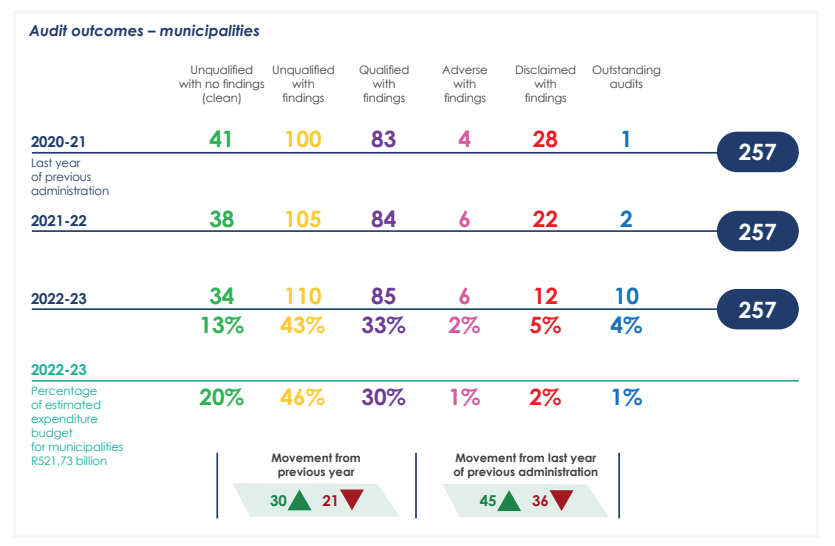
Only 34 out of South Africa’s 257 municipalities received clean audits for the 2022/23 financial year, the Auditor-General has revealed.
On Tuesday, Auditor-General (AG) Tsakani Maluleke released the Consolidated General Report on Local Government Audit Outcomes for 2022-23, revealing a dismal performance.
Maluleke said the report was “an urgent call for performance, accountability, transparency and institutional integrity in local government.”
Municipalities are essential for the delivery of basic services in South Africa, with them being the main touchpoint for government in the country.
“After years of service delivery failures, council and administrative instability, financial mismanagement, and disregard for the law, this sphere of government faces greater demands than ever before to regain the trust of South Africans,” Maluleke said.
The AG said despite calls for improvement in previous reports and commitments from local government officials, little action has been taken, and South Africans continue to experience dismal service from their municipalities.
“As a result, I can only report on pockets of improvement. Continued excellence at municipalities that maintained their clean audit status and a reduction in the number of disclaimed audit opinions offer a further glimmer of hope.”
“Otherwise, there is still little to celebrate,” she said.
The AG’s latest report showed that the trend of poor audit outcomes in local government continues, with only 34 (13%) municipalities receiving clean audits.
While 45 municipalities have improved their audit outcomes since 2020-21, 36 have seen their performance decline. The report said that 77 municipalities made little effort to comply with key legislation.
Compliance with legislation remained the biggest obstacle for municipalities, with 86% receiving material compliance findings, slightly regressing from 85% in the previous year and 83% in 2020-21.
Metros’ audit outcomes have worsened since the last year of the previous administration despite typically having greater capacity and bigger budgets.
Maluleke said the financial health of South Africa’s major metros remains concerning. Despite implementing financial recovery plans and turnaround strategies, they struggled to improve their revenue-collection levels.
Infrastructure delivery and maintenance still do not receive enough attention, with projects delayed, grant funding returned to the National Treasury, and no consequences for poor performance.
The poor performance of South Africa’s municipalities can be seen in the graphic produced by the AG’s office below.
What can be done
There are some signs of improvement, with fewer municipalities receiving disclaimed audit opinions – which is the worst possible outcome.
The AG noted particular improvement from municipalities in KwaZulu Natal, Mpumalanga, and the North West.
Furthermore, the number of municipalities that submitted their financial statements by the due date continued to increase, reaching 94% in the latest report. Still, ten municipalities did not submit financial statements by the 31 March 2024 cut-off date.
However, more must be done, Maluleke said, declaring that it is unacceptable for only 34 municipalities to receive clean audits.
She listed three ways in which municipalities can improve their outcomes and called on them to take action –
- Professionalising and capacitating local government
Skills and capacity gaps can be addressed through a concerted effort to support and implement local government professionalisation initiatives.
In pursuing professionalisation, municipal managers, councils and provincial leadership should strive towards a future where local government is a career of choice for professionals and where scarce skills can thrive and be retained.
- Capable institutions with intergovernmental support
Support from all spheres of government – through coordinated and collaborative efforts in partnership with municipal leadership – will promote strong governance within municipalities.
- A culture of ethics and accountability
A shared vision of responsiveness, consequence management, accountability and ethical behaviour is essential to ensure that actions are taken promptly and that individuals are held accountable.
The lack of consequences for poor performance and transgressions hinders a culture of performance, accountability, transparency and institutional integrity.






Comments