Transnet miracle on track


Transnet CEO Michelle Pillips said the utility is too big to fail, and its turnaround plan is already showing some green shoots – but a lot of work still needs to be done.
In the latest instalment of PSG’s Think Big series, Phillips said the utility may be too big to fail, but it is not too big to manage.
“Certainly, with this new leadership team, the board, organised labour, and our customers, we’ve really rallied together to ensure that this organization does not fail, and she will not fail,” she said.
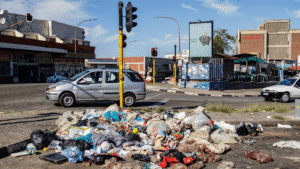
In recent years, Transnet has made headlines for all the wrong reasons: mismanagement, corruption, collapsing infrastructure, strike action, and criminal syndicates stealing cables.
These factors have reduced the South African rail, port and pipeline company’s ability to deliver services to the country’s businesses and citizens.
As a result, South African companies have begun to reduce their reliance on the utility by transporting their goods via road rather than railways and using ports outside the country to export their goods.
Transnet’s collapse has gone largely under the radar compared to Eskom. The economic impact of South Africa’s rail and port utility has only been quantified recently, and it is far worse than expected.
Transnet’s failures are estimated to cost the country R1 billion a day in economic output, equivalent to 4.9% of annual GDP or R353 billion.
This was revealed in a study by the GAIN Group, a boutique consultancy focusing on freight transport contract research.
The utility’s collapse culminated at the end of 2023 when Transnet’s board underwent a massive overhaul.
CEO Portia Derby and CFO Nonkululeko Dlamini resigned in September last year following pressure from business lobby groups, mining companies, and unions.
Derby stepped down at the end of October, while Dlamini left in September. This is when Phillips entered.
She served as acting CEO from October and became the utility’s official chief executive in February 2024.
Since her appointment as interim CEO in October 2023, Phillips has led a recovery plan for the struggling utility that is now starting to show green shoots.
Phillips explained that it is an 18-month recovery plan, of which the first six months have been completed – with great success.
“We’ve seen the stabilisation and, in fact, some turnaround in our operations and in our financials. We’ve seen the positive impact of the kind of work that we’ve been doing,” she said.
The next “phase” of the turnaround will run until the end of the 2024/25 financial year.
Transnet must follow a Freight Logistics Roadmap, which was unveiled in 2023 and seeks to ensure there’s a reform in South Africa’s logistics sector.
This plan must be followed alongside Transnet’s recovery plan, which ensures the utility deals with “bread and butter” issues plaguing its operations and performance. This plan seeks to ensure that the utility is sustainable and can survive.
“So, we’ve got a transformation leg together with a recovery leg. It’s not an easy place to be,” Phillips said.
“There is a lot of work to be done and we are by no means out of the woods, but certainly we are beginning to see some green shoots.”

Phillips’ optimism about the utility has been supported by recent news from the utility.
In early August, Minister in the Presidency Khumbudzo Ntshavheni said South Africa’s ports – ranked among the world’s worst – are improving, and Transnet will fix them within the next 12 to 14 months.
These steps “will help stability,” Ntshavheni said. “As we get more control over our own domestic environment, the improvements will come.”
The utility has also entered into partnerships with the private sector that will significantly boost Transnet’s performance.
For example, Vivien Chaplin and Gaby Wesson of legal firm Cliffe Dekker Hofmeyr said signing the Economic Regulation of Transport (ERT) Act is a marked step towards rail reform and privatisation.
On 11 June 2024, President Cyril Ramaphosa signed this Act into law, marking a significant development in the economic regulation of transport and rail reform.
The ERT Act introduces major changes to the transport sector by establishing the Transport Economic Regulator.
“It is intended that the Regulator will serve as a consolidated economic regulator for transport, in respect of road, rail, shipping, ports and aviation,” Chaplin and Wesson explained.
“This streamlining of regulators, if implemented effectively, will help to make the transport system more efficient and cost-effective.”
The ERT Act empowers the regulator to control prices across the transport sector.
It also introduces provisions governing third parties’ access to rail infrastructure, which is currently controlled by Transnet. This includes private sector players.
Chaplin and Wesson explained that the regulator would act similarly to the National Energy Regulator of South Africa (NERSA) by approving price tariffs for regulated entities like Transnet for using the infrastructure in those sectors.
“This aims to prevent monopolistic pricing by regulated entities and inefficiencies while also levelling the playing field,” they said.
“Importantly, the regulator has the discretion to tailor the price controls in respect of each sector. The process entails the submission of tariff proposals by regulated entities for approval.”