Two South African provinces where more people are unemployed than working



The expanded unemployment rates for the North West and Eastern Cape show that more people in those provinces are unemployed than working.
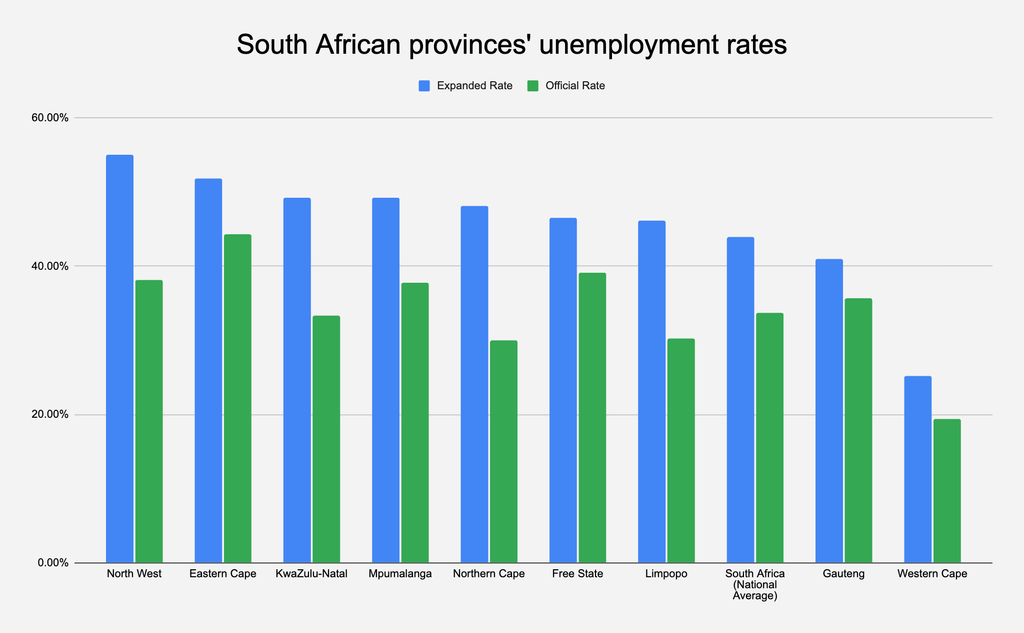
The North West’s expanded unemployment rate reached 55% in the third quarter of 2026, while the Eastern Cape’s rose to 51.8%.
This means the North West has the highest expanded unemployment rate in the country. The Eastern Cape has the country’s highest official unemployment rate, at 44.3%.
These data points were revealed in Statistics South Africa’s (Stats SA) Quarterly Labour Force Survey for the third quarter of 2026.
The survey showed that South Africa’s official unemployment rate stood at 33.7% in the third quarter, rising from 33.6% in the second quarter.
The national expanded unemployment rate, which includes discouraged, potential, and unavailable workseekers, rose quarter-on-quarter from 43.8% to 44%.
At a provincial level, five of South Africa’s nine provinces had official unemployment rates above the national average.
These five were the Eastern Cape (44.3%), the Free State (39.1%), the North West (38.1%), Mpumalanga (37.8%), and Gauteng (35.7%).
However, when looking at the expanded unemployment rates, seven of the nine provinces exceeded the national average.
In order, these provinces are the North West (55%), the Eastern Cape (51.8%), KwaZulu-Natal (49.2%), Mpumalanga (49.2%), the Northern Cape (48.1%), the Free State (46.5%), and Limpopo (46.1%).
Therefore, the Eastern Cape and North West led the charge regarding unemployment in the third quarter of 2026.
These two provinces’ unemployment rates being above 50% mean that more people were unemployed than employed.
In the North West’s case, the substantial disparity between its official unemployment rate (38.1%) and its expanded rate (55%) points to an enormous pool of discouraged work-seekers.
With only 32.1% of the North West’s working-age population employed, this means almost two out of every three adults in the province do not have a job.
South Africa’s unemployment crisis deepens
A deeper look at Stats SA’s third-quarter unemployment data shows a troubling anomaly compared to previous years.
Historically, the third quarter of the year is associated with a seasonal recovery in employment in South Africa.
This is largely due to seasonal agricultural demand for specific crops, with the third quarter coinciding with harvest and export peaks in horticulture, citrus, and avocados.
South Africa also typically sees post-winter employment rebounds in the tertiary sector in the third quarter, particularly in finance, manufacturing, and mining.
However, the third quarter of 2026 broke this trend, with national unemployment rising quarter-on-quarter and year-on-year.
Anchor Capital economist Dr Lerato Ntuli attributed this to an increasingly challenging global environment.
She explained that this environment has compounded weak domestic economic growth and South Africa’s long-standing structural constraints.
“In particular, the global oil shock has exacerbated existing pressures on businesses and households, adding to operating costs and weighing on an already strained domestic economy,” she said.
Ntuli explained that this is evident in the fact that South Africa saw not only growth in unemployment but also a year-on-year decline in employment.
“Compared with a year earlier, total employment fell by 215,000 jobs (-1.3%), while the number of unemployed people rose by 571,000 (+7.1%),” she said.
“The divergence between declining employment and unemployment growth highlights the extent to which job creation remains insufficient to keep pace with labour force growth.”
She added that this divergence also reflects the persistent structural challenges facing South Africa’s labour market, as well as a difficult external environment.
“Higher fuel, transport and production costs added additional pressure on local businesses and households already facing subdued domestic demand,” she said.
“Until confidence and fixed investment recover more meaningfully, job creation is likely to remain modest.”
Login or register for unlimited free access.






Conversation
2 commentsThink how service delivery is being curtailed in these provinces. Think how human rights are being abused.
All this, is result of economic sabotage, under ANC policies of structural recession… brought to you by ANC.