South Africa’s unemployment crisis getting worse by the day



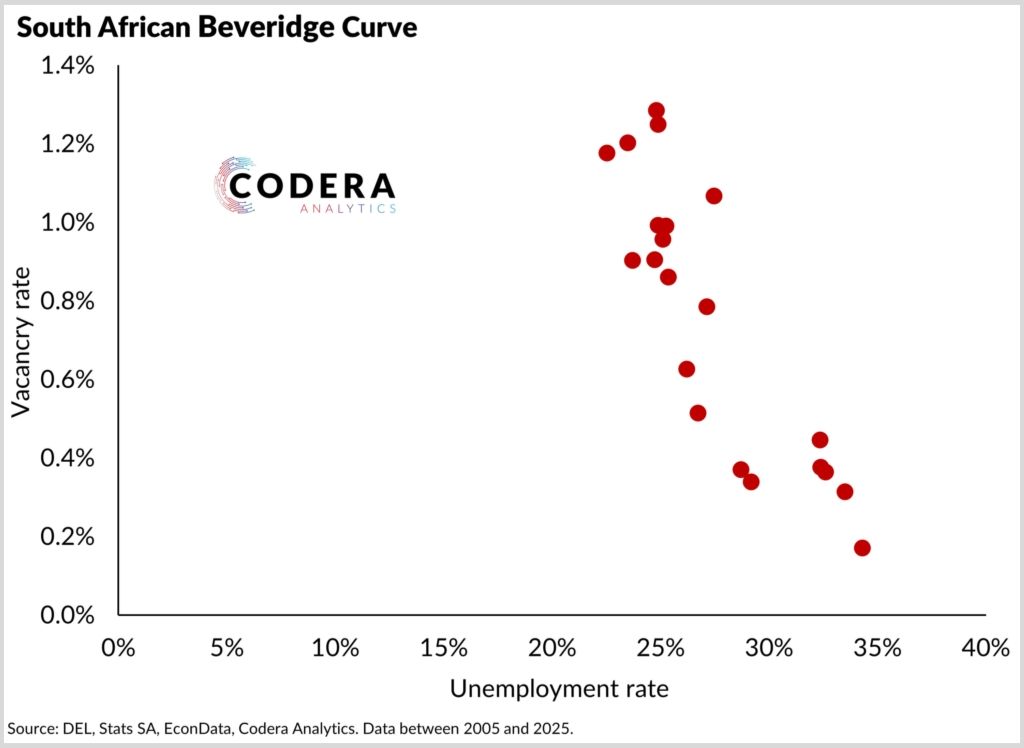
South Africa’s Beveridge Curve shows a profound dysfunction in the local labour market, where a small pool of open positions exists alongside a large proportion of unemployed individuals.
In simple terms, demand is outstripping supply: South Africa’s economy does not create nearly enough jobs to absorb its growing workforce.
However, this is not solely the result of weak economic growth, as skills mismatches and spatial inequality also play major roles.
This was explained by Codera Analytics in a recent blog post, wherein the firm outlined historical data on South African job openings and unemployment.
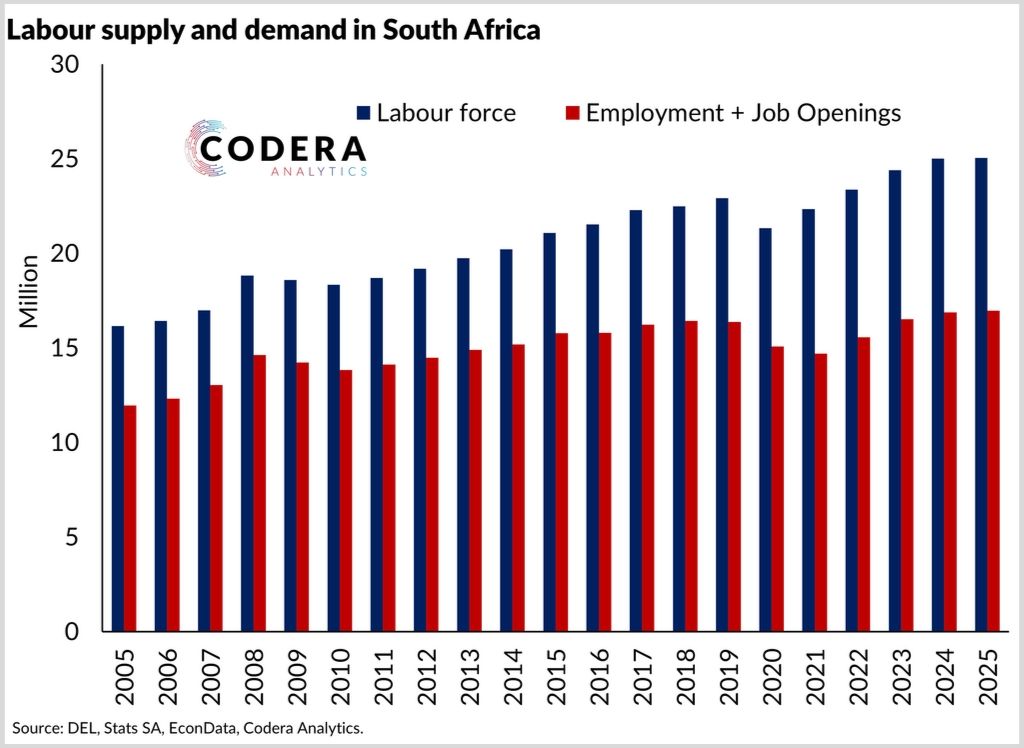
Codera said this data reveals a widening structural rift, where a rapidly growing labour supply vastly outstrips the pace of labour demand.
This widening rift has seen South Africa’s Beveridge Curve shift outward over time, which leads to the coexistence of unfilled vacancies alongside elevated unemployment.
The Beveridge Curve plots a country’s unemployment rate against its job vacancy rate, showing the inverse relationship between labour supply and demand.
Coera said South Africa’s shifting curve proves that spatial and skill mismatches, rather than a simple demand deficit, are driving the country’s unemployment crisis.
While weak economic growth plays a role, the coexistence of unfulfilled openings and high unemployment means that the crisis cannot be solved through higher economic demand alone.
South African employers have job openings, but are struggling to fill them because job seekers lack the skills, qualifications, and training required by modern hiring industries.
In addition, Codera said large physical and geographical divides separate many job seekers from commercial employment hubs.
These divides make it more difficult for some job seekers to travel to work or find jobs, preventing them from accessing and securing open roles.
South Africa’s Beveridge Curve is shown below, with Codera explaining that the country’s curve lies exceptionally far from the origin.
This, the firm said, “highlights a severe structural mismatch where only a small number of open positions exist alongside a large share of unemployed people in the labour force”.
South Africa’s unemployment rate is rising
On Tuesday, 10 November, Statistics South Africa released the country’s unemployment data for the second quarter of 2026.
The Quarterly Labour Force Survey showed that South Africa’s official unemployment rate increased to 33.6% in the second quarter.
This is up 9 percentage points from 32.7% in the first quarter. In actual terms, this means the number of unemployed people rose by 345,000 to 8.5 million.
Investec economist Lara Hodes attributed this increase in part to the war in the Middle East, which has driven up energy prices.
She said these fuel price increases have weighed heavily on firms’ input costs and, in turn, dampened business confidence, expansion plans, and hiring intentions.
The impact is evident in the RMB/BER Business Confidence Index, which slid to 38 from an already subdued 39 recorded in the second quarter of 2026.
“Accordingly, GDP expectations for this year have fallen to a projected 1.0% year-on-year,” Hodes said.
Momentum Group chief economist Sanisha Packirisamy made a similar argument, telling SABC News that this rise in unemployment was inevitable given South Africa’s lacklustre growth in 2026.
“We knew that the second and third quarters of the year, given the issues that we’re seeing in the Strait of Hormuz and the impact it is having on economic growth rates around the world, were going to be tough economic quarters,” she said.
“And in light of that, you would also see the impact coming through on the job side.”
However, domestic factors have also played a role in the rise in unemployment, Econometrix chief economist Dr Azar Jammine told SABC News.
“What is particularly disappointing at the moment is to witness the deindustrialisation of the South African economy gaining momentum,” Jammine said.
“We saw in these latest employment figures that employment in the manufacturing sector, for example, has fallen by 6% over the past year.”
To make matters worse, Jammine said this decline seems to be gaining momentum.
“The only way to fix it is really for there to be a complete change in mindset of the government to start getting rid of cadre deployment within municipalities,” Jammine said.
He argued that cadre deployment in local government is at the heart of the deterioration in the economy’s structure.
Login or register for unlimited free access.






Conversation
1 commentsAnother good story to tell – proudly brought to you by the ANC