Johannesburg’s water system on the brink of collapse


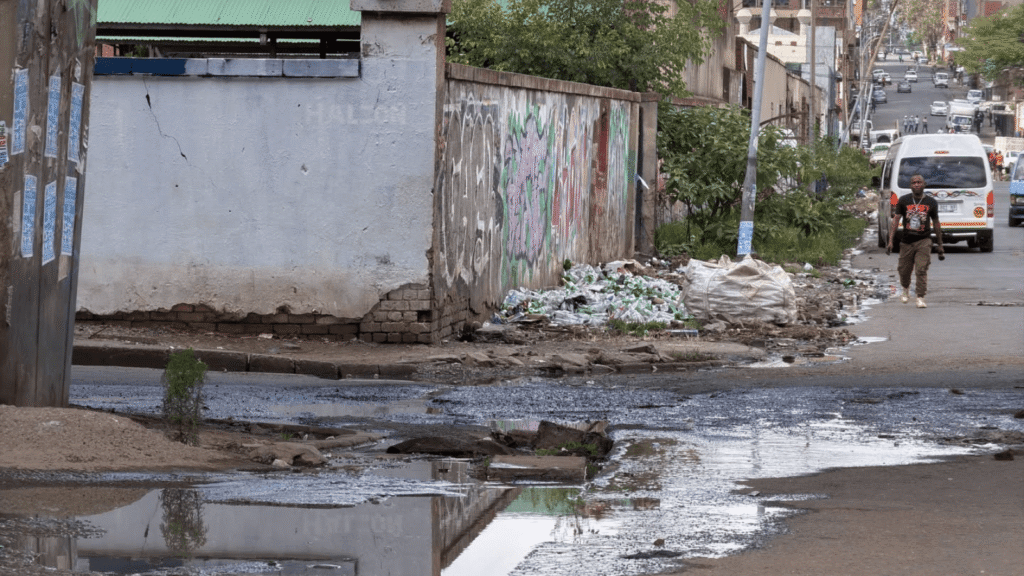
When the taps suddenly run dry in the low-slung house that Sharlene Smith shares with her ailing mother in Westbury, Johannesburg, the 59-year-old South African is forced to leave the safety of their property, and cross dangerous territory in search of water.
Often, Smith finds what she needs at a church or a mosque, around a kilometre away. There, she joins other residents collecting supplies from large storage tanks.
Sometimes, the municipality’s water entity, Johannesburg Water, gives notice that the network will be shut down for maintenance or repairs, allowing her to prepare by filling bowls, buckets and the bathtub.
Water tankers tend to stay away, and when they do turn up, they’re escorted by the police to protect workers from gang-related shootings that local activists say have killed 22 people since July.
The community, like others elsewhere in the country, is caught in a cycle of urban decline after years of mismanagement and underinvestment in basic services. Potholed roads hinder travel, power cuts disrupt work and education, and public safety has deteriorated.
But for Smith, it is the lack of water, which can last for weeks at a time, that is the most pressing concern.
Without it, drinking, cooking, washing, and caring for her mother become so much harder.
“We go without a lot of services, most recently it was electricity, but water is life,” she said. “You can’t do anything without it.”
In Johannesburg, a city of 6.2 million people that’s home to Africa’s largest stock exchange and many of its largest companies, water shortages are also affecting businesses’ ability to function, though the full economic cost is hard to determine.
At the national government’s request, local authorities have introduced punitive tariffs and measures, such as reducing pressure or flow, to curb usage.
That translates into calculations over how much water people can store, and how much they can afford to spend on securing a private, safe and reliable supply.
“In South Africa, that is particularly troubling because this is already one of the world’s most unequal societies, unemployment is extraordinarily high, and millions of households live in poverty,” said UJ’s Anthony Kaziboni.
“The danger is the emergence of a two-tier water system.”
These issues loom large over South Africa’s 4 November municipal elections. No single party is likely to win enough seats on Johannesburg’s council to rule alone.
This has been the case since the ANC lost its outright majority in the city in 2016, complicating the long-term planning and decision-making required to fix the last mile of supply for which it is responsible.
“Nothing brings the failure of municipal governance closer than the realities of water failures, interruption of deliveries and unreliable delivery,” said Susan Booysen, director of research at the Mapungubwe Institute for Strategic Reflection.
“One hopes that political parties have become more mature and aware of how essential it is to cooperate substantively and constructively.”
She added, “The coalition government will have to bring about a redemption. Without that, it’s going to be a total collapse.”
‘Myriad challenges’
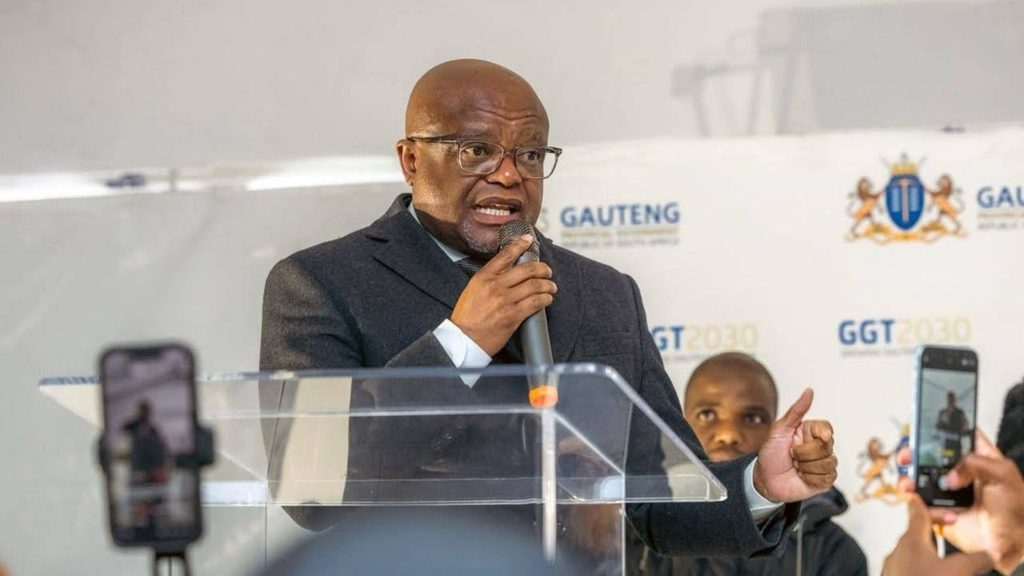
South Africa’s constitution, entered into force in 1997, enshrined the right to sufficient water to help promote equality in the new democracy.
More than 82% of households were connected to the network in 2022, a third more than at the end of apartheid.
Yet, access has not meant reliable supply, especially in water-scarce urban centres like Johannesburg, largely because administrations failed to set aside sufficient revenue for re-investment in water infrastructure, Booysen said.
“They didn’t ringfence.”
The city faces a R26.6 billion infrastructure renewal backlog, while at the current pace, it would take 200 years to replace its ageing pipe system.
This is according to estimates by the Centre for Development and Enterprise, a South African think tank. Around half of the water that it pumps is lost to leaks.
The municipal council declined to comment and referred questions to Johannesburg Water.
Its spokesperson, Nombuso Shabalala, said that the company has “short, medium, and long-term plans to alleviate delivery issues,” including repairs to leaking reservoir and tower infrastructure, as well as active and passive leak detection, in an emailed reply to questions.
Illegal connections, theft and vandalism are also among “myriad challenges” affecting the entire nation’s water supply, she added.
In Melville, a more middle-class neighbourhood, about four kilometres away, more people have the means to become less dependent on the municipality. But anger is mounting.
At a protest on 28 October, residents and business owners stood on the road chanting, “We want water.” Cars honked as they passed by.
The Residents’ Association contributed funds to set up tanks at a satellite police station with a combined storage of about 15,000 litres as a temporary backup system, according to its chair, Darryl Gouws.
Johannesburg Water sends trucks to refill them, and volunteers manage access, but households are limited to roughly 50 litres a day so that the supply can be shared.
On his own property, Gouws installed a tank, pump and plumbing system that feeds stored water back into his house.
The expense, roughly R25,000, came after he, like plenty of other South Africans, had already spent years investing in generators, batteries, gas stoves and solar panels to protect against electricity outages.
“Not everyone is privileged or has the spare cash lying around to be able to do that,” Gouws acknowledged.
In Gauteng province, where Johannesburg is located, 12% of the poorest households experience weekly water interruptions.
These are people in areas that tend to be served by poorly serviced infrastructure, with more overloaded parts of the network, who earn less than $50 a month, while only 1% of those earning over $3,000 a month suffer the same fate, according to Kaziboni.
Further north, in Sandton, office towers, hotels, shopping centres, and corporate headquarters form the heart of the city’s main financial district.
Signs outside office blocks, including Nedbank, the country’s fourth-largest bank, advertise another solution: “Borehole water used on these premises.”
City authorities have received 825 applications for boreholes since October 2025, the council said in an emailed reply to questions, without providing further details. The total cost of such systems ranges from R60,000 to R120,000.
Knock-on effects

Johannesburg Water said the problems in Westbury and Melville are linked to their dependency on the Commando System.
This is an interdependent network of reservoirs and related infrastructure that serves densely populated areas, including major hospitals and universities.
Because it relies on water being pumped uphill across long distances from Rand Water facilities, disruptions like power cuts or pump station breakdowns can trigger immediate drops in reservoir levels and low pressure, according to Shabalala, the company spokesperson.
For the system to stabilise, the reservoirs need to fill up. That means it can take time for water to start flowing again, with elevated neighbourhoods the last to recover.
Private efforts to get around the shortages also have vulnerabilities. Pumps require electricity to bring water to the surface, while tanks can run out, and both fixes carry risks.
Drilling for and installing a borehole can deplete groundwater, erode soil or contaminate water sources.
And, when too many people top up storage tanks after an outage, the spike in consumption exceeds what networks can deliver, leaving some households without water for longer.
“Those are considerations we should have,” said Kaziboni, the professor. “Just because you can afford it, doesn’t mean that you should do it.”
He added that there may soon come a point where “formal access statistics tell us less and less about actual water security.
A household may have a tap and therefore be counted as ‘served’ while enduring repeated outages, unsafe water, or dependence on tankers.”
Gouws said he switches his tank system off during severe outages when necessary to avoid drawing more water as soon as the supply returns.
For many businesses, operating expenses are mounting.
Ruth Ndlovu manages a property that includes three diners, a beauty salon, and a cafe. She said disruptions began as periods of low pressure and maintenance outages around 2021 and became much more severe in 2024.
She added, “We couldn’t cope.”
Eventually, the landlord installed two tanks to be shared by the five businesses, but they have sufficient capacity for only about 48 hours, and for some tenants, that isn’t enough.
The cafe, for example, needs piped water for its equipment and operations. So when the municipal supply fails and their backup is exhausted, she said they “have to close shop and lose revenue.”
For criminals, the shortages are creating money-making opportunities.
They’ve taken control of tanker operations and resell water at inflated prices in some communities, “pointing to opportunistic profiteering, if not organised syndicates,” The South African Human Rights Commission said.
With little incentive to see the problems fixed, these gangs are actively trying to make them worse.
In the port city of Durban, eight water service employees were murdered between 2022 and 2023, while in the capital city of Pretoria, security guards at a wastewater treatment plant were held at gunpoint in 2024 as the plant was vandalised.
Back in Westbury, community leaders moved quickly through some streets one recent morning, past a tavern whose walls bore the pockmarks of bullet holes.
A short walk away, behind their property’s steel gates, Smith’s mother lay on a couch under three thin blankets as volunteers registered her for a special vote because she cannot travel easily to a polling station.
Smith said she hopes the winning parties will work together. Her message was simple: “Make our lives better, that is all that we want, nothing else.”





Conversation
1 commentsProvision of potable water is an essential part of any high density living society.
Without it, people die in a few days. Such a society is not viable.
CoJ residents, your property is becoming worthless.