It will take 40 years for 1 million South Africans to get the papers that prove they own their homes


If the government continues to transfer title deeds at its current pace, it will take four decades to clear South Africa’s title deeds backlog.
This means the owners of 1,000,856 properties across South Africa will need to wait for decades to receive the official documents proving they own their homes.
This was revealed in Business Leadership South Africa’s (BLSA) Reform Tracker for the third quarter of 2026.
The quarterly tracker monitors and measures South Africa’s reforms that are designed to address structural inefficiencies and improve the local business environment.
One of the reforms tracked in this report is spatial inequality, with efforts aiming to unlock under-utilised public land for affordable housing through more systematic release processes.
Clearing South Africa’s national title deeds backlog is a key initiative in the effort to reduce spatial inequality.
In July 2026, the backlog was estimated at 1,000,856 outstanding title deeds spread across 223 municipalities. These 1 million properties are valued at R300 billion.
This backlog is highly concentrated, with 20 municipalities accounting for 61.7% of the national total and 8 metropolitan municipalities alone accounting for 42.7%.
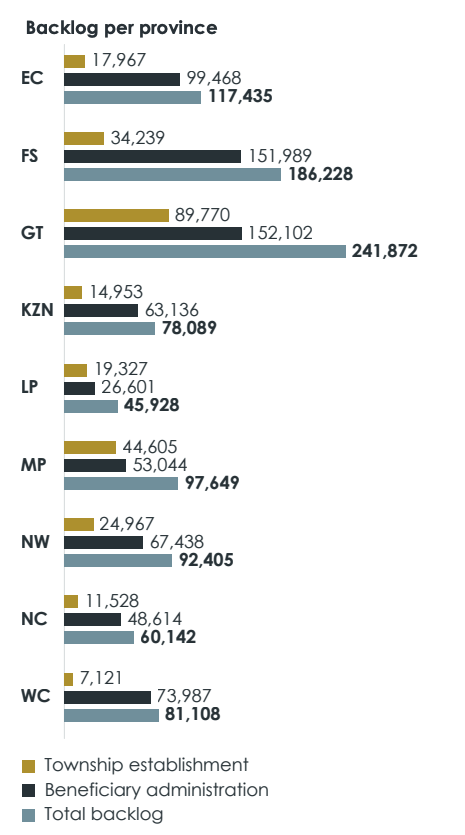
The backlog is split into two main operational phases: beneficiary administration and township establishment.
Beneficiary administration accounts for the majority of cases, at 736,379 out of the total 1,000,856, or 73.6%.
In these cases, the townships are proclaimed, and properties are occupied, but the final legal transfer to the beneficiary was never completed.
This is largely due to administrative constraints, deceased estates, missing subsidy documentation, and municipal conveyancing bottlenecks.
Township establishment accounts for 264,477, or 26.4%, of the total backlog cases.
In these cases, properties have been surveyed, pegged, and approved, but the township register was never opened. This leaves the area unproclaimed.
Four decades to clear the backlog
BLSA’s Reform Tracker showed that, at the government’s current pace, it will take four decades to clear the national title deeds backlog.
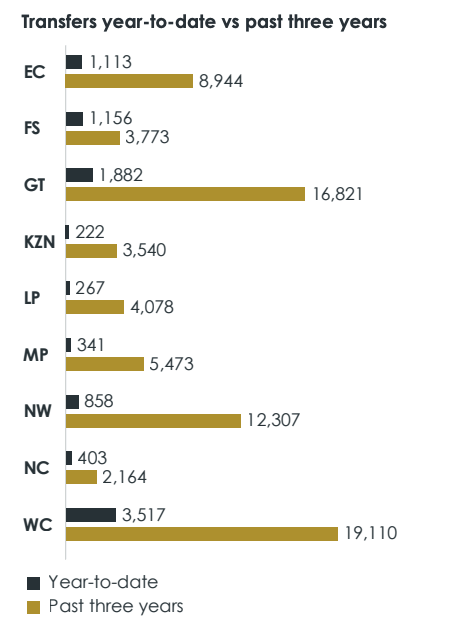
Over the past three years, 76,210 transfers were recorded, which averages out to 25,403 transfers per year.
At this rate, resolving the 1 million title deeds backlog will take 40 years. To shorten the timeline to 15 years, the government would need to double its current rate.
The government has made some effort to accelerate the current pace, with an initiative planned to be piloted in Ekurhuleni and Johannesburg in the fourth quarter of 2026.
This initiative is the Cities Support Programme Title Deed Dashboard, which was launched by the National Treasury and serves as the primary tool tracking the deeds backlog.
This dashboard maps individual freehold title processes from raw land to completed registration.
Ekurhuleni and the City of Johannesburg will serve as the pilot municipalities for targeted clean-ups, using a door-to-door brigade to locate unclaimed title deeds and expedite handovers.
“However, there is little information on their scope, targets or funding,” BLSA’s report said.
Based on BLSA’s data, Gauteng accounts for 241,872 cases of the national title deeds backlog, and has transferred 1,882 deeds year to date.
Aside from the pilot programme, BLSA said the public land asset registry could also come online alongside more detailed plans for a proposed model to release priority properties.
“The quantification of the backlog gives National Treasury, the Department of Human Settlements, and provincial and municipal authorities a reference point to prioritise actions and set comparable targets,” BLSA said.
“However, this needs to be backed up by meaningful action and accountability.”