National shutdown protestors targeting these businesses in South Africa


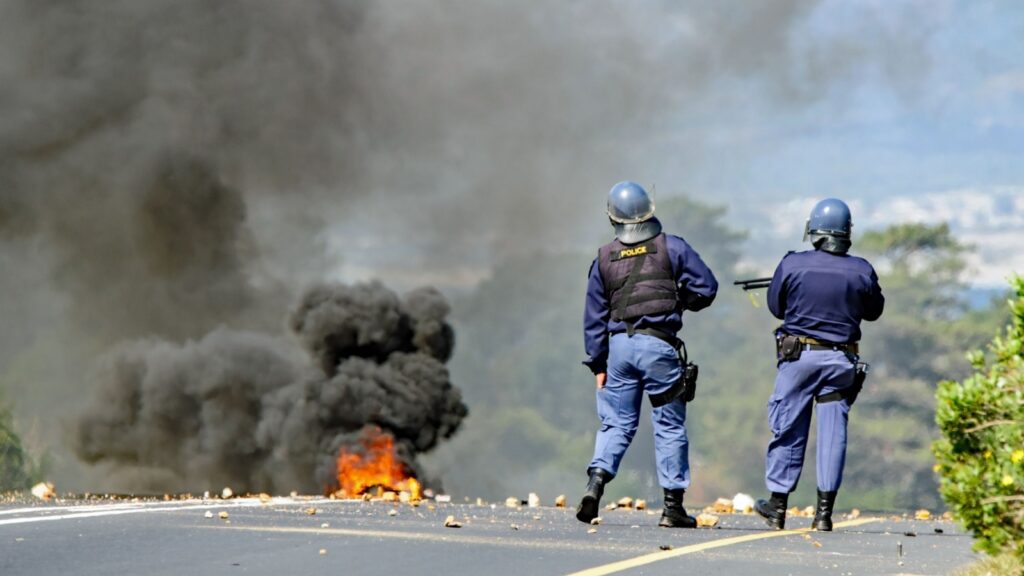
Businesses that are perceived to employ foreign nationals, are prominent, and consumer-facing are most likely to be targeted during the planned national shutdown on 30 June.
In particular, these kinds of businesses located in Gauteng and KwaZulu-Natal are at the highest risk of disruption.
This is feedback from the Centre for Risk Analysis (CRA), which outlined in a note to clients what it thinks will happen on 30 June.
A citizen-led movement, March and March, has issued an ultimatum to illegal immigrants to leave South Africa by 30 June.
It has threatened a national shutdown should this not happen, with the police and private security companies preparing for incidents of social unrest around South Africa.
While the threat is for a national shutdown, the CRA explained that exposure to social unrest is highly concentrated and not country-wide.
It said exposure to the protests is driven by specific, identifiable conditions present in particular parts of the country and in particular businesses.
“Underlying hostility is not the variable that determines where violence occurs. Antipathy toward foreign nationals is pervasive, deep-rooted, and not reducible to economic competition,” it said.
“It is found across class lines, including among those who face no competition from migrants at all, and it is animated by durable myths rather than by any actual change in migrant numbers.”
This means that the likelihood of violence is set to last in the build-up to 30 June and in the days following, without it really going away.
“The most likely near-term path is persistent, localised friction. Mobilisation occurs in particular geographies and sectors, with sporadic violence and forced closures,” the CRA said.
Broader social unrest is unlikely, but will occur in situations where localised shutdowns gain momentum, and police presence appears stretched.
“A third path, the least likely in the near term, is rapid de-escalation, in which political messaging and community-level pressure blunt momentum,” the CRA said.
“This is the lowest precisely because the political incentive structure cuts against it. In the runup to the election, the rewards of confronting mobilisation are smaller than the rewards of riding it.”
The businesses at risk

The CRA explained their five-condition model to determine a business’s risk exposure throughout the mobilisation around 30 June.
A business sits in the high-exposure zone when several of these conditions converge.
The first condition is what the organisation calls the proximate trigger. This is whether a business employs or is perceived to employ foreign nationals.
“Perception matters as much as fact. In this kind of violence, the target is selected as a symbol of a despised group, and it matters little whether any given worker belongs to it,” the CRA said.
Visibility is the second condition. “The movements target what they can see and identify. These targets are street-level, consumer-facing, single-site operations,” it explained.
Examples of these businesses include spaza shops and informal retailers, as well as restaurants and small retail stores.
“Operations behind a perimeter, in secured industrial estates or with no public storefront are harder to target and less useful as a symbol,” the CRA said.
A major condition is the third: location. Key areas include KwaZulu-Natal urban areas, particularly Durban, which is where many of the anti-immigrant movements originated.
In Gauteng, the CRA said the active zones include the East Rand and the inner cities of Johannesburg and Pretoria, along with their surrounding townships.
While fewer, there are still flashpoints in the Western Cape in Mossel Bay, Kleinmond, and Stanford.
“Exposure is highest where there is an organised local chapter, a history of mobilisations, and pre-existing conflict infrastructure such as contested local authority and established patterns of taxi, gang, or political violence,” the CRA said.
The fourth condition is the sector in which businesses operate. Some sectors carry the “taking-jobs” narrative more heavily than others.
Examples of these include informal retail, road freight, agriculture, hospitality, construction, private security, and personal services.
The final condition is a business’s ability to disperse or harden its assets. A single, fixed, immovable, high-visibility site concentrates exposure.
“A consumer-facing operation that employs, or is assumed to employ, foreign nationals, on a fixed and visible single site, in a symbolically charged sector, inside one of the active geographies above faces high exposure,” the CRA said.
“Concretely, this includes informal and small-format retail, hospitality and freight operators in Durban, the East Rand, and the Johannesburg inner city.”
The CRA said these firms risk facing intimidation, demands to dismiss staff, forced closure, and property damage.



Comments