Post Office trucks drove around South Africa ‘filled with fresh air’


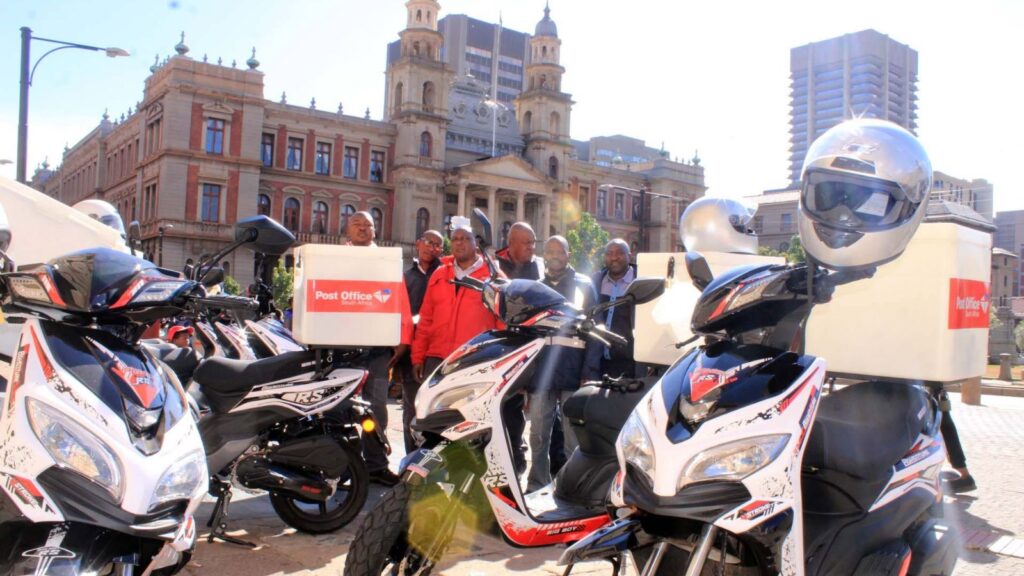
During its decade of collapse, trucks at the South African Post Office were transporting fresh air because they had too few packages to carry.
This stemmed from the Post Office not investing in smaller trucks as its parcel load declined, or optimising its logistics network to fill up larger vehicles.
As such, the large trucks drove around largely empty as the state-owned entity refused to adapt to the changing reality of private competition and declining usage of its services.
This made its logistics network significantly more expensive to operate than private alternatives, contributing to its collapse.
Former Post Office CEO Mark Barnes recently recalled discovering this problem during his tenure at the entity from 2016 to 2019.
Barnes famously left his lucrative career in the private sector to try to save the Post Office and reinvent it for the future.
His tenure was marked by positive developments, such as a sharp decline in the entity’s debt and taking its equity position back to a positive R16 billion.
Barnes also had ambitious plans to turn the Post Office into a modern e-commerce and banking powerhouse, leveraging Postbank to compete with commercial banks.
However, these ambitions would prove too much for the government, with Barnes resigning in August 2019 after a fallout with the state over the structure of the Post Office and Postbank.
Barnes told Podcasts from the Edge that the Post Office has an asset base that any private company would envy.
Its extensive branch network, which includes almost every town in South Africa, could not be replicated by a private company, providing a significant competitive edge for the Post Office.
However, mismanagement squandered the potential of these assets, leaving the Post Office unable to compete with private couriers.
This would kick off the entity’s downward spiral, which, despite Barnes’ efforts, would leave it a shadow of its former self.
Transporting fresh air

The scale of the Post Office’s mismanagement was laid bare during Barnes’ first few months at the entity, when he went on fact-finding missions to its sorting facilities.
While he was under no illusion about how bad things were at the Post Office and had his own opinion on the matter, Barnes wanted to hear from staff members about what was going wrong in their view.
The entity’s staff admitted to Barnes prior to his appointment that it was extremely inefficient, resulting in widespread mail delays, poor service delivery, and declining usage.
These seemed like typical challenges for an entity struggling to keep pace with technological change and rising competition.
“There were the normal spirals of death that you face in a business when turnover is declining, and you can’t adapt,” Barnes explained.
However, upon speaking to workers on the floor at Post Office sorting centres, Barnes found out that the entity was simply refusing to act as if it was facing a death spiral.
It still operated as though it were the only game in town and as though it were transporting the same volume of mail it had years prior.
“After I took over, I went down to Maitland to visit one of our sorting houses there and spoke to someone who had been working at the Post Office for 40 years,” Barnes recalled.
“I liked to ask people what they thought was going on before I told them what I thought. I asked him, ‘What is wrong with the Post Office?’”
Barnes got a simple answer: The trucks are too big. “If he had been to Harvard, he would have said we had a logistics scheduling optimisation problem,” Barnes said.
The worker was alluding to the fact that the trucks were never full, as they were simply too big to transport the number of parcels the Post Office was handling.
“He told me the trucks had been too big for three years. What had happened three years earlier was a strike at the Post Office,” Barnes said.
“I explained that what happened with the strike is that the turnover went down and parcels declined, but they did not change the size of the trucks. So, they were transporting fresh air.”
This translated into the Post Office’s delivery costs surging as it was spending money on fuel and trucks to transport very little cargo.
“The cost per unit for transport went up, and so we became less competitive in the delivery space,” Barnes explained.
Barnes said this insight was sophisticated and notable for its clarity, with it pointing to serious management issues at the Post Office.
While the worker knew the problem and the solution, it fell outside his department, so he was not able to raise the issue or implement a fix.
“We had to break down the walls between the divisions. There was no more ‘That is transport’s problem’. It is now our problem,” Barnes said.
“We had to start listening from the bottom up about what the ills were before we started to fix them. You have to listen first.”





Comments