Two provinces in South Africa where more people are unemployed than working


The Eastern Cape and North-West Province have more people unemployed than working under the expanded definition of unemployment and their respective labour forces.
These two provinces have borne the brunt of South Africa’s unemployment crisis, with their relatively unsophisticated and undiversified economies coming under strain.
However, they are by no means alone in suffering from rising unemployment, with the national rate under the expanded definition edging closer toward 50%.
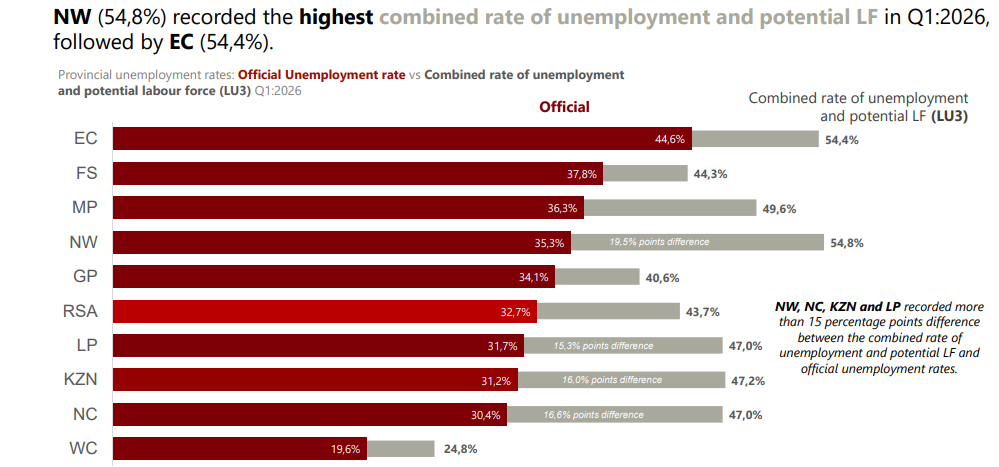
The expanded unemployment rate currently sits at 43.7% as opposed to the official unemployment rate of 32.7%.
Stats SA revealed a surge in unemployment in its Quarterly Labour Force Survey (QLFS) for the first quarter of 2026, with 345,000 South Africans losing their jobs.
This means that 8.1 million South Africans are now unemployed, with the lion’s share failing to have a formal job in the past year.
The problem is also likely to get worse in the next QLFS as it will incorporate the impact of the conflict in the Middle East, which has sent fuel prices soaring.
International agencies have lowered their growth forecasts for South Africa, with the International Monetary Fund slashing its projection to 1% from 1.4% earlier this year.
Higher fuel costs and potentially higher interest rates mean that economic growth in 2026 will undershoot the forecasts made at the start of the year, Symmetry chief investment strategist Izak Odendaal said.
Instead of 1.5% growth in 2026, it is more likely to be around 1.2%, which means South Africa will avoid a recession.
However, this rate of growth is also far too low to make a meaningful impact with regard to unemployment, as the economy cannot absorb a growing labour force.
It is estimated that South Africa’s economy creates around 100,000 new jobs a year, with it having a relatively strong job coefficient. This means that higher economic growth directly correlates to higher employment.
With the country’s labour force growing by around 500,000 people per year, the current rate of growth is not enough to make a dent in the growing unemployed population.
This is most clearly seen in the Eastern Cape and North-West Province, which have more people unemployed than working.
The Eastern Cape’s unemployment rate, according to the expanded definition, sits at 54.4%, while the North West’s is 54.8%. This can be seen in the graph below, courtesy of Stats SA.
False hope
The latest QLFS data shows that South Africa was given false hope by improving unemployment figures across the previous quarters.
At first glance, the improving data was encouraging, with formal employment rising strongly and the official unemployment rate dropping to 31.4% at the end of 2025.
However, FNB senior economist Thanda Sithole explained that this masked an underlying weakness in the labour market.
“Yet a closer look reveals that this improvement was driven less by job creation and more by falling participation,” Sithole said.
“Participation is weakening, discouragement is rising, and inequality remains entrenched. The challenge is not simply to lower the unemployment rate statistically, but to raise labour absorption meaningfully.”
There is another, deeper problem, which is the focus of South African policymakers and business leaders on supporting small businesses.
While not a problem in itself, small businesses only make a meaningful impact on economic growth and employment when they scale and become medium-sized enterprises or large corporates.
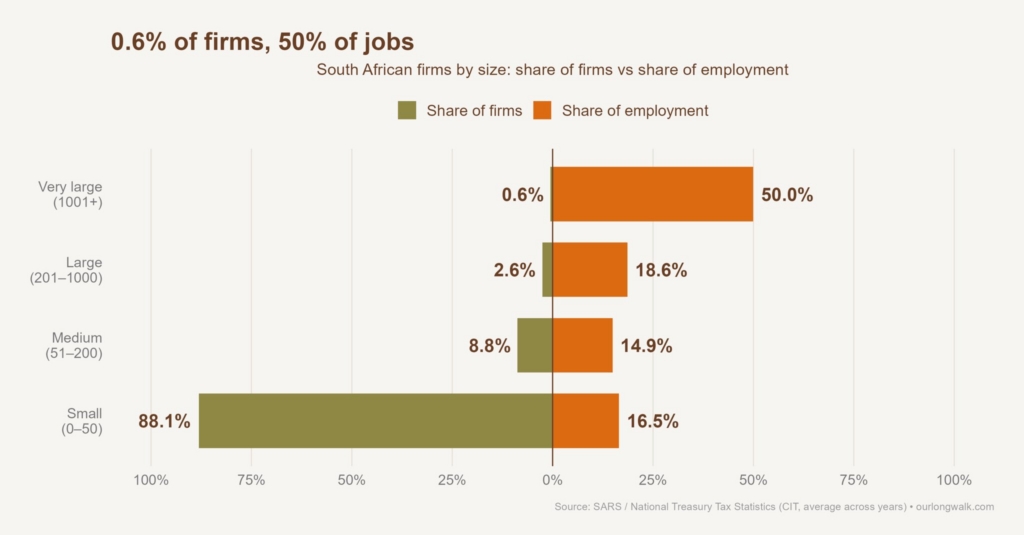
Stellenbosch University economic historian Johan Fourie’s analysis shows that the majority of formal workers are employed by just 0.5% of South African companies.
Small businesses with fewer than 50 employees make up the majority of companies in South Africa. This fuels the idea that they are crucial to creating jobs and tackling unemployment.
However, they employ only 16.5% of all formal workers in South Africa, despite accounting for 88.1% of all companies in the country.
“If South Africa wants jobs, stop romanticising smallness. Make sure the big firms can compete with the best in the world,” Fourie said.
This requires a shift in thinking, with a focus on what big businesses need to succeed in South Africa. Fourie suggested the creation of a Department of Large Firm Competitiveness in this regard.
“That is because the uncomfortable truth is that small firms – however admirable their hustle – are not the ones that will move the needle. Large firms will,” Fourie said.
Efficient Group chief economist Dawie Roodt has argued this point for some time, saying that small businesses fundamentally do not move the needle regarding employment in South Africa.
“Small businesses tend not to survive for very long and tend not to employ many people over a long period of time. As such, they do not pay much tax either,” Roodt said.
“That is why the government is wrong to try to create small businesses that cannot compete with big businesses. They may be important for niche products and services, but not much else.”
“Small businesses, in the grand scheme of things, are only important because they can become medium-sized businesses and big businesses in time. That is what has to be done. We have to create corporates. That is where the emphasis must be.”
Fourie’s analysis shows that this is the case in South Africa, where large firms employ the majority of formal workers.
Around 0.6% of companies employ 50% of all formal workers in the country, in comparison to small firms, which only employ 16.5% of formal workers. This can be seen in the graph below.






Comments