The ANC destroyed South Africa’s most important companies


The ANC-led government over the past 20 years has fundamentally mismanaged South Africa’s state-owned enterprises (SOEs), leaving them saddled with debt and unable to render the services they are supposed to.
Eskom and Transnet provide the most obvious examples of the effect of this mismanagement, with it resulting in load-shedding and increased logistical inefficiencies.
Now these two sectors of electricity and logistics are increasingly being opened up to private participation, as these companies do not have the balance sheets to invest adequately in maintaining or upgrading infrastructure.
Private participation has also been required at various levels, from an advisory capacity to managing the infrastructure and building their own, to halt the collapse of sectors dominated by state-owned monopolies.
Efficient Group chief economist Dawie Roodt explained that the collapse of these SOEs and the implementation of poor macroeconomic policies are the reasons why improved investor sentiment towards South Africa has not translated into real economic outcomes.
“South Africa’s financial markets reacted very, very quickly and very positively to a few changes in policy, such as a lower inflation target, and a few improvements, such as getting off the greylist and a credit rating upgrade,” Roodt told State of the Nation.
“That is the financial markets. Unfortunately, that is not the economy. The positive impact on financial markets will spill over into the real economy and will support growth.”
Roodt said the positive impact on the economy will not happen until South Africa implements the right macroeconomic policies.
“The wrong macroeconomic policies are things like expropriation without compensation. Things like BEE and even the NHI scheme,” Roodt said.
Apart from this, the collapse of SOEs has prevented meaningful economic improvements in South Africa over the past few years.
This collapse has seen South Africa miss out on commodity booms that should have generated billions in economic activity and tax revenue for the state.
It has also resulted in companies being hesitant to invest in growing their operations, focusing instead on subsistence investing in alternative energy sources and backup water supply.
This investment does not grow their operations and translate into more employment in South Africa.
“Crucially, SOEs are not functional in South Africa. They have been destroyed operationally and financially by the ANC,” Roodt said.
These SOEs, particularly Eskom and Transnet, provide critical services in the South African economy and have effective monopolies over key economic sectors.
The services provided by these SOEs are often the main touchpoint with the government for South African citizens, Roodt explained.
From zero to hero

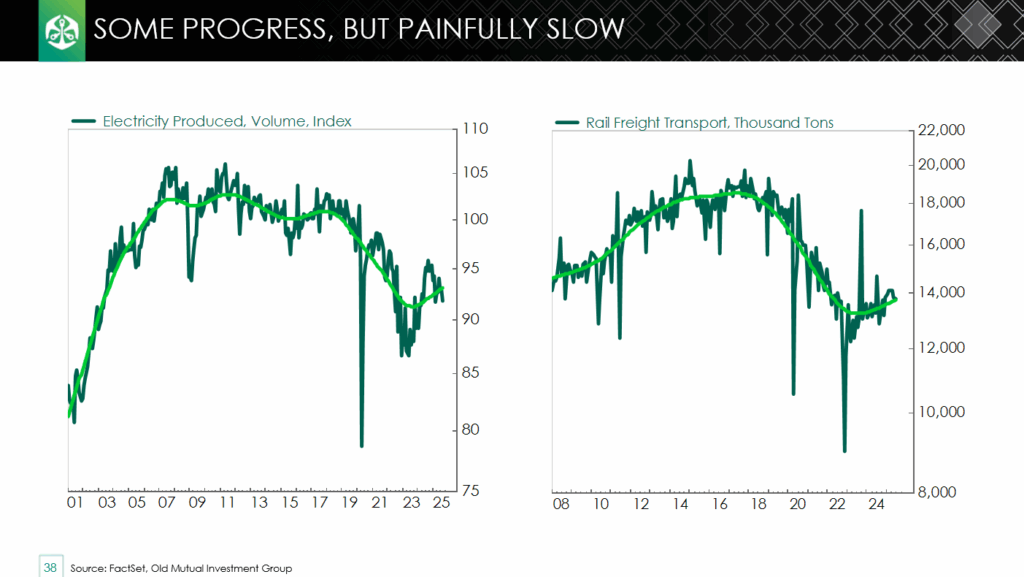
The performance of Eskom and Transnet has stabilised in recent times, as the government’s reform efforts begin to bear fruit.
This is a stark turnaround from just a few years ago, when both Eskom and Transnet were experiencing sharp operational and financial declines.
The government’s reform agenda is set to dramatically increase the role of the private sector in the sectors once monopolised by these SOEs.
Old Mutual Investment Group portfolio manager John Orford said reforms of this scale thrive on quick wins as they provide the justification for deeper reform.
With regard to Eskom, the reform agenda appears to have a momentum of its own, with vital legislation passed, making it difficult to reverse any progress.
Operationally, Eskom appears to have turned the corner, with load-shedding becoming something of the past due to the utility’s improvements and substantial private-sector investment.
Most importantly, the progress made in South Africa’s electricity sector provides a template for future reforms to occur, with it showing that deregulation and private participation can yield positive outcomes relatively quickly.
Similar reforms at Transnet are occurring at a much slower pace, with the logistics sector also set to be opened up to private players in the coming years.
Transnet will concession out some of its key rail corridors and various port terminals to private operators, increasing investment in infrastructure and equipment to drive better outcomes.
Orford warned that, outside of the electricity sector, these reforms are moving far too slowly to drive meaningful improvements to economic growth.
The slow pace of these reforms result in private capital sitting on the sidelines and not being invested heavily in infrastructure and driving economic growth.
Private capital has become increasingly important in South Africa, as the government and SOEs simply do not have access to the money required to invest sufficiently to drive economic growth.
Gross fixed capital formation (GFCF) is seen as a proxy for fixed investment, which remains poor in South Africa and declined to 15% as a share of GDP in 2024.
This is half of the level seen in 1976 and is far below the levels seen in South Africa’s faster-growing emerging market peers.
Fixed investment levels are a key driver of economic growth. As a result, with GFCF declining as a share of GDP, South Africa’s economy has stagnated, averaging 0.8% annual growth over the past decade.




Comments