Goodbye Cape Town – South Africans are semigrating to these coastal hotspots


While the Western Cape is set to remain South Africa’s top-performing property market in 2026, rising prices in the City of Cape Town are driving semigration toward more affordable coastal hotspots.
Independent economist John Loos explained that he expects the Western Cape to once again be the outperformer in house prices and residential rental growth in 2026.
“Some have argued that the deterioration in relative home affordability should ultimately stem the Western Cape’s property market outperformance, and indeed, at some point, one would expect this,” he said.
There has also been talk of a growing reverse semigration trend, with the migration of skilled and affluent households from Gauteng to the Western Cape now reversing.
A major contributor to this argument is the relative affordability of homes in Gauteng compared to the Western Cape.
Loos explained that, over the past few decades, the Western Cape’s relative affordability of housing, both for home buyers and tenants, has deteriorated significantly.
This largely reflects the province’s popularity as a place to live, but also partly reflects greater land scarcity in and around the City of Cape Town and other landlocked metros, especially Gauteng.
Western Cape home values have deteriorated in relative affordability. According to StatsSA’s house price data, the average Western Cape house price has risen by 179.6% from January 2010 to September 2025.
By comparison, South Africa’s other two major housing markets – Gauteng and KZN – have moved at a much slower pace, with increases of 79.7% and 76.7%, respectively.
The Western Cape’s rental market has also experienced a similar deterioration in relative affordability, Loos noted.
The province’s CPI for Residential Rentals has increased by 128.6% from January 2010 to January 2026. Over the same period, Gauteng has increased by a far lesser 63.8%, and KZN by 76.9%.
Semigration shift hits South Africa
Even with the Western Cape’s deteriorating housing and rental affordability, though, Loos said there is little evidence of “reverse semigration” from the Western Cape to Gauteng.
“However, I do believe that the Western Cape’s affordability deterioration is causing a shift in semigration patterns over time, and thus a shift in subregional outperformance/underperformance in its house price growth,” he said.
“But this is not a perceived shift between Gauteng and the Western Cape. Rather, it is a shift within the Western Cape and possibly along the broader coastline of South Africa to come.”
For quite a number of years, the shift in semigration patterns within the Western Cape has been a topic of conversation.
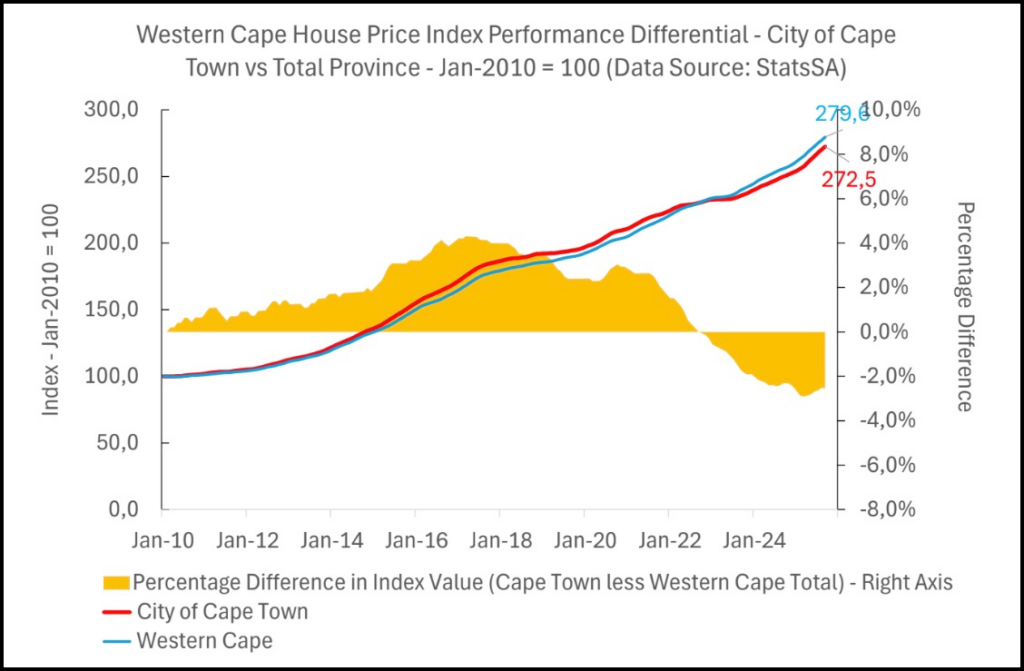
Loos said this shift may have been driving a narrowing in the outperformance gap between the City of Cape Town House Price Index and the overall Western Cape House Price Index from 2017.
In 2022, this gap turned negative. The trend points to the province’s intra-regional house price growth outperformance, which, for some years, has been outside the City of Cape Town.
A growing number of aspirant migrants appear to be searching for new, perhaps less crowded and more affordable destinations, as the City of Cape Town and its surroundings fill up.
“And so, the Southern Cape, including towns such as George and Mossel Bay, has become popular, and to a lesser extent, the West Coast,” he said.
“This may have begun to cause the rest of the Western Cape to outperform the City of Cape Town.” Loos added that he expects more of this outperformance from the smaller regions in 2026.





Comments