More people in South Africa get social grants than have jobs


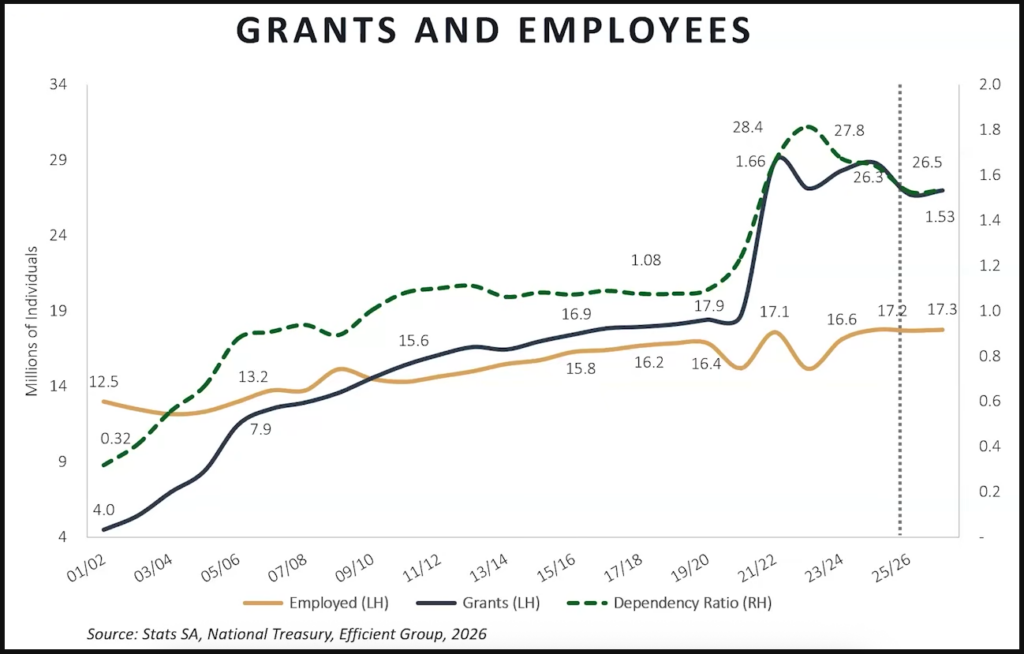
Economist Dawie Roodt pointed out that more people in South Africa depend on the state for their income in the form of social grants than have jobs.
He explained that this is unsustainable, as the grants South Africans receive are not enough to live off. The only solution, he said, is to grow the economy.
Roodt made these comments in an Efficient Group presentation following the tabling of South Africa’s 2026 national Budget.
Finance Minister Enoch Godongwana presented the Budget on 25 February 2026, wherein he revealed that South Africa had 26.25 million grant recipients in the 2025/26 fiscal year.
This number is expected to increase to 26.5 million people in the 2026/27 financial year, and decline to 18.12 million the year after, as the social relief of distress (SRD) grant is set to end.
According to Statistics South Africa’s latest Quarterly Labour Force Survey for the fourth quarter of 2025, the number of employed individuals in the country increased by 44,000 to reach 17.1 million.
This means South Africa has more grant recipients than employed citizens, creating a dependency ratio of 1.5:1.
Roodt and several other economists have warned that this is not sustainable, as it means a small personal income tax base is supporting a far larger grant beneficiary base.
South Africa’s personal income tax base is even smaller than the number of employed people in the country, as some employees earn below the tax threshold.
The South African Revenue Service’s latest Tax Statistics show that the country has 7.7 million personal income taxpayers, far less than half its 26 million grant recipients.
Concerningly, the number of grant recipients in South Africa has boomed over the past two decades, while its tax base is shrinking.
In 2003, only 5.8 million South Africans received a social grant. This number more than doubled to 12 million in 2007. Now, this figure stands at over 26 million.
The only reason the number of grant recipients is expected to decline over the next two years is that the SRD grant is set to end, after being extended every year since its introduction as a temporary lifeline during the Covid-19 pandemic.
However, Roodt said this is unlikely to materialise, as taking the grant away would not be a politically popular decision.
The most likely outcome, he said, is that the grant will be extended again or replaced by a basic income grant, an idea the government is actively working towards.
Not enough to live off
Aside from the pressure it places on taxpayers, Roodt said the real problem with South Africa’s high number of grant recipients is that they simply do not get enough from the government to live off.
“If you look at those various grants – remember, 26 and a half million people receive these
Grants – there were increases of roughly 3.8%,” he said.
“The amount of money that you get from these grants is really not money that you can live off. It’s a tiny amount of money.”
“I’m not suggesting people should depend on the state. I would like the economy to grow much faster. But these people get very small amounts of money.”
“In the case of the Covid grant, it’s something like R370 rand per month. It is impossible to survive on a grant like this.”
The National Treasury explained in the full 2026 Budget Review that social grants constitute the largest share of spending on social development.
Excluding the SRD grant, spending on social grants is set to increase from R246.6 billion in 2025/26 to R276.5 billion in 2028/29.
The Treasury also announced increases to social grants for the 2026/26 fiscal year. The old age, disability and care dependency grant was increased to an average maximum of R2,400, while the war veterans grant increased to R2,420.
The foster care grant was increased to R1,295, and the child support grant and grant-in-aid grant rose to R580. The SRD grant remained unchanged at R370.
To put this into context, the minimum wage in South Africa is currently R30.23 per hour, having increased from R28.79 previously.
Assuming someone works 160 hours a week, this equates to R4,836.80 per month. This is double the largest social grant the government offers.

Comments