South Africa is wasting its most important resource


Due to South Africa’s low economic growth over the past decade, only 40% of the people who want to work are employed.
According to Efficient Group chief economist Dawie Roodt, this signifies the single biggest waste of the most important resource in any economy.
Concerningly, he pointed out that despite recent improvements, unemployment over the long term is still trending upwards.
“Recently, the unemployment rate has been coming down a little bit. Everybody is jumping up and down, clapping hands, because unemployment is coming down, but the reality is unemployment has been going up,” he said.
“The longer-term trend has been unemployment going up, and we have exceptionally horrible high levels of unemployment in South Africa.”
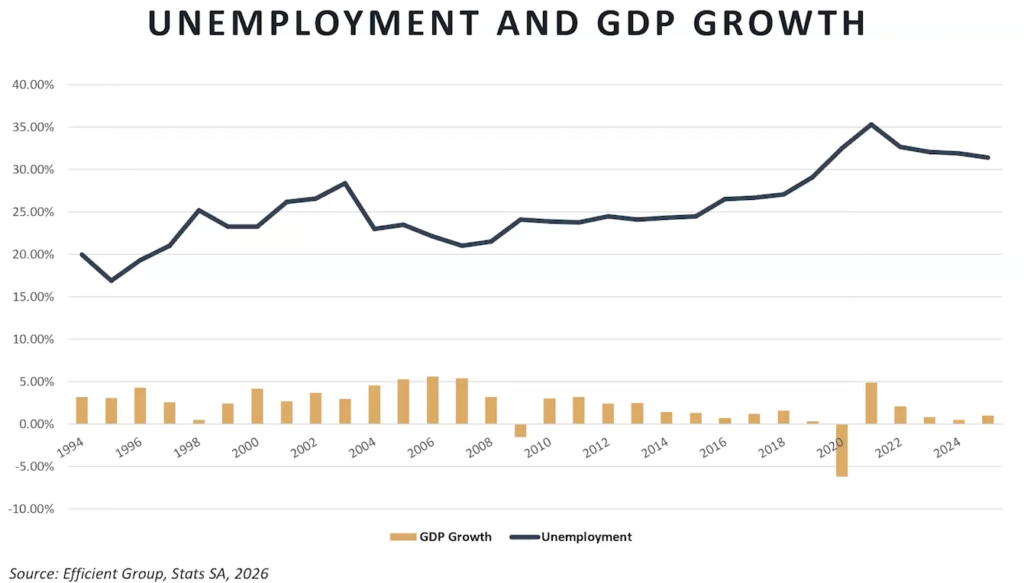
Roodt explained that there is a clear relationship between unemployment levels and economic growth rates.
A historical overview of these two metrics shows that during economic booms like those between 2004 and 2008, the unemployment rate fell.
Therefore, considering South Africa’s GDP growth has averaged less than 1% over the past decade, he said it is not surprising that the country’s unemployment rate is as high as it is.
Roodt stressed that this is why the government should pivot its focus from job creation to economic growth.
“We have to forget about creating more jobs in South Africa. What we need to do is grow the economy, and if we grow the economy, jobs will happen. This is the proof of this,” he said.
A more granular view of South Africa’s labour market puts into perspective how bad the unemployment crisis truly is.
South Africa’s potential labour force – comprising people aged 16 to 65 – represents 100% of the country’s working-age population, i.e. people capable of participating in the labour market.
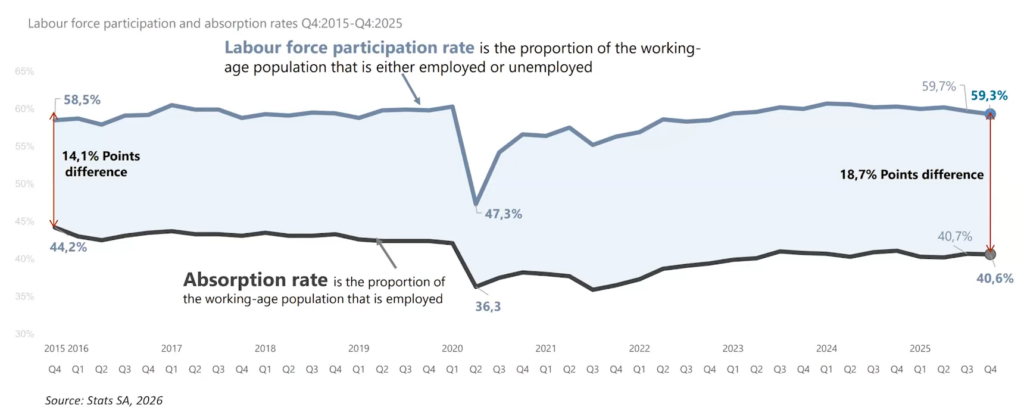
Of this group, about 59.3% want to work. The other 40.6% typically include people like students or homemakers who choose not to work.
However, of these 59.3% of people who want to work, only 40.6% are employed in South Africa’s labour market.
“This is the single biggest waste of the most important resource in any economy,” Roodt said.
“We just don’t use our people. And the reason why we don’t use our labour force in South Africa is because the economy is not growing.”
The breakdown of South Africa’s labour market can be seen in the graph below.
The plan to fix South Africa’s unemployment crisis
In South Africa’s 2026 Budget Review, Finance Minister Enoch Godongwana acknowledged the country’s economic shortcomings as they related to unemployment.
“Growth remains well below the levels needed to meaningfully reduce unemployment and generate sufficient revenue to expand social and economic services,” he said.
“Critical reforms to increase GDP growth, improve government efficiency and scale up public investment have been prioritised to add momentum to the economic recovery.”
Like Roodt, he also referred to South Africa’s low labour force absorption rate of 40.6%, pointing out that this is below the pre-pandemic level of 43.1%.
In essence, this means that only four out of every 10 adults in South Africa are employed or actively seeking work.
“South Africa’s persistently and extremely high unemployment rate reflects the depth of structural constraints in the labour market, where labour force growth exceeds the pace of job creation,” the Budget Review stated.
It explained that the key to solving this problem is for South Africa to address long-standing regulatory barriers, narrow spatial and infrastructure disparities, reduce high levels of crime, and improve education and training outcomes.
Positively, South Africa appears to be making progress on all of these reforms.
The country is on a far healthier fiscal trajectory, with state debt set to stabilise in the current financial year. This will free up funding for more productive budget line items like infrastructure, housing, education, healthcare, and basic services.
In addition, the Treasury expects 1.6% GDP growth for South Africa in 2026.
While not near the level needed to meaningfully reduce unemployment, this is a significant improvement from the sub-1% growth the economy has averaged over the past decade, and marks a step in the right direction.
The graph below, courtesy of the Efficient Group, shows the clear link between unemployment and economic growth in South Africa.





Comments