From 0 to 600 million trips per year


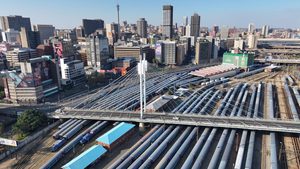
South Africa’s state-owned passenger rail company has a target to complete 600 million journeys per year by 2030. In its latest fiscal year, it only completed 77 million trips.
More pressingly, the Passenger Rail Agency of South Africa (PRASA) needs to complete between 350 million to 400 million trips annually just to become financially sustainable.
This comes as PRASA is looking to reverse its decline over the past few decades, with the state-owned enterprise (SOE) having faced years of mismanagement, corruption, and inadequate infrastructure maintenance.
Symmetry chief investment strategist Izak Odendaal previously described PRASA’s collapse as “one of the saddest tales of corruption and mismanagement in South Africa”.
“It has had a devastating impact on hundreds of thousands of working-class people who have been forced to use more expensive alternatives,” he said. “This is a shock to disposable income that is not widely discussed by economists.”
Similar to many of South Africa’s current crises, the crux of PRASA’s decline lies in financial mismanagement and the deterioration of its infrastructure.
Like many other local SOEs, PRASA spent years prioritising spending on consumption rather than maintaining and upgrading its infrastructure. At the same time, the utility had to contend with corruption and vandalism, with devastating results.
Between 2009 and 2024, the number of passenger journeys per year declined by 89%, from 649,787 to 73,557.
The SOE was also particularly hard hit by the Covid-19 pandemic, during which extensive vandalism, cable theft, and infrastructure damage forced PRASA to suspend operations on multiple routes, bringing its monthly trips to zero for a period.
These operational struggles manifested in the SOE’s financial health, with PRASA’s fare revenue collection going from R228 million in 2010 to only R2.8 million around a decade later.
In recent years, PRASA has been hard at work addressing these issues and reviving commuter rail in South Africa.
Notably, it has made some inroads. In the 2024/25 financial year, PRASA increased its passenger trips to 77 million, nearly double the 39.4 million it completed the year before.
“Across every region, we have registered momentum. Gauteng delivered 40.7 million trips, the Western Cape 22.7 million, KwaZulu-Natal 12.7 million, and the Eastern Cape 670,000 trips,” PRASA CEO Hishaam Emeran said.
“We expect the growth in passenger trips to grow across the PRASA network.”
The graph below, courtesy of Odendaal, shows the collapse of PRASA’s rail journeys over the past decade.

Unforgiving arithmetic
PRASA’s turnaround is one of many reform efforts measured by Business Leadership South Africa’s (BLSA) Reform Tracker.
In the tracker’s second quarterly review, spatial inequality improved from a score of 60.2 to 62.2.
This was due to improvements in passenger rail line restoration, with PRASA having made operational achievements, as well as movement on housing subsidy reform.
Another improvement highlighted in this review was Transport Minister Barbara Creecy’s launch of a passenger rail RFI targeting private investment in PRASA.
“Private operators would lease and manage PRASA’s new trains under performance-based contracts – a significant departure from the status quo,” the review explained.
While a positive development, PRASA faces a significant uphill battle, with a target of reaching 600 million passenger journeys per annum by 2030.
BLSA’s review explained that the government’s focus on improving Transnet’s operations over the past few years sometimes means Prasa’s achievements are easily missed.
“The state-owned enterprise achieved a clean audit last year for the first time in nine years and doubled passenger trips,” it said. “Credit is due.”
PRASA also celebrated this milestone at the release of its 2024/25 Group Annual Report.
“While challenges remain in financial controls, supply chain management, and consequence management, we have implemented concrete remediation measures with visible year-on-year improvement,” Emeran said.
However, despite all of these improvements, BLSA noted that PRASA still needs 350 million to 400 million trips annually just to become financially sustainable.
This is a far cry from its latest 77 million milestone, but also far less than the 600 million target set for 2030.
“It has just over four years and a R7 billion budget cut to absorb in 2025/26. The arithmetic is unforgiving,” BLSA said.



Comments