Historic library at South Africa’s best university left as a burnt out shell


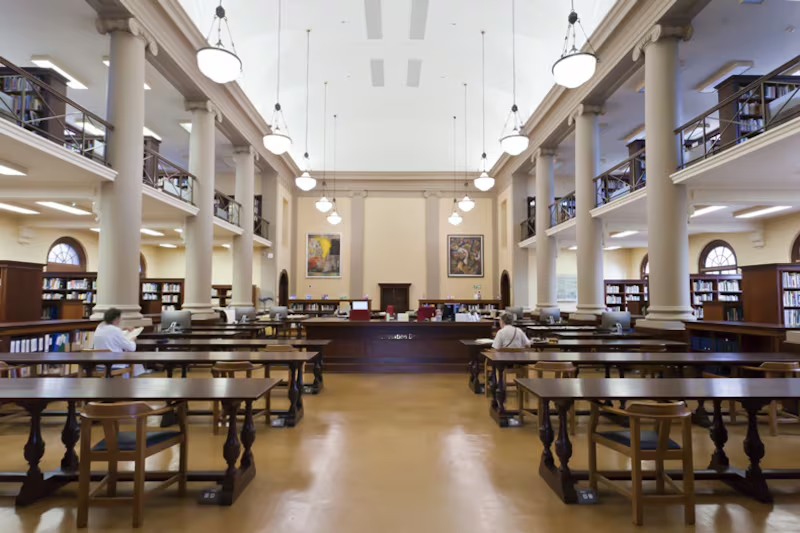
The University of Cape Town’s (UCT) iconic Jagger Library, home to over 85,000 published items, including ultra-rare books and translations, has remained a burnt-out shell for over five years since it was partially destroyed by a wildfire.
While much of its special collections have been salvaged and restored, as they were stored in the library’s basement and protected by fire doors, the historic main reading room retains the scars of the fire.
This is despite a “re-imagining” process taking place in 2022 at the university, where stakeholders from UCT and Cape Town more broadly were invited to rethink the Jagger Library’s restoration.
The process set out to develop ideas for how the building could be used in the future. However, no concrete action has been taken to restore the library or create something new in its place.
GroundUp reported that UCT spokesperson Elijah Moholola explained the re-imagining process was “intentionally ambitious in scope and, in some cases, deliberatively speculative”.
“The question is not only how to repair a building, but how to ensure that Jagger contributes meaningfully to a contemporary African, urban, post-colonial university,” Moholola told the publication.
The Jagger Library housed arguably the world’s premier collection of African studies, with over 85,000 rare items stored in the building.
This includes extremely rare collections of historical maps and posters documenting African history, over 2,000 volumes of Rudyard Kipling, and some of the only original translations from 18th-century Dutch explorers.
Constructed in the 1930s, the Jagger Library stands along the main facade of UCT’s upper campus, just off to the side of the main Sarah Baartman Hall.
The library was named after John William Jagger, a prominent South African businessman and cabinet minister, who was a major benefactor to UCT Libraries.
As UCT expanded, the library’s role shifted to serving as the main reading room within the network of eight libraries on campus. The Jagger, as students call it, could house over 1,000 readers in its various rooms before its restoration in 2011.
This restoration aimed to return the Jagger Library to its original condition, with the additional walkways and balconies installed in the 1960s and 1970s being removed.
It was subsequently painted, refurbished, and its original elements restored, becoming the university’s premier library once again.
Fire and hope

In mid-April 2021, a wildfire spread across the Table Mountain National Park and the neighbourhoods of Newlands, Mowbray, and Rondebosch.
The fire completely gutted a restaurant behind Rhodes Memorial on the slopes of Devil’s Peak before making its way down towards UCT’s upper campus.
Allegedly started by a vagrant, the fire was fuelled by dried-out bush on Devil’s Peak and spread by the Cape’s notorious winds.
The fire damaged several buildings on UCT’s upper campus, with much less severe damage caused to its middle campus, which sits below the M3.
The Jagger Library was completely gutted by the fire, and many books and archive material were lost. Crucially, the building’s fire systems ensured that a substantial portion of the library’s collections, particularly those stored in the basement, were salvaged.
Salvageable material was moved to an office park in Mowbray, where experts carefully restored and conserved what they could. Researchers can access these materials by appointment in Deneb House in Observatory.
While its material has been saved, the Jagger building itself remains empty and boarded up. GroundUp said the building is surrounded by a fence with a locked gate.
“While the building has not yet been reoccupied in a conventional sense, it would be inaccurate to suggest that it has remained entirely unused or unattended since the 2021 fire,” Moholola said.
So far, all that has been done at the library is the construction of a temporary roof to protect it from the elements, with the university still developing proposals for rebuilding Jagger.
Moholola said the building may not be the same as before, explaining that the project’s cost will be determined only once the redesign plans are approved.
Restoring a building of immense heritage, such as the Jagger Library, is a tricky affair, with it being protected by the National Heritage Resources Act.
This means that any alterations will require approval from Heritage Western Cape, which has yet to receive an application from the university for the redesign of the Jagger building.
“Moving from exploration to implementation requires a professional, disciplined and decisive approach, which takes time to achieve,” Moholola said.
“Haste would risk producing an outcome that is neither durable nor true to the university’s values.”
Images of Jagger Library




 Loading ...




Comments