End of an era for Eskom and Transnet


South Africa’s private sector is set to play a far greater role in the local economy than before, with the opening up of sectors once dominated by state-owned monopolies.
In particular, the private sector will play a significant role in the provision of electricity and the transport of goods via rail for the first time in decades.
This is a significant change for South Africa’s economy, which has historically had key sectors controlled by state-owned enterprises (SOEs).
The deterioration of the financial health of SOEs and their inability to execute their mandate effectively has resulted in the government having to turn to the private sector to operate within various key sectors.
This is set to significantly boost fixed investment by private companies in the South African economy, which is desperately needed to sustainably increase economic growth.
Chief investment strategist at Old Mutual’s Symmetry Izak Odendaal explained that much has been made of the impact of elevated interest rates on South Africa’s economy.
While elevated interest rates limit growth, this is to a relatively small extent in South Africa, whose economic probelms lie on the supply side of the economy and not the demand side, Odendaal said.
Demand seems to be improving modestly already, with consumer spending rose almost 3% year-on-year in the second quarter in real terms.
Credit growth seems to have bottomed, suggesting that interest rates, while elevated, are not crushing consumer demand. New car sales growth is also strong, according to industry body Naamsa.
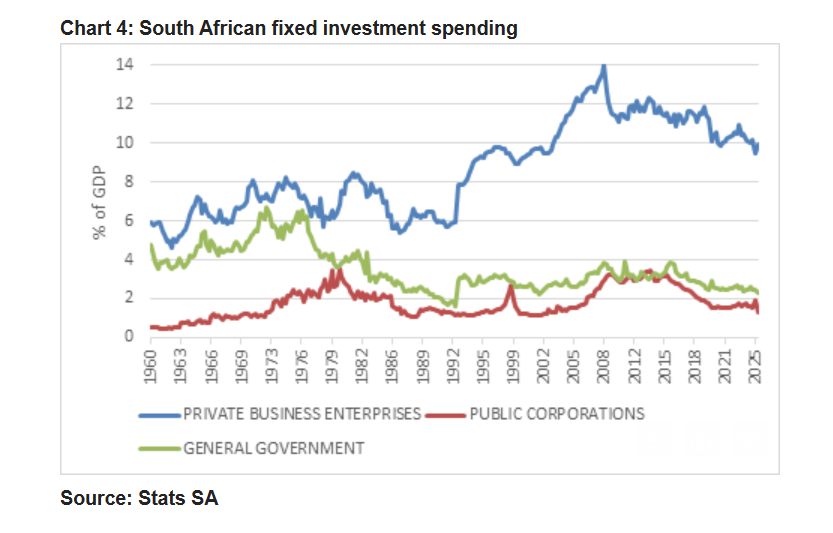
Where demand is weak is in terms of fixed investment. Odendaal said it remains below pre-pandemic levels in real terms.
As expressed as a percentage of GDP, it is about half the 30% rule of thumb, where it sustains rapid economic growth.
Interest rates are a factor in fixed investment decisions, but the biggest consideration is probably the size of the opportunity.
Confidence in the future also matters a lot, particularly confidence that the regulatory and political environment will be stable. This includes the state of US import barriers, which are still up in the air and will constrain opportunities for some firms.
Companies also require confidence in the rule of law, protection of property rights and the safety of staff and suppliers.
South Africa’s poor fixed investment rate as a share of GDP can be seen in the graph below.
Breaking the stranglehold
One of the main ways to attract private fixed investment is to open up sectors once monopolised by SOEs to private competition.
The government has been implementing reforms over the past few years to ensure a competitive electricity market is created, whereby Eskom will compete against private generators to sell to the grid.
On the other hand, the logistics sector is gradually being opened to private players through concessioning particular rail corridors and port terminals.
This is good news for investment, Odendaal said, as it will create new opportunities in sectors previously monopolised by the state.
Following the ongoing deregulation of the electricity sector, eleven firms have now been selected to run their own trains on Transnet rail corridors.
When finalised and implemented, this will not only unlock tens of billions in new investment funded by the private sector but also boost trade volumes and export earnings.
South African corporates are estimated to be sitting on over R1.5 trillion in cash on their balance sheets, which is sitting idle in money market funds or call accounts rather than being deployed in the economy.
Much of this has to do with these companies waiting for better opportunities to invest than in a stagnant economy, as well as the need for greater confidence about South Africa’s future and policy direction.
This remains the biggest bright spot in the South African story – after decades of the state controlling the commanding heights of the economy through the likes of Eskom and Transnet, it is letting go, even if reluctantly.
Space is opening for the private sector to step in and do what it does best, Odendaal said. However, this does not mean it should do everything.
It remains to be seen whether the South African government can step up and do what governments theoretically do best, namely, provide public goods like safety and security.
Things surely can’t get any worse, but the upcoming inquiry into SAPS will be an important marker, Odendaal said.
The private sector only solves problems where there is a profit to be made. Other problems must be addressed by the government and civil society.
While businesses are willing to deploy capital and have the skills to fix many of South Africa’s major challenges, the governmetn has to create an environment in which they are willing to invest and deploy those resources in the local economy.
 Loading ...


Comments