South Africa went from hero to zero in less than two decades


South Africa’s ten-year average annual GDP growth is back below levels seen in 1994, with the hard work done to revive the local economy in the mid-2000s being undone by 15 years of mismanagement and corruption.
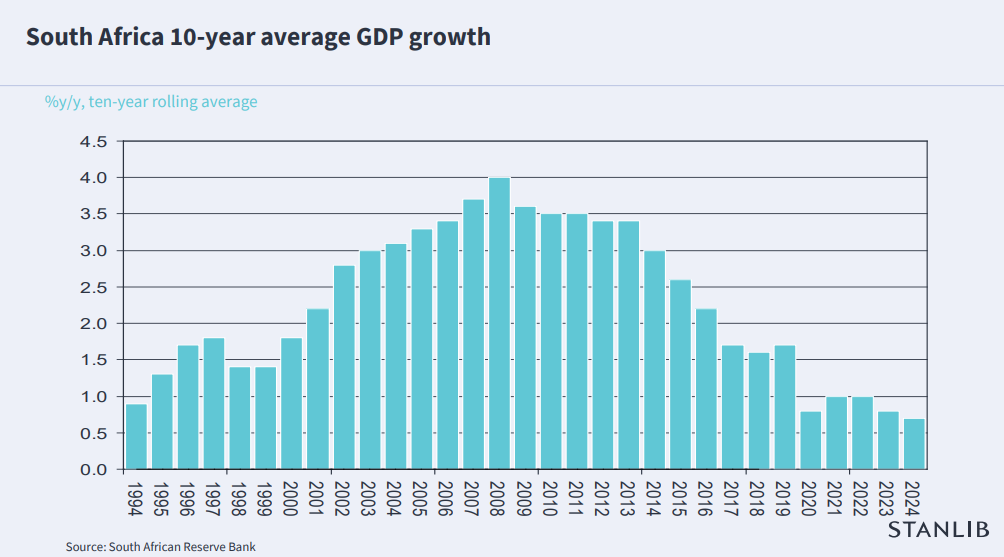
The country’s economy has gone from averaging an annual growth rate of 4% in 2008 to 0.8% less than two decades later.
This rapid decline coincided with widespread corruption during the State Capture era, wasteful government spending, and a lack of attention to what makes a modern economy flourish.
As a result, South Africa is now sitting with a stagnant economy, record unemployment, and an unsustainable debt pile – undoing efforts to save the country from a debt spiral in the 2000s.
This is feedback from Stanlib chief economist Kevin Lings, who outlined South Africa’s journey from zero to hero and back to zero.
Lings explained that the government knows what it has to do and that it has previously gotten things right, with the economy averaging 4% GDP growth in the mid-2000s. During this period, the economy created around 500,000 jobs a year.
The ANC and its leaders need to be praised for this outcome because South Africa’s economic growth was dismal in the decade leading up to 1994.
“In the decade leading up to 1994, South Africa’s average annual growth rate was less than 1%. That is terrible, and the country was in serious trouble financially,” Lings said.
For the three years in the build-up to 1994, South Africa suffered a recession as economic output declined year-on-year from 1992 through 1994.
“Then the ANC did something brilliant. They appointed Trevor Manuel as Finance Minister. I don’t think he knew he was brilliant, but he ended up there and did remarkable things for this country,” Lings said.
South Africa avoided bankruptcy, arrested the decline of the rand, and the economy began to grow as the private sector invested heavily.
“The economy took off. It took a couple of years to gain momentum, but then it did really well. In 2008, South Africa’s ten-year average annual growth rate was 4%,” Lings said.
“We have achieved it. It is not impossible. We have hit 4% GDP growth, and the economy has created more than 500,000 jobs a year, with government debt being reduced to 26% of GDP.”
The country’s credit rating improved to an A, with foreign investment coming into the country by the billions.
While some point to the commodity boom and the additional growth and tax revenue this provided, Lings explained that it was still a brilliant decision for Manuel to use it the way he did.
“Manuel, because of that growth, was collecting lots of tax revenue and generating budget surpluses. What did he do with the extra money? He paid down the country’s debt. He put us in a really good position,” Lings said.
“We were reducing our debt burden and accelerating economic growth. Besides all the other benefits of employment and growing revenue, this was exceptional for South Africa.”
This period of extraordinary growth can be seen in the graph below, courtesy of Lings.
What went wrong
South Africa in 2008 was in a phenomenally good position, with low government debt, a growing economy, and unemployment on the decline.
“But then something changed, right? They got rid of Trevor Manuel and there was a leadership change at the top of the ANC and government,” Lings said.
“Can you think of any particular change in the ANC that might have caused a problem? And now we find that average annual growth is less than 1%.”
In just 15 years, South Africa’s government debt as a share of GDP has skyrocketed from 26% to over 76% and the country is paying R1.2 billion a day just to service this debt.
After Manuel left the government, state spending soared with little to show in terms of faster economic growth. Much of this spending went towards consumption rather than productive areas, such as infrastructure.
As a result, South Africa’s credit ratings plummeted to below investment grade with all three major rating agencies, which is also known as “junk status”.
Following this decline, investors pulled out of South Africa, with foreign ownership of local bonds and equities plunging to some of the lowest levels on record.
This creates a vicious cycle, where declining investment further weakens economic growth, impacting the government’s finances and increasing the risk of investing in the country.
South Africa has been in this cycle for the past 15 years, with the government running its last budget surplus in the 2007/8 financial year. Since then, it has consistently run deficits while economic growth has slowed.
“The problem is actually very simple, the economics of it are clear and the solutions are relatively simple. But, to make the solution effective, you need political will,” Lings said.
To get out of its current crisis, the government has to create an enabling environment for private investment and business growth.
Corporates have over R1.5 trillion in cash that is waiting to be deployed in the local economy if the conditions are right. Currently, low business confidence and political uncertainty prohibit such investment.
“We have gone back to 1994 in terms of economic growth and that is a major, major problem as South Africa’s population is growing at 1.4% per annum,” Lings said.
“When you grow at less than 1% and significantly slower than your population growth, then fundamental things begin to break. You cannot absorb a growing workforce, resulting in millions of youth being unemployed.”
“You cannot offer the population a chance to participate in the economy. It is not possible. Businesses cannot employ more people for the hell of it, they have to be growing and expanding. If you do not have that growth and expansion, you stagnate.”
Lings attributed the decline in South Africa’s economic fortunes to five things –
- Infrastructure failure
- Government has run out of money
- Crime and corruption
- Overregulation
- Declining labour productivity
“In order to go forward, to lift South Africa, you have to fix this. It is not an if, but, or maybe – you have to. It is not a choice anymore,” he said.


Comments