South Africans kissing casinos goodbye


Casinos and gambling houses in South Africa are being pushed to the side in favour of online betting.
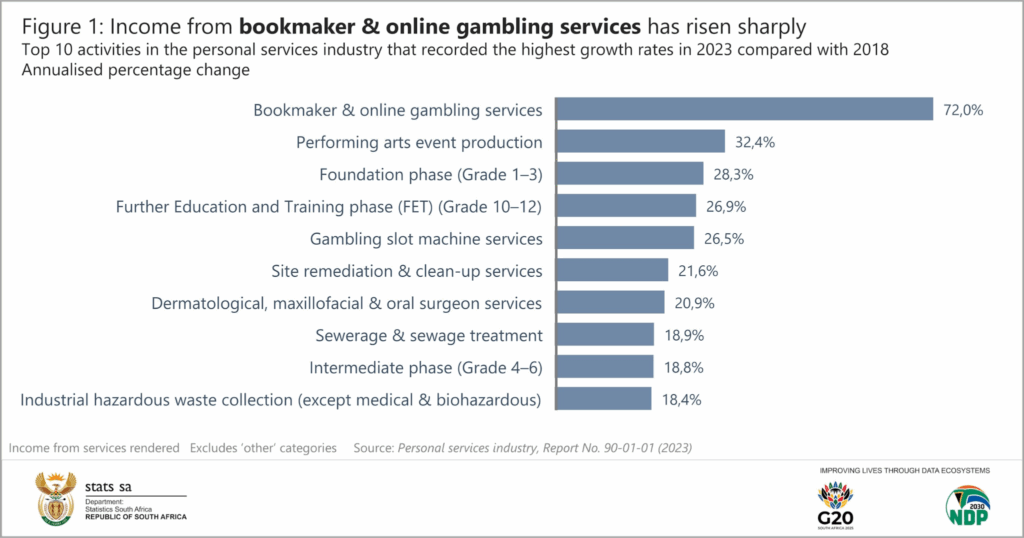
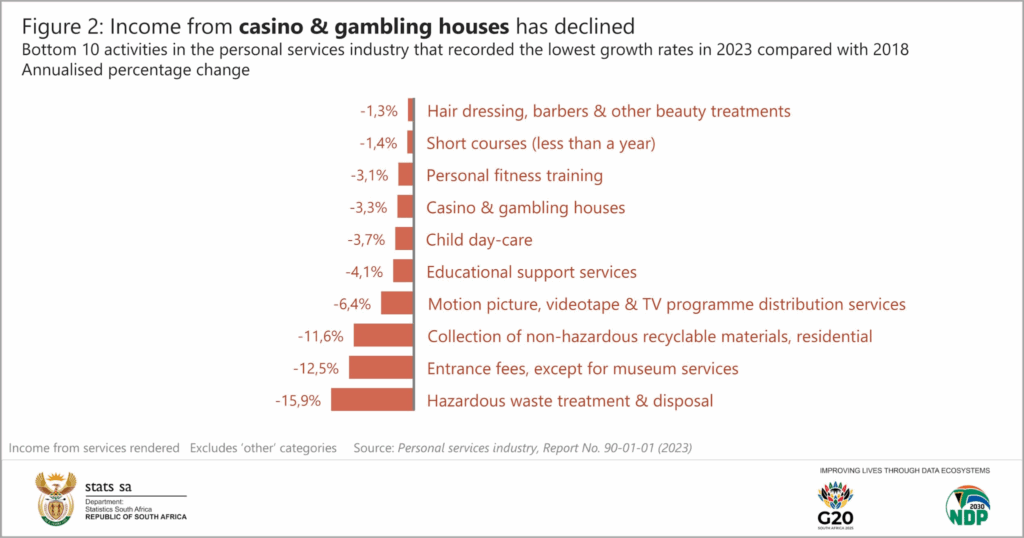
Recent data from Statistics South Africa show that income from bookmaker and online gambling services has risen sharply, by 72%, while income from casino and gambling houses has declined.
Stats SA explained that the country’s gambling and betting industry is booming, with gross gambling revenue reaching R59.3 billion in the 2023/24 financial year.
This represents a 25.7% rise from R47.2 billion in 2022/23 and a sharp increase from R34.4 billion in 2021/22 and R23.3 billion in 2020/21.
This growth was primarily driven by betting, a big change from just a few years ago, when the casino industry was the most popular form of gambling.
Casinos boasted 84% of market share in 2009/10, while betting only accounted for 10%.
However, betting has boomed in popularity over the past decade, with the Covid-19 pandemic marking a significant turning point.
Online betting overtook casinos during the pandemic, as lockdown regulations limited South Africans’ ability to gamble in person.
Stats SA’s recent report on the personal services industry confirmed this, showing that bookmaker and online gambling services experienced a rapid surge in income between 2018 and 2023.
These services outpaced all other activities over this period, including education, health, entertainment and recreation.
In rand terms, bookmaker and online gambling services generated R152.6 billion in 2023 from services rendered, up sharply from R10.1 billion in 2018.
In contrast, casino and gambling houses registered an annual decline of 3.3% over the same period. This places them among the bottom 10 worst performers in the personal services industry.
Stats SA explained that the popularity of gambling and betting activities can also be seen in the consumer price index, as it now accounts for 1.6% of total household spending.
The growth in online gambling and the decline in casinos can be seen in the graphs below, courtesy of Stats SA.
Sun International
The boom in online gambling compared to the decline in popularity of casinos can clearly be seen in the latest results of South African hospitality and gambling giant Sun International.
Sun International operates resorts, hotels, and casinos nationwide. Its most well-known resort is Sun City in the North West.
The company also operates the popular online betting platform, Sunbet, which has grown tremendously over the past few years.
In its latest results for the six months ended 30 June 2025, Sun International provided a breakdown of how its individual segments performed.
The company’s Urban casinos segment, which remains the cornerstone of Sun International’s land-based operations, reported income of R3.2 billion, representing a 1.4% year-on-year decline.
This segment delivered an adjusted EBITDA of R1.0 billion, pre-management fees, with a margin of 31.7%, down from 33.1% in the prior period.
The company explained that this market continues to be under pressure, and now requires a reassessment of its approach to this portfolio.
Therefore, Sun International plans to direct investment toward casino floor optimisation, service enhancements, product innovation, and improved marketing to convert footfall more effectively.
“This, in combination with a sharpened focus on customer acquisition and retention strategies, is expected to support income in the medium term,” the company said.
In contrast, the company’s online betting platform, Sunbet, delivered standout results over the same period.
Sunbet’s income was up 70.7% over the six-month period to R874 million. The business also delivered an adjusted EBITDA of R292 million, pre-management fees, a substantial uplift from R166 million in the prior period.
This means Sunbet’s adjusted EBITDA margin reached 33.4%, higher than the 31.7% margin of Sun International’s Urban casinos segment.
However, the company’s results also revealed that in-person gambling is not all doom and gloom. Its limited pay-out machine business, Sun Slots, generated an encouraging 2.2% increase in income to R701 million.
This segment’s adjusted EBITDA was R161 million with a margin of 23.0% compared to 23.6% in the prior period.
 Loading ...

Comments