The collapse of South Africa’s police


The performance of South Africa’s police has deteriorated significantly over the past decade, with kidnappings surging and murder detection rates declining.
According to the most recent statistics from the South African Police Service (SAPS), its murder detection rate is 12.4%. This means that for every 100 murders, only 12 are solved.
This rate has declined substantially from levels seen in 2011/12, when the police solved 31.1% of murders in South Africa.
The decline in the murder detection rate is emblematic of the collapse of South African policing, with widespread crime and corruption significantly limiting economic activity.
This is feedback from Stanlib chief economist Kevin Lings, who outlined the four things South Africa has got wrong since 2010.
In the mid-2000s, South Africa experienced an economic boom, averaging annual GDP growth of around 4% and creating 500,000 jobs a year.
However, since 2010, the economy has averaged an annual growth rate of just 1.1% and the country now has the highest unemployment rate in the world.
One of the main things South Africa has got wrong over this period is its inability to tackle crime and corruption successfully.
“In 2011, we caught 31% of all murderers. That is pathetic, but still far better than today, where the police only solve 12.4% of murders,” Lings said.
“I am thinking that when we get the next update, that number is going to be 10%. A 10% murder detection rate means that you have a 90% chance of getting away with murder.”
This is indicative of more significant issues within the South African police force, which is highly inefficient and unable to perform basic functions.
“Think about the efficiency of this. Think about the problems we have in the police system. How do you only catch 12% of murders?” Lings said.
“Do you know how inefficient your police have to be? And this is not even all the areas of inefficiency.”
The graph below, courtesy of Lings, shows the decline in South Africa’s murder detection rate since 2011/12.

Rule of law vital for economic growth
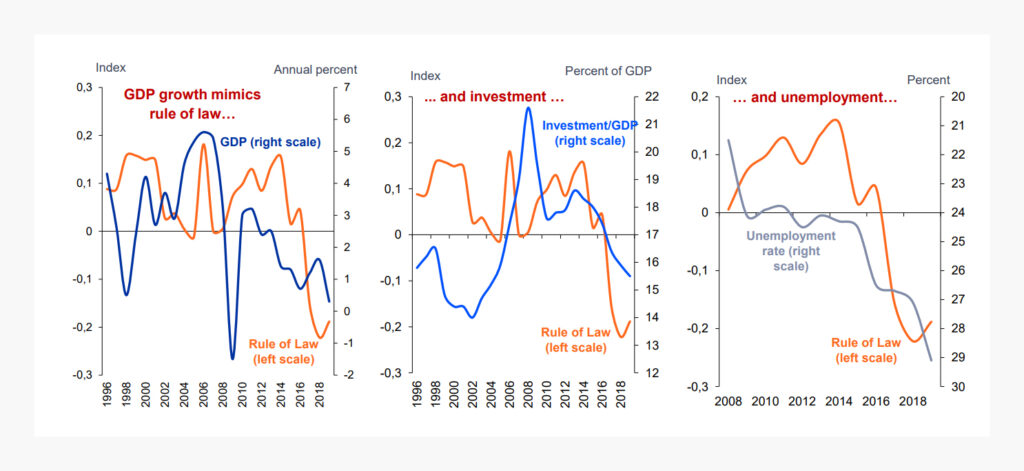
The collapse of South Africa’s police indicates a significant decline in the rule of law, which significantly impacts investment in the country.
Rule of law and good governance, particularly policy certainty and safety, are significant factors in attracting investment to a country.
South Africa has relatively low policy certainty compared to some of its peers and more developed economies.
In addition, the rule of law has come under immense pressure in South Africa, from a collapsing police service to the widespread corruption of the state capture era.
Standard Bank chief economist Goolam Ballim explained to Daily Investor that the rule of law and good governance are vital for faster economic growth in South Africa.
“It may sound a little academic, but it is something that I support quite vigorously, and that is the rule of law or good governance. I treat those two as synonyms,” Ballim said.
“By the rule of law, I am referring to the overall governance climate within a country that is vital to attract investment locally and abroad.”
Standard Bank’s research indicates that around three-quarters of all investment and economic growth hinges on the rule of law and good governance.
The remaining quarter is made up of capital, innovation, labour dynamics, and everything else in an economy, reflecting just how important the rule of law is.
“I am making a bold statement here. I have said it before, and the data support me in saying that governance is about two-thirds to three-quarters of the economic growth of a country,” Ballim said.
“And so, continued improvement in the governance structure will be the bedrock of enhancing predictability, efficiencies, and increased private sector participation in the economy.”
“So, if you want to say what the silver bullet is, I’d say it is the rule of law.”
Ballim said improved governance and the rule of law are easy to advocate for but very difficult to implement in practice.
In South Africa, this proves particularly difficult as many of those responsible for defending the rule of law may be working to undermine it.
“It is easy to say and sometimes it has even been done, but sometimes the very politicians responsible for the rule of law are also the ones who seek to preserve their patronage networks and so forth,” Ballim said.
“This has been a crime on society for a long time, and it is one of the things that we should continue to talk about as policy advisors and as citizens.”
 Loading ...





Comments