Bad news for Shein and Temu in South Africa


The National Treasury has proposed removing the current tax-free limit on imported goods, which means that all low-value imports will be subject to VAT.
This will bring to a complete end any low customs value consignment relief, which was exploited by Chinese eCommerce giants Shein and Temu to drive down the costs of their products for sale in South Africa.
Previously, imports valued at R500 or less were subject to a flat 20% rate without VAT. If the proposal is implemented, all imports will be hit with the standard VAT rate of 15% in addition to the 20% flat rate.
This proposal was included in the National Treasury’s publication of the 2025 Draft Tax Bills and Draft Regulations for comment.
Published in partnership with SARS, these new bills and regulations aim to make significant chagnes to South Africa’s tax system.
Partly driven by the confusion regarding the implementation and reversal of the proposed VAT hike, the bills and regulations are set to clarify several existing tax measures.
These include the treatment of foreign retirement benefits, the VAT treatment of airtime vouchers, and phase two of the carbon tax, among others.
One of the most significant proposals is to remove the current tax-free limit on imported goods and subject all imports to VAT on arrival.
In November 2024, SARS, in response to calls from the local clothing industry, introduced VAT on all imports and reconfigured the flat rate system.
However, the new proposal from the National Treasury seeks to remove any low customs value consignment relief.
This marks the end of a concession first launched in 2007 by SARS to provide various benefits to multinational companies as they gained access to the South African market.
SARS’ measures also sought to benefit South African consumers as eCommerce stores boomed, with the relief set to keep prices low through reduced duties and taxes on certain imports.
However, this relief has been overly exploited by Chinese giants Shein and Temu, which have grown rapidly in South Africa over the past few years.
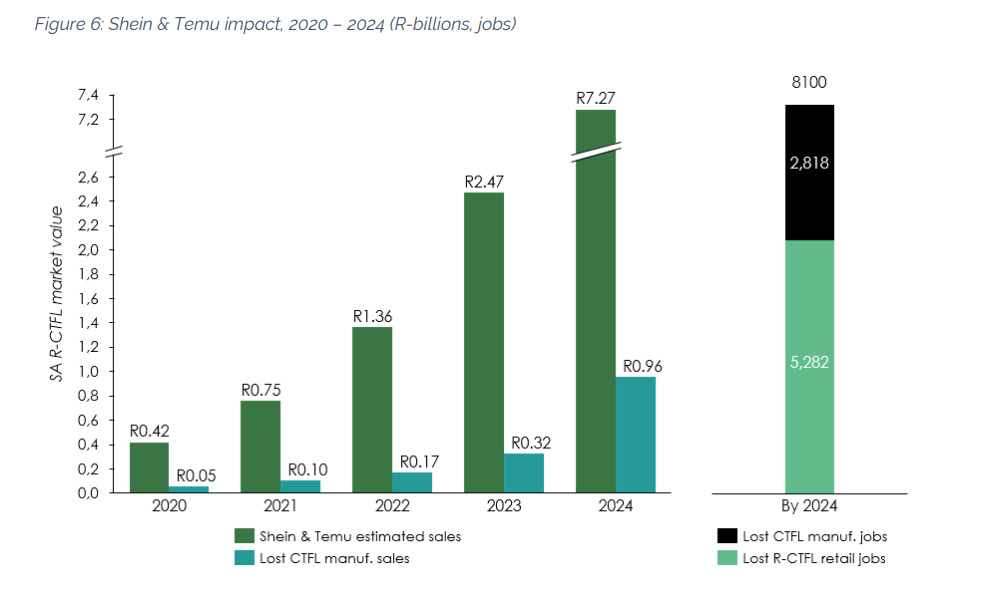
The two Chinese giants secured an estimated R7.3 billion in sales in 2024, accounting for more than a third of all online clothing sales in South Africa.
Their rise has led to questions regarding whether they should benefit from any low-value customs relief while local retailers are left paying VAT on imports.
While Shein and Temu could split customer orders to keep them below R500 and thus not pay VAT, local retailers import their goods in bulk, which are then hit with the 20% flat rate and 15% VAT.
In response, SARS removed the VAT relief on imports valued at below R500, with National Treasury’s proposal seeking to make this law and levy 15% VAT on all imports.
The growth of Shein and Temu in South Africa can be seen in the graph below, courtesy of the LSF.
Shein and Temu under fire
It has also resulted in significant scrutiny regarding the impact of the rise of Shein and Temu on the local clothing industry, including retailers and manufacturers.
Recently, the Localisation Support Fund (LSF) commissioned a study to analyse the impact of the rise of the Chinese giants on South Africa and the local clothing industry.
It found that the rise of Shein and Temu has diverted demand away from domestic value chains, undermining local manufacturers and retailers.
The study estimates that more than 8,100 local jobs, two-thirds in retail and one-third in manufacturing, have not materialised due to the market presence of Shein and Temu.
If current trends persist, more than 34,000 jobs could be displaced by 2030 if the higher-end scenario were to materialise.
Under a high-growth scenario with limited intervention, the local impact could reach over R6.2 billion in non-realised South African clothing manufacturing sales, 18,300 manufacturing jobs, and 16,400 retail jobs by 2030.
Despite these impacts, some have argued that Shein and Temu have had a positive impact on South Africa by driving down prices for consumers in the eCommerce space.
A report from Boston Consulting Group (BCG) on South Africa’s eCommerce market found that international players’ entry into the country can bring significant benefits.
It also found that the intense scrutiny faced by Shein and Temu is not experienced by other international players, such as Amazon, which, in some cases, engages in similar tactics.
The report said the presence of these international players should not be frowned upon entirely, as it indicates that they will use the country as an entry point for regional expansion into Sub-Saharan Africa.
This means South Africa could become the continental eCommerce hub, potentially boosting local employment and economic outcomes.
Their presence also has the potential to raise the bar for customer expectations from local retailers, resulting in improved offerings, prices, and experiences for local consumers.
This, in turn, may result in increased investment from local retailers to match their international counterparts, further increasing job opportunities and economic activity in the sector.
Shein has also responded to the end of the low-value consignment relief by introducing new features to help shoppers navigate the elevated customs duties.
The Chinese giant now displays and charges import duties on South African orders at checkout, where previously it did not.
In the past, customers placed and paid for their orders through the platform and waited to be informed of the customs levied once the order arrived in
Customers had to pay import duties directly to an international logistics company before the order would be dispatched. These companies included Buffalo Logistics, Aramex, and iMile.
This was a significant obstacle for Shein in South Africa, as many customers were hesitant to place orders without knowing how much they would have to pay in import duties.
However, an update to the Shein platform now includes the customs duty at checkout and asks customers to pay the duty with their order.
The checkout process now includes a “import charge” line item, and according to Shein, the fee consists of customs duties, VAT, and other import duties.
 Loading ...





Comments