South Africa’s best-performing clothing retailer still lost R240 million in value this year


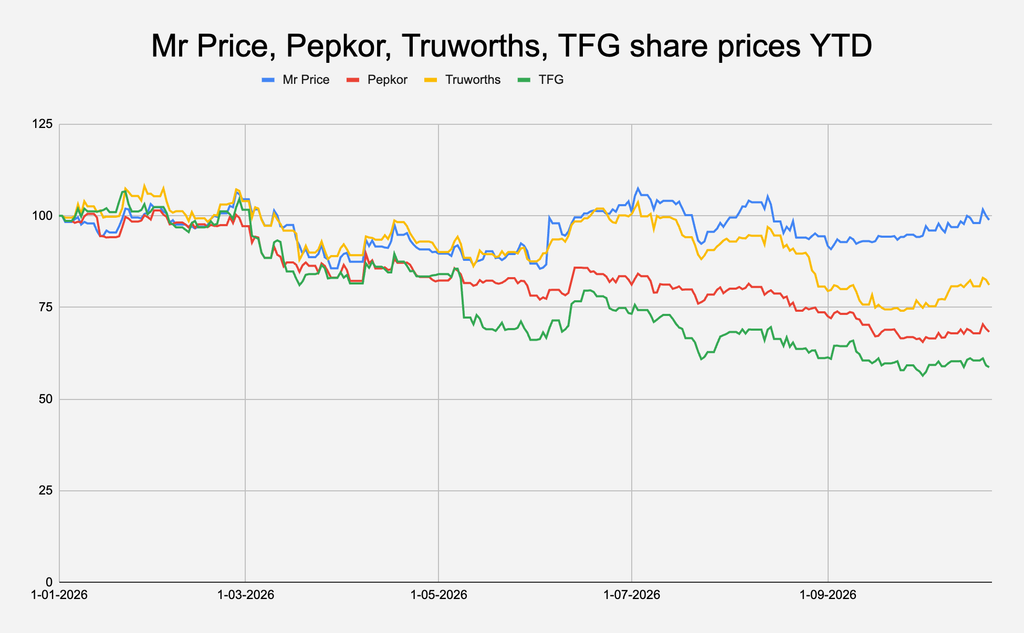
In South Africa’s tough apparel retail environment, even the country’s best-performing clothing retailer, Mr Price, has seen its share price decline by 1.13% year to date.
While this is not a significant decrease, it is notable that not one of South Africa’s JSE-listed apparel retailers has seen its share price increase in 2026 to date.
From Mr Price to Truworths, TFG, and Pepkor, local apparel retailers are facing an increasingly difficult operating environment, and their share prices reflect this.
Allan Gray portfolio manager Rory Kutisker-Jacobson said on 13 October that while no clothing retailer has seen its share price rise this year, the spread between them remains extreme.
“The ‘best’ performer has been Mr Price, down 7% year to date, while Foschini has fallen a staggering 43%. Pepkor and Truworths sit somewhere in between,” he said.
The situation has changed since Kutisker-Jacobson made this comment, with Mr Price in particular seeing a recovery.
At the time of writing, Mr Price’s share price is down 1.13% year to date. This implies that the company’s market capitalisation has declined by R240 million since January.
A Daily Investor analysis in October showed that the worst performer among South Africa’s listed apparel retailers in terms of share price is TFG, which is down 41.29% year-to-date.
This is followed by Pepkor, down 31.63%, and Truworths, down 18.84% year-to-date.
PSG Financial Services wealth manager Schalk Louw told Daily Investor that the primary driver of these share price declines across the sector is the downward revision of forward earnings expectations.
Louw explained that a weak consumer, further squeezed by higher fuel prices and interest rates, is coinciding with margin pressure from discounting and no clear sign of recovery.
These factors, he said, have led analysts and investors to cut their forecasts for next year’s earnings. “As a result, valuations have de-rated across the sector,” he said.
Louw said investors are also concerned that retailers will have to sacrifice margin to remain competitive.
This risk has been amplified by the shift toward low-cost online rivals, which reflects a lasting change in the industry’s economics rather than a passing cycle.
“That makes it harder to argue for a near-term re-rating until there is evidence of earnings stabilisation,” Louw said.
Pressure on local clothing retailers and Mr Price’s win
Louw told Daily Investor that the local apparel retail sector faces a squeeze from both demand and margins.
“Household budgets remain stretched, and because clothing is discretionary, it is typically the first category consumers cut back on,” Louw explained.
“At the same time, competition is intensifying from several directions.”
This includes heightened competition from international players, such as Chinese e-commerce retailers like Shein and Temu, as well as traditional brands like H&M.
Competition from local players also continues to intensify, especially with grocery retailers like Shoprite and Pick n Pay pushing further into the apparel market.
“Together, these forces are driving higher promotional activity and putting gross margins under pressure, while limited pricing power makes it hard to pass on cost inflation,” Louw explained.
“The result is a sector where earnings growth is increasingly difficult to deliver.”
Amid these pressures, Louw identified Mr Price as the standout performer, able to navigate the risks well.
He pointed out that Mr Price has delivered resilient revenue growth, improving margins, and disciplined cost control in a difficult environment.
“Its value positioning is well suited to a more price-sensitive consumer, and its scale and operational efficiency allow it to remain competitive on price without sacrificing profitability,” he said.
“That combination of top-line resilience and margin discipline is what we look for in a defensive operator.”
Despite these advantages, Louw noted that some risks remain for Mr Price.
This includes competition from international online platforms, the group’s premium valuation relative to its peers, and execution risk associated with its offshore investment in NKD Group.
However, Louw maintained that Mr Price’s execution has been the strongest in the sector.