The major property developer cashing in on the sport taking over South Africa


Balwin Properties reported that the addition of padel courts at some of its developments has supported the company’s revenue growth.
This comes as padel’s popularity is growing across the country, with the sport now the fastest-growing in the world.
Africa Padel’s head of operations, Bradley Emmett, told Daily Investor earlier this year that padel is experiencing unprecedented global growth.
He said over 2,500 new courts were built worldwide in 2023, with an average of 51 new clubs opening every week.
“In South Africa, we see new players joining daily, taking up lessons, participating in beginner tournaments, and immersing themselves in the game,” he said.
Padel originated in 1969, when a Mexican businessman invented the sport because he did not have enough space to build a tennis court at his house in Acapulco.
Thus, he decided to build a smaller, enclosed court, and in the process, invented a new sport.
Padel can be a combination of tennis and squash, with two players on each side. Padel courts are smaller than tennis courts and enclosed in glass walls.
Unlike tennis, padel uses a softer and slower ball that can bounce off the glass walls and remain in play.
While it was invented nearly six decades ago, South Africa only saw its first padel court built in 2019, at the luxury Winelands estate of Val de Vie.
After that, the sport experienced a boom in popularity, with clubs starting to pop up across the country.
“Padel’s popularity in South Africa has grown rapidly since its introduction, driven by its accessibility, social appeal, and the inclusive nature of the sport,” Emmett said.
He said Africa Padel has expanded to 21 venues across South Africa, with clubs in Cape Town, Bloemfontein, Umhlanga, Sandton, and beyond, now boasting over 90 courts.
Balwin gets a boost
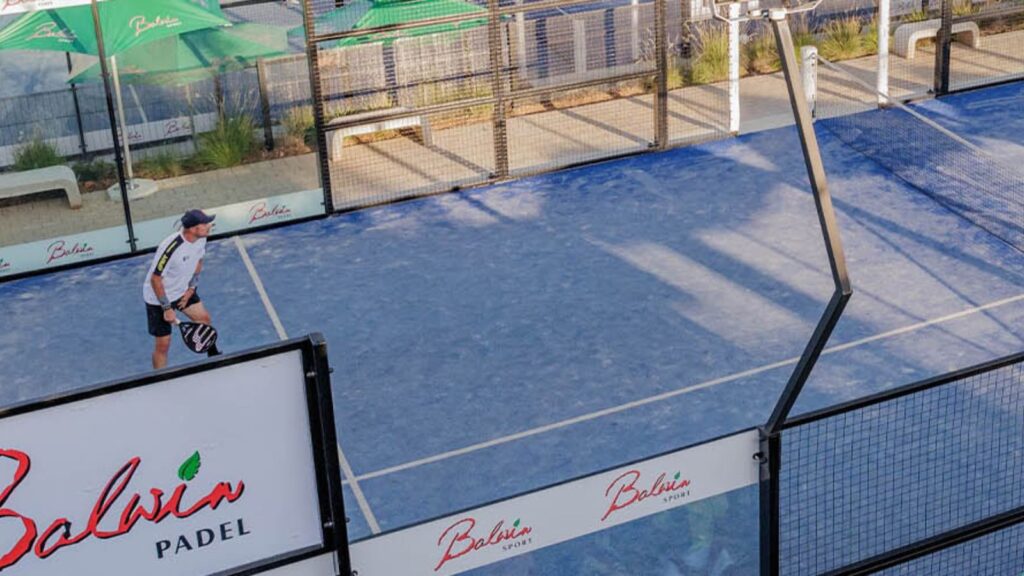
In its results for the year through February 2026, released on 11 May, Balwin described how it has benefited from the rising popularity of padel.
Balwin is South Africa’s leading residential property developer of large-scale sectional title estates with a focus on high-quality, environmentally efficient, and affordable apartments with an innovative lifestyle offering.
Over the past year, padel courts have emerged as an “exciting extension” of the group’s lifestyle offering, with Balwin saying it now has padel facilities available at six of its estates – with more in the pipeline.
In September 2025, the group opened its first indoor padel facility at Munyaka in Waterfall, Johannesburg, which has supported the company’s revenue growth.
The group said these courts have emerged as additional revenue streams, specifically highlighting its facilities at Thaba Eco Estate in Johannesburg, Munyaka, and Mooikloof Smart City in Tshwane.
Balwin said these facilities, alongside related padel retail sales, have demonstrated the group’s ability to identify and capture emerging lifestyle trends.
The company said further sports centres with padel facilities are planned for the new year.
These sports centres are planned for Izinga Eco Estate in KwaZulu-Natal, Mooikloof Smart City, and De Buurt in the Western Cape.
Emmett attributed the rising popularity of padel to its accessibility and the sport’s social components.
“A key factor in padel’s success is its low barrier to entry – it’s easy to learn, doesn’t require high technical skill at the outset, and is enjoyable for all fitness levels,” he said.
“The social element is another major draw, as padel is fundamentally a team sport, creating a dynamic, interactive experience.”
“Padel resonates with South Africans because it is a social, inclusive, and accessible sport that caters to players of all skill levels and backgrounds.”
According to data from Africa Padel, the sport attracts a broad range of players, with nearly equal participation between men and women.
It also shows strong engagement across age groups, particularly among people aged 35 to 44, followed closely by those aged 25 to 34 and 45 to 54.
“We anticipate that padel will continue expanding at both a grassroots and professional level, particularly as discussions around its potential inclusion in the Olympic Games gain momentum,” Emmett said.


Comments