Goodbye Western Cape – South Africa’s new luxury property hotspot


Limpopo’s premium residential market is rapidly expanding, driven by strong demand for higher-value homes, rising property prices, lifestyle buyers seeking scenic bushveld living, and limited supply in luxe estates and game farms.
This is according to Lightstone, which said the province’s high-end residential property market has emerged as one of the most dynamic sectors in South Africa’s real estate industry in recent years.
What used to be a region of holiday farms and small towns is now attracting young families, entrepreneurs, and remote workers, all looking for more space and better value.
Limpopo is South Africa’s northernmost province, and shares a border with Botswana, Zimbabwe, and Mozambique.
Named after the Limpopo River, it includes part of the Kruger National Park and its capital lies on the N1 highway, connecting Gauteng to Zimbabwe. It offers proximity to unrivalled natural landscapes with world-class game reserves.
“While Limpopo accounts for 10% of South Africa’s adult population, it lags when it comes to income,” said Lightstone Business Development Executive Esteani Marx.
The province has disproportionately more (13%) of South Africa’s households with income under R6,500 per month, and 9% of households earn between R6,500 and R9,000 per month, in line with its population average.
“It is in the upper income brackets where Limpopo fares less well, with just 5% of households in the R13,000-R68,000 bracket and only 2% of households earning above R68,000 a month.”
Lightstone explained that Limpopo’s economy is driven by mining and agriculture, and the importance of tourism is evident.
According to telemetry data, in December, there were 33% more vehicles on the province’s roads than in a month outside the holiday season, such as February.
Limpopo attracts high volumes of domestic travellers, notably visiting friends and relatives (VFRs) and nature/game reserve visitors.
The Kruger National Park alone receives upwards of 1.5 million visitors a year and often ranks highly for overnight trips and bed-nights in the domestic market.
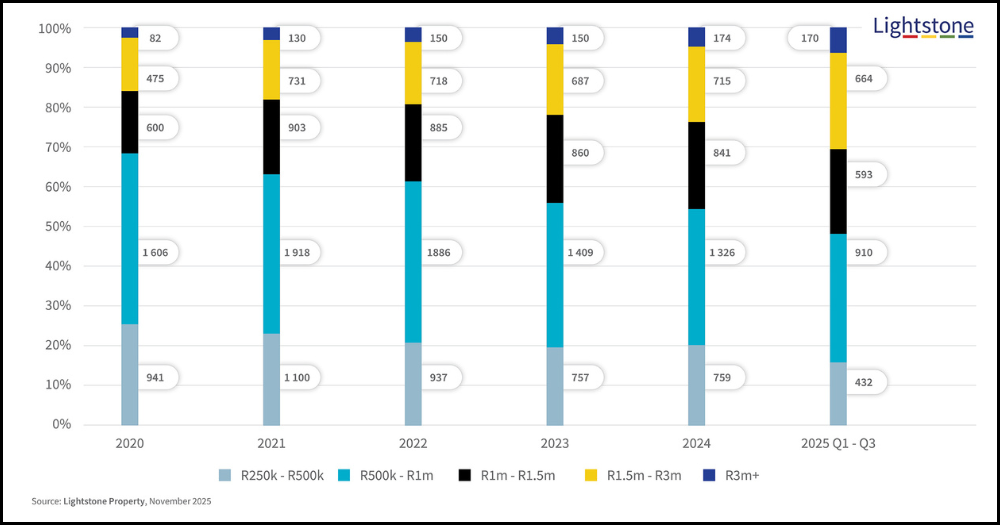
Lightstone’s 2025 data revealed that one-third of residential sales above R250,000 exceeded R1.5 million, compared to 15% in 2020. Sales below R250,000 are often subsidised transactions and have therefore been excluded.
Nationally, the share increased from 27% to 37%, so while Limpopo lags, its rate of improvement has outpaced the national change.
Estate Agents, banks and media reports all reinforce Lightstone’s data, which reveals strong demand for properties priced around R3 million and above.
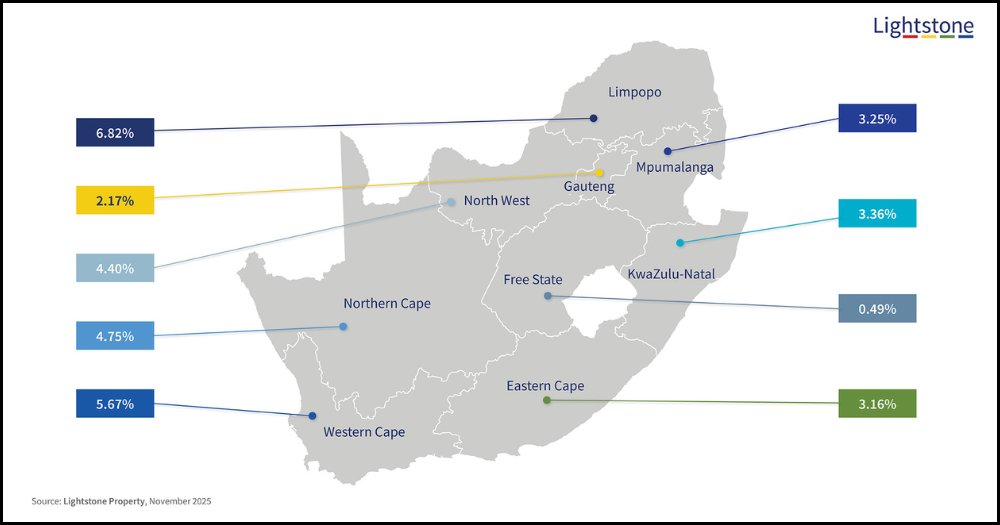
Factors driving the higher-value property sales
According to Lightstone’s HPI index, rising property price inflation is highest in Limpopo. As a result, homes that sold for R800,000 to R1 million just a few years ago now regularly exceed the R1.5 million mark.
Demand from lifestyle buyers for holiday or retirement homes in Limpopo’s scenic, bushveld locations and wildlife Estates is creating pressure on prices of higher-value properties in areas like Hoedspruit and game farm Estates.
Foreign investors are buying lodges, Estates, and game farms, as are older local buyers (50-65+ years, retirees) with the resources to pay more for the lifestyle they want.
Lightstone noted that improving infrastructure and connectivity will further boost confidence in the province’s property market.
Planned or promised projects, such as the Limpopo-Gauteng high-speed train link, will open new lifestyle opportunities for people to live in semi-rural areas while having access to urban job markets.
Tight supply and under-development have created a shortage of good stock in quality, higher-end properties in estates, game farms, and security estates.
Strong economic pull from mining, agriculture and tourism also creates jobs and attracts people, which increases demand for housing.
Lightstone added that rental market activity has strengthened in Limpopo by 10-12%+ in some quarters, which is driving demand in the buy‐to-let market.
High-value properties boom
Lightstone explained that the proportion of higher-priced sales in Limpopo has increased over time. Between 2020 and 2024, there was a steady decline in the number of properties sold for under R1 million.
Of the five full years being reviewed, all price bands, except those above R3 million, recorded their best years in 2021, as Covid helped push buyers out of the main cities.
The R1 million to R1.5 million bands have been reasonably consistent since then, while the R1.5 million to R3 million and R3 million+ bands have increased in number over the years.
Media reports and local broker data indicate significant growth in the upper-end market (R3 million and above) in some areas of Limpopo.
This is driven by game-estate and farm sales, as well as holiday and retirement buyers, and constrained formal stock. Key features of this market include:
- Geographic concentration: The above R3 million growth is strongest in tourism and Estate areas. The top five towns include Polokwane, Hoedspruit, Bela-Bela, Tzaneen and Greater Tzaneen, as well as where farms and game farms trade.
- Product mix: Game farms, wildlife estate plots, and larger farming stands (some converted to lodges) account for outsized value per transaction, and just a few of these sales can shift averages and the count of deals above R3 million.
- Older, wealthier buyers are more active in this segment.
- Supply constraints: Lightstone and local estate agents have highlighted limited formal stock in value segments, and when supply is thin, prices and share of high-value transactions rise.
- Increased popularity of estate living: Estates account for just under 60% of sales above R3 million (see graph below), and this is above the national average of 40%.
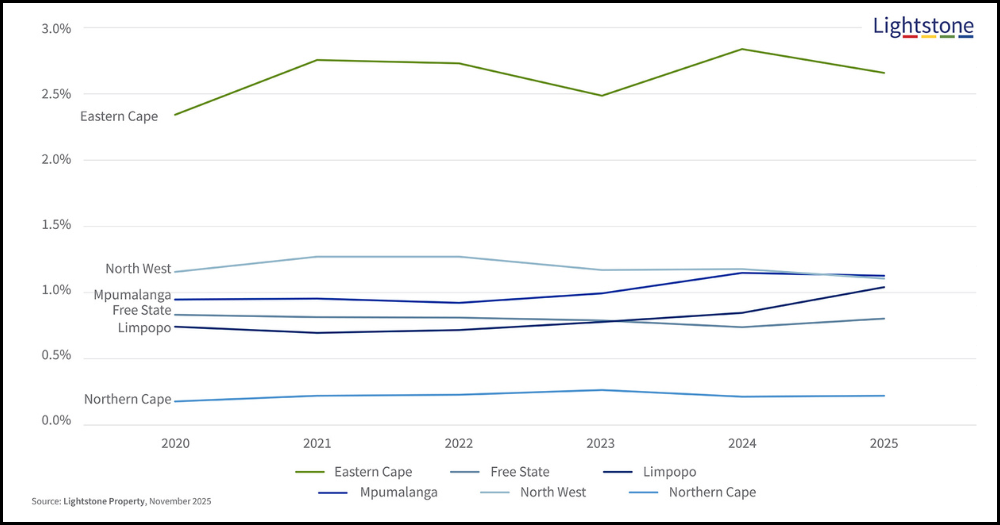
The proportion of sales above R3 million is on the rise in Limpopo, which is the star performer among provinces outside the big three, namely Gauteng, Western Cape, and KwaZulu-Natal.
While volumes are lower than in the Eastern Cape, in particular, they are rising in Limpopo and either dropping or remaining flat in the other four provinces.





Comments