Two men cost South Africa 50,000 jobs


South Africa’s mining sector has lost 47,000 jobs over the past two decades as policy uncertainty and poor service delivery crush the industry.
Historically the backbone of South Africa’s economy, the mining sector has seen its output stagnate and decline in the three decades under ANC rule.
This has culminated in the industry effectively being hollowed out and a shell of its former self. The country is now among the ten worst mining jurisdictions to do business in.
The Institute for Race Relations (IRR) recently conducted research on the collapse of South Africa’s mining sector as part of its Free Facts campaign.
Its research revealed an industry that is thousands of jobs and billions of rands lighter after decades of decline and mismanagement.
South Africa’s mining industry has been beset by policy uncertainty, strained labour relations, and declining investment since the ANC rose to power in 1994.
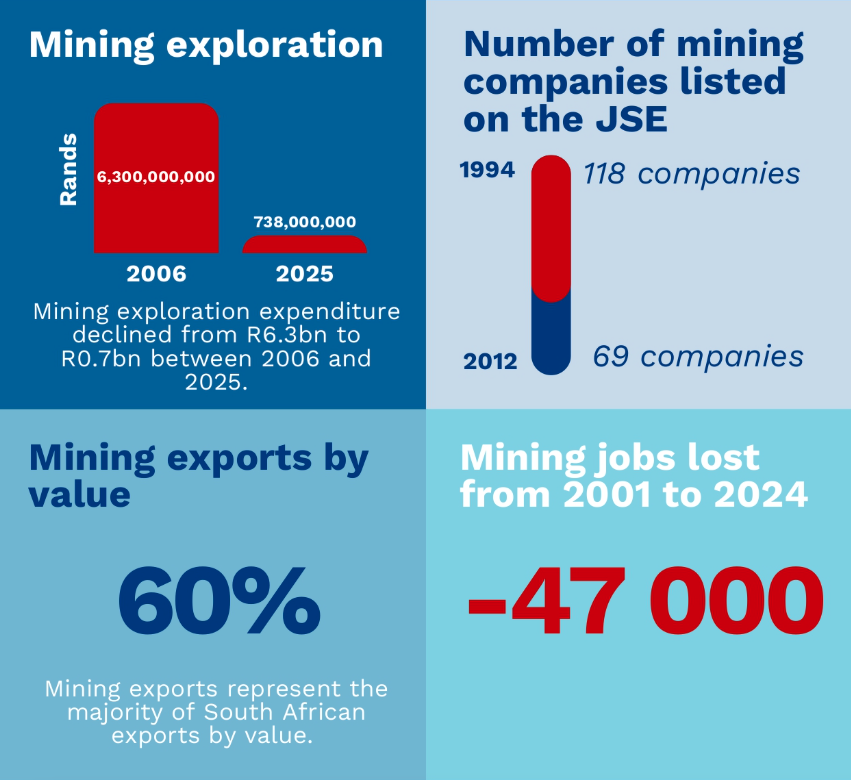
As a way of showing the decline of the sector, the IRR pointed out that in 1994, there were 118 mining companies listed on the JSE.
By 2012, this had fallen to 69, and as of the end of 2025, only 39 mining companies are listed on the exchange, which was historically dominated by resource giants.
As the local environment became increasingly difficult to operate in, South African miners looked overseas for opportunities.
This was coupled with increasing demand and prices for metals and minerals of the future, such as copper, cobalt, and now rare earths.
These are predominantly found outside of South Africa, which remains heavily exposed to precious metals, chrome, and manganese.
Mining exploration investment has plunged from R6.3 billion in 2006 to R0.7 billion in 2025. This means companies are no longer searching for minerals and metals in South Africa.
This does not mean there are no resources in the country, as South Africa’s share of global reserves remains high. South Africa has 88% of platinum group metal resources, 80% of manganese, and 72% of chromite.
Jobs bloodbath
Data compiled by the Centre for Risk Analysis shows that the industry lost 47,000 jobs between 2001 and 2024.
This excludes the number of indirect jobs supported by the industry, whether it be through equipment, machinery, basic services, or local town economies near mining operations.
Some estimates of the total number of jobs lost, including indirect employment, range up to 500,000. However, this is hard to calculate for certain.
IRR strategic engagements manager Makona Maja said that the government is to blame for these job losses and the billions of rands in investments that flowed elsewhere.
“Poor policy choices such as the nationalisation of mining rights, the regulatory maze of licensing, race-based legislation and the discretion granted to the mining minister, engender uncertainty, cause delays and create inefficiencies,” Maja said.
“As the job losses show, it is South Africans who bear the brunt of these failings, while politicians continue down this path.”
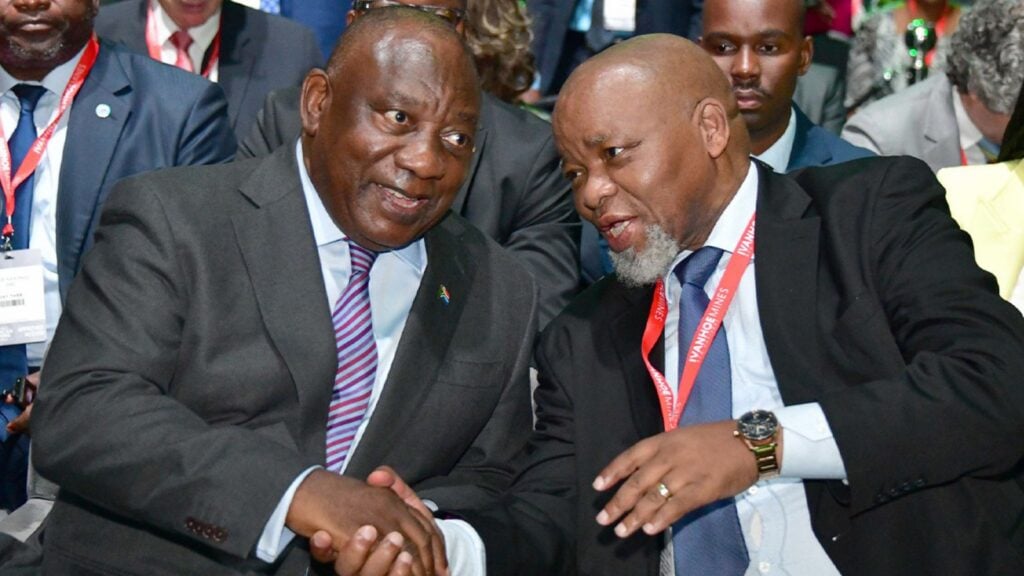
Maja’s critique is similar to that of Modern Corporate Solutions mining analyst Peter Major, who said the blame lies at the feet of President Cyril Ramaphosa and Minister Gwede Mantashe.
Major explained that Mantashe and Ramaphosa have had the opportunity to listen to the industry’s concerns and contribute to a resurgence in local mining.
“He just ignored the entire panel before him, which outlined all of the challenges the mining industry is facing in South Africa,” Major said after the most recent Johannesburg Mining Indaba.
“That was the perfect opportunity for Gwede to rise to the occasion, instead of totally ignoring it and those people who were making a really good contribution.”
Major explained that Ramaphosa and Mantashe have played a major role in the hundreds of thousands of miners who have lost their jobs over the past few decades.
“It would have been so easy to show some concern for the 450,000 gold miners that he and Ramaphosa have helped to lay off and for probably another 100,000 miners in other sectors,” Major said.
“These people have been laid off unnecessarily. But, he does not seem to care about those people and will not address the industry’s concerns.”





Comments