Reality sets in for South Africa


South African investors and asset managers are beginning to take a more cautious view on local assets as attention shifts from optimism and hope towards fundamentals.
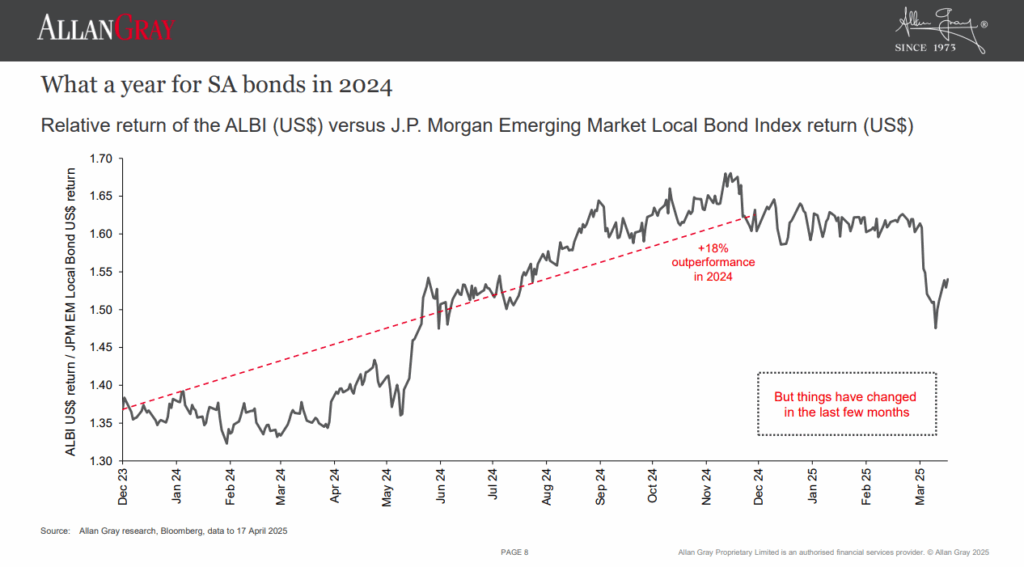
The optimism and hope created by the formation of the Government of National Unity (GNU) saw South African assets, both stocks and equities, appreciate significantly since June 2024.
However, more recently, this upward momentum has stagnated as the focus shifts to tangible GNU outcomes, particularly the pace of reforms in South Africa.
This is feedback from Allan Gray’s chief investment officer, Duncan Artus, who outlined some of the market trends the asset manager is monitoring closely.
Artus was speaking at the company’s The Times investment update, where an overview is provided of the past quarter regarding market fluctuations and how Allan Gray is investing clients’ money.
One of the points made by Artus and the Allan Gray team is the impact of volatility and uncertainty on investor behaviour, with many choosing to follow the herd in search of safety.
This, almost always, results in negative investment outcomes, with irrational and emotional decisions being made due to short-term fluctuations.
However, Artus said the impact of herd mentality works both ways, with investors also choosing to follow optimism and positivity when they should be more sceptical.
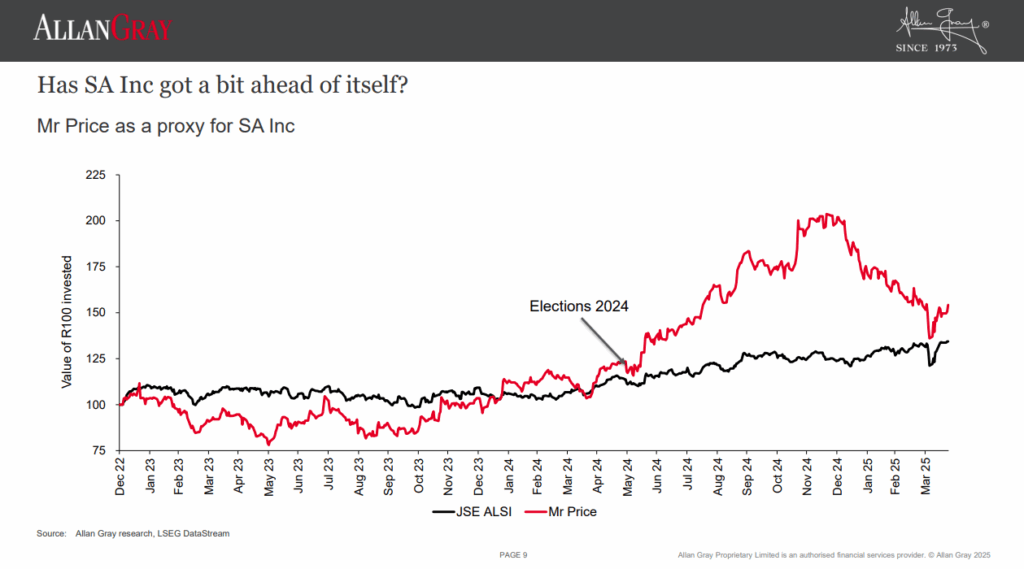
A classic case is the post-GNU rally in South African bonds and equities, which rapidly appreciated from June 2024 until the end of January.
Artus said that the GNU is a business-friendly coalition and has sent positive signals regarding reform, economic growth, and government finances.
While this is true, the rise in value of South African stocks and bonds was detached from improvements in the fundamentals of companies and the country’s economy.
Markets, being forward-looking, are pricing in improved economic growth and thus increased earnings for companies.
The reality is that hard, economic data does not indicate any improvement in this regard so far, with economic growth forecasts being revised down and little evidence of enhanced reform.
As a result, investors are beginning to once again examine the fundamentals of local companies and bonds, shifting their investment preferences slightly.
This has translated into relatively flat performance for companies heavily exposed to South Africa in the past few months and minimal appreciation in bond values.
Cautious approach
Artus explained that this indicates that reality has now set in for investors in South Africa, who are adopting a more cautious approach to investing in local companies.
Stocks and bonds had appreciated on nothing more than optimism and emotion. Now that the Budget has been unveiled and difficult compromises made, the reality has set in.
The portfolio managers of Coronation’s flagship Top 20 fund have similar sentiments to Artus regarding the local equity market.
Neville Chester, Nic Stein, and Nicholas Hops explained that they have been managing the fund on a more cautious basis for some time.
This means that they tried to avoid getting caught up in the GNU rally last year, which saw SA-specific stocks rally hard in the hope of improved economic growth.
“We were sceptical that such growth would filter through, and that what would come through would take much longer, given the frictions inherent in the system,” they said.
On top of this, a central bank which persists in running very tight monetary policy with some of the highest real rates in the world meant that we were always unlikely to see the 2% GDP growth that many market participants were forecasting.
This positioning proved to be beneficial for the fund, with the saga surrounding the local Budget and other pieces of legislation shaking the GNU.
As a result, there was a sharp sell-off in SA-specific assets, with equities, bonds, and the rand all weakening.
The fact that this happened in the midst of a global risk-off period due to the imposition of tariffs on the rest of the world by the US just added to the selling pressure.
This exemplifies the importance of not building a portfolio around a specific view or outcome, with multiple outcomes always being possible.
 Loading ...





Comments