South African investors warned about the Magnificent 7


South African investors with exposure to America’s biggest technology companies face growing risks as political changes threaten the incentives and infrastructure behind the artificial intelligence boom.
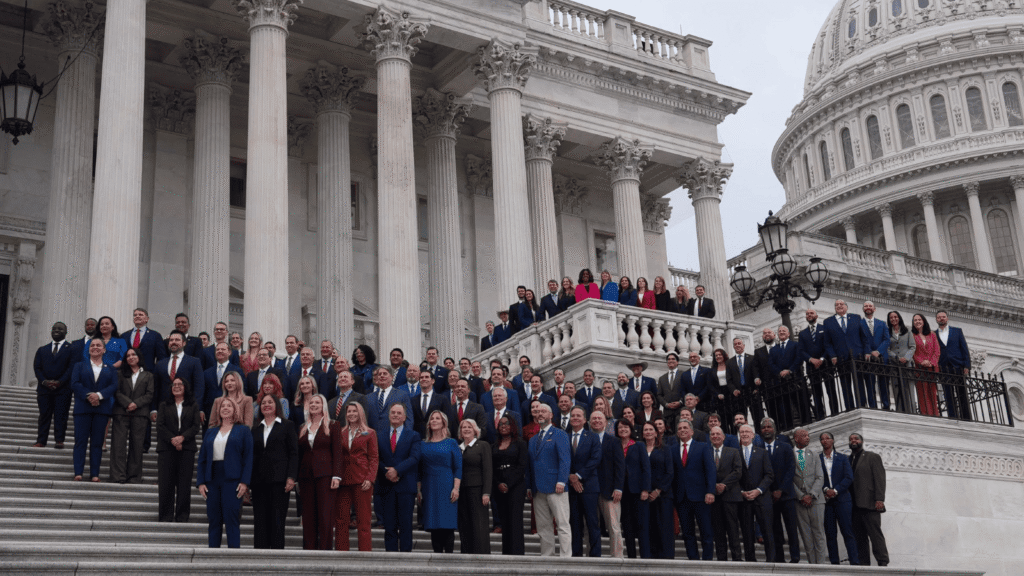
The warning comes from Efficient Wealth, which said the Democratic Party’s strong performance in the November 2026 United States midterm elections could affect the future growth prospects of major technology companies.
The so-called Magnificent Seven – Apple, Microsoft, Nvidia, Amazon, Tesla, Meta and Alphabet – have been among the biggest beneficiaries of the AI investment boom.
However, their share prices have come under pressure as investors question whether the companies can generate sufficient returns from their substantial AI spending.
Efficient Wealth explained that changes to United States tax incentives and restrictions on data-centre development could add another risk.
This is because it could make large technology investments more expensive or delay the time until they begin generating returns.
Following the November 3 midterm elections, the Democrats won control of both the House of Representatives and Senate. However, President Donald Trump and the Republicans remain in control of the White House.
This creates the possibility of greater political resistance to some of the policies that encouraged private investment under the Republican-controlled Congress.
In 2025, Republicans passed tax legislation that restored immediate deductions for domestic research spending and permanent full first-year deductions for qualifying assets.
These provisions improve companies’ cash flow when they invest in research, equipment and infrastructure.
Efficient Wealth explained that they can also make projects that would otherwise be marginal financially viable.
A 2024 research review estimated that the 2017 United States corporate tax reforms increased tangible corporate investment by approximately 11%.
However, Democratic lawmakers have proposed measures that could reduce some of these incentives.
For example, Democratic Senator Ron Wyden has proposed an excise tax on data centres and the withdrawal of certain investment incentives. These proposals would require legislation, and Trump retains his presidential veto.
Even so, the change in congressional control gives Democrats greater political influence over the debate.
The concern for technology investors is that higher taxes or less favourable investment rules could reduce the expected returns from building AI infrastructure.
Efficient Wealth also pointed to the election of Democrat Gina Hinojosa as Texas governor.
Hinojosa has called for a moratorium on new data-centre approvals until the state legislature introduces further protections for communities.
This could extend restrictions already imposed under outgoing Republican Governor Greg Abbott.
Texas is an important location for data-centre development. Uncertainty over permits, electricity supply and water requirements could therefore affect the timing and cost of projects.
Why this matters for the Magnificent Seven

The Magnificent Seven companies are investing heavily in AI infrastructure, including data centres, specialised chips and cloud computing capacity.
Their ability to earn returns from these investments depends partly on whether they can build infrastructure quickly enough to meet demand and generate sufficient revenue from the services it supports.
Restrictions on new data centres could delay projects and increase costs. Higher taxes could also reduce the financial benefits of investing in new infrastructure.
Efficient Wealth warned that these changes could affect future growth, even if the broader United States economy continues to expand.
The investment risks are already evident in the group’s recent share price performance.
On 30 October, Yahoo Finance reported that Meta and Alphabet were more than 20% below their 52-week highs. Tesla was down 19.2%, Amazon 15.1% and Nvidia 12.2%.
The declines followed concerns about pressure on free cash flow after several companies reported aggressive AI spending.
Investors were also questioning whether hyperscalers would eventually need to reduce capital expenditure.
The pressure intensified after the midterm elections. The S&P 500 rose on November 4, but fell by more than 4% the following day. The Nasdaq dropped more than 5%.
TheStreet reported that the Nasdaq’s decline on November 5 left the technology-heavy index in correction territory.
Investors were reassessing the potential impact of political changes on data-centre development and AI investment.
The Magnificent Seven are no longer moving together
The recent performance of the group also shows why investors should not treat the Magnificent Seven as a single investment.
In October, CNBC reported that the average correlation between the seven companies’ share-price movements had fallen to its lowest level in more than a decade.
The companies have different exposure to AI and different sources of earnings growth.
Microsoft’s cloud business, Azure, is an important growth driver. Amazon’s AWS and Alphabet’s Google Cloud are also competing for demand for AI computing capacity.
Nvidia’s prospects are closely linked to demand for its chips, while Meta is investing in AI applications and infrastructure.
Tesla’s investment case increasingly includes robotics and autonomous vehicles, alongside its electric vehicle business.
Apple has a different exposure. Its earnings are more closely linked to hardware sales and services than to large-scale data-centre construction.
This has affected how investors view the company. Zacks reported on November 9 that Apple had gained more than 27% in 2026, while several other Magnificent Seven shares had delivered weaker returns.
The company has also benefited from its relatively strong cash position and lower exposure to the infrastructure spending driving much of the AI boom.
The divergence suggests that company-specific performance and spending decisions may become increasingly important when assessing the group.
Message for South African investors
For South Africans with offshore investments, the political and regulatory uncertainty in the United States could affect the value of their portfolios.
The Magnificent Seven companies have significant influence over major United States market indices.
Their share price movements can therefore affect investors who hold broad-market funds, technology-focused ETFs, or other offshore investments with substantial exposure to these companies.
Efficient Wealth warned that investors should look beyond the immediate market reaction to the election.
A proposed tax or restriction does not necessarily become law. The decline in technology shares also reflected crowded investment positions and funds unwinding trades, rather than political developments alone.
However, policy uncertainty can affect investment decisions before legislation is passed. Companies may delay projects if they cannot predict the costs, approval timelines or potential returns.
Efficient Wealth stressed that the longer-term risk is not limited to existing companies losing value. Projects that are never built and competitors that never get started can also reduce future economic growth.
This means the outlook for the Magnificent Seven will depend not only on demand for AI, but also on the cost and regulatory environment in which these companies operate.
Login or register for unlimited free access.