The South African income fund that you need R10 million to invest in has outperformed its benchmark for 24 years



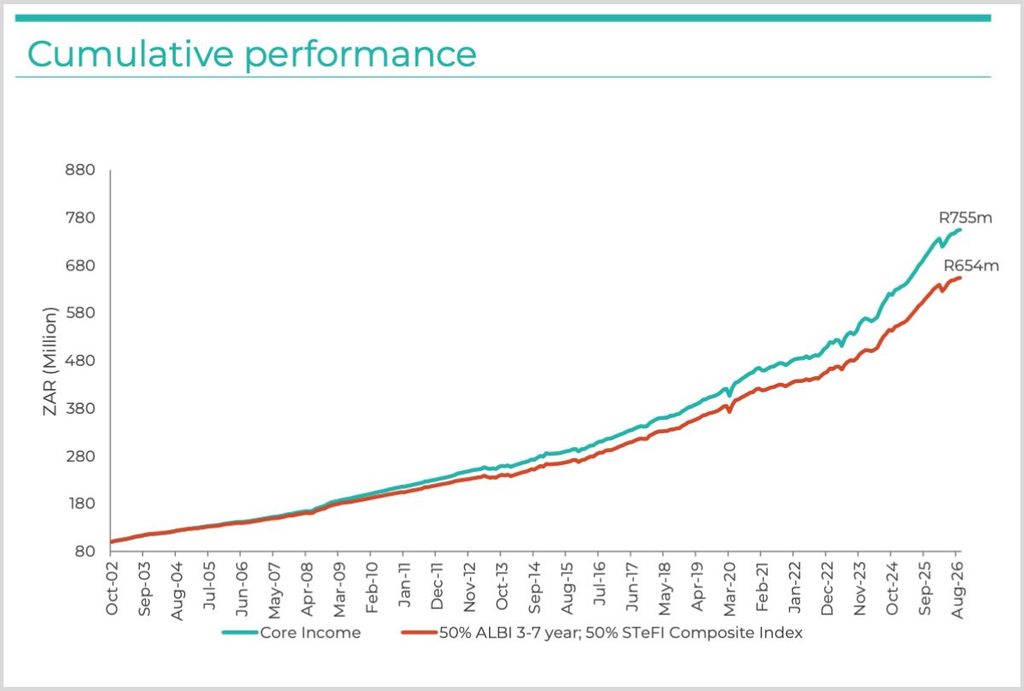
Futuregrowth Asset Management’s Core Income Composite has outperformed its benchmark since its inception in 2002.
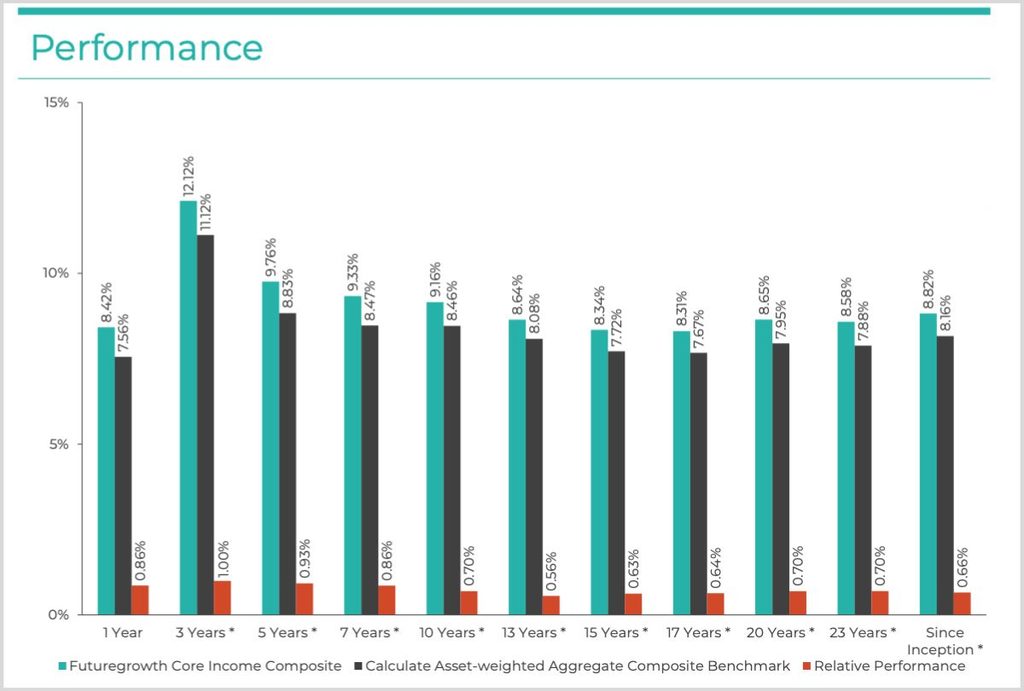
The fund has also outperformed its benchmark over a 23-, 17-, 15-, 13-, 10-, 7-, 5-, 3-, and 1-year period.
Currently overseen by Futuregrowth portfolio manager Rhandzo Mukansi, this fund has total composite assets of R2.7 billion.
Futuregrowth was founded in 1994 as an empowerment and developmental product within a firm named Southern Life, which was backed by Anglo American.
It initially had a small suite of investment funds focused on social development and empowerment, making it the first socially oriented fund launched in South Africa.
“Our reason to exist was to concurrently serve investors and play a meaningful role in South Africa’s transition into a successful post-apartheid nation,” the firm explains on its website.
The company explained that, when it was first launched, many investors were under the impression that it was impossible to make returns from social development investments.
“There was a huge amount of nervousness around the risks of doing business with entities and individuals in areas that had previously been excluded from the mainstream apartheid economy,” it said.
In 1998, the firm’s parent company, Southern Life, was acquired by FirstRand, which folded Futuregrowth into its banking group.
Two years later, FirstRand transformed Futuregrowth into an independent financial services company.
The firm continued to grow, and in 2002, Women’s Investment Portfolio Holdings (WIPHOLD) acquired a 40% equity stake in the business.
At the same time, 20% was transferred to an Employee Share Option Scheme, while FirstRand retained the remaining 40% stake.
In 2005, WIPHOLD increased its shareholding to 70%, while employees held the remaining 30% through the share option scheme.
Three years later, Futuregrowth was bought out by Old Mutual Investment Group, which acquired WIPHOLD’s entire shareholding.
While Old Mutual sold a 21.2% stake to African Women Chartered Accountants Investment Holdings in 2022, it has retained the majority interest in Futuregrowth ever since.
Today, Futuregrowth oversees R244 billion in assets under management and has grown into one of South Africa’s top asset managers.
Futuregrowth’s Core Income Composite
Futuregrowth’s Core Income Composite aims to deliver excess return through a combination of different methods.
This includes interest-bearing asset allocation, active interest-rate risk management, appropriate yield-curve positioning, and moderate exposure to higher-yielding non-government bonds.
“Our yield-enhanced strategy relies on maintaining strong relationships with market players,” the firm explains on its website.
“This allows us to see a large degree of deal flow on a continuous basis and keep an eye on ever-evolving credit events in the market.”
The Core Income Composite was launched in November 2002, and it requires a minimum investment of R10 million for a pooled option or R100 million for a segregated option.
It invests in a wide range of fixed-rate, variable-rate, and inflation-linked bonds issued by the South African government, state-owned enterprises, and the corporate sector.
Its benchmark is 50% of the South African STeFI Call Index and 50% of the 3-7 Years All Bond Index. It aims to outperform this benchmark over a rolling three-year period.
The fund’s latest minimum disclosure document for September 2026 revealed that it had total composite assets of R2.7 billion.
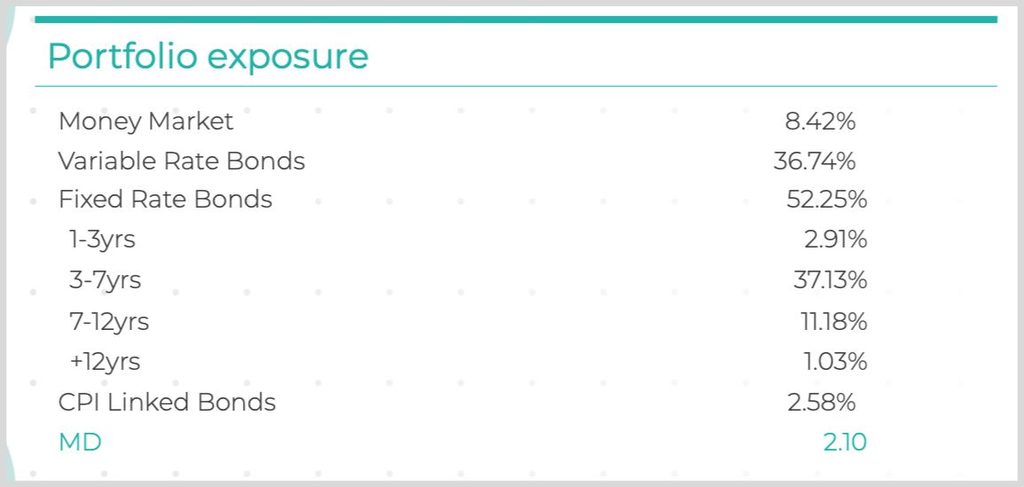
This document also revealed that the fund’s largest holding is fixed-rate bonds, which account for 52.25% of the portfolio.
This is followed by 3-7-year bonds at 37.13%, variable-rate bonds at 36.74%, and 7-12-year bonds at 11.18%.
Since its inception in 2002, Futuregrowth’s Core Income Composite has outperformed its benchmark, returning 8.82% versus 8.16%.
The fund has also beaten its benchmark over a 23-year period, delivering 8.58% versus 7.88%.
The performance of Futuregrowth’s Core Income Composite against its benchmark across multiple time periods is shown in the graph below.
Login or register for unlimited free access.