Johannesburg to pay back R14 million in traffic fines, and Apple’s AI secret revealed



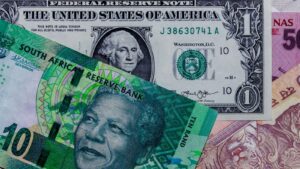
On Saturday, 21 November, the rand weakened to R17.54 against the dollar, R19.23 against the euro and R22.95 against the pound.
It was around 3.6% weaker against the dollar over the week, as the US currency strengthened on expectations of higher interest rates.
South Africa’s 10-year government bond yield ended the week around 8.78%, slightly higher despite a rally on Thursday.
The South African Reserve Bank kept the repo rate at 7.25%, although three of the seven Monetary Policy Committee members favoured a 25-basis-point increase.
This followed an increase in annual inflation to 5.2% in October, from 4.5% previously. The Bank reaffirmed its 3% inflation target.
The US 10-year Treasury yield fell to around 5.09%, from 5.16% a week earlier. Markets were pricing in a roughly 90% chance of a Federal Reserve rate increase in December.
Germany’s 10-year Bund yield rose to 3.41%, while the UK equivalent reached 5.32%.
US equities recorded a sixth consecutive day of losses on Thursday. The S&P 500 fell 2.02% to 7,175.89, while the Nasdaq Composite declined 2.25% and the Dow Jones dropped 2.19% to 49,097.
The technology-heavy Nasdaq was particularly weak as investors continued to reassess artificial intelligence-related valuations and investment spending. The VIX volatility index approached 28.
Asian markets also recorded substantial losses on Friday. South Korea’s KOSPI fell 4.5% to 4,906, while Japan’s Nikkei declined 4.41% to 56,820.
The MSCI Asia Pacific index was down 3.05%. European markets were weaker, with the Euro Stoxx 50 falling 0.97% and the FTSE 100 declining 0.93%.
The JSE All Share Index fell 0.33% to 106,216, reaching a fresh 52-week low. Gold and platinum shares weighed on the local market.
Gold fell to around $3,552 an ounce, its lowest level in 52 weeks, as a stronger dollar and expectations of higher US interest rates pressured the metal.
Platinum traded around $1,347 an ounce, down approximately 18% over the month, while palladium had fallen around 17%.
Brent crude traded near $92.53 a barrel and was heading for a third consecutive weekly decline. Ample supply, softer demand and the stronger dollar continued to weigh on prices.
The market weakness comes as investors assess the possibility of the Federal Reserve raising interest rates, with equity markets already under pressure.
Such moves have been uncommon historically. Previous tightening cycles in 1994, 1999–2000, and 2018 show that higher rates can put pressure on equities, particularly when valuations are elevated, or companies rely heavily on external funding.
The current concern extends to the financing behind artificial intelligence investment.
Companies with strong cash flows and balance sheets may be better positioned to manage higher borrowing costs, while businesses dependent on continued access to capital could face greater pressure.
However, a market sell-off does not necessarily mean equities cannot recover before the final rate increase.
Important finance and investing news

Joburg paying back R14 million in traffic fines: The Road Traffic Infringement Agency has announced in its 2025/26 annual report that over R14 million in traffic fines and related fees must be refunded to motorists. This refund is due because payments were collected for Administrative Adjudication of Road Traffic Offences notices that were not properly served. [SABC News]
Apple’s AI secret: Apple removed a job listing suggesting it was developing its own AI agent. The listing described an AI capable of tasks such as browsing the web and writing code. Mark Gurman at Bloomberg noted that this is typical of Apple when it reveals too much information. [Yahoo Finance]
Essential medication shipments delayed: Persistent congestion at Durban Port is causing nationwide delays, leaving 30 shipments of essential medicines trapped and raising fears of hospital shortages. [eNCA]
Court rules on automatic tips: The National Consumer Tribunal has ruled that a restaurant’s automatic 10% service charge violates the Consumer Protection Act. [EWN]
Breakthroughs for big pharma: Artificial intelligence has expedited early-stage drug development at some of the world’s largest pharmaceutical companies this year, cutting the time required to produce new molecules and move them into clinical trials by as much as half. [Reuters]
Login or register for unlimited free access.