WeBuyCars kisses R8.57 billion goodbye


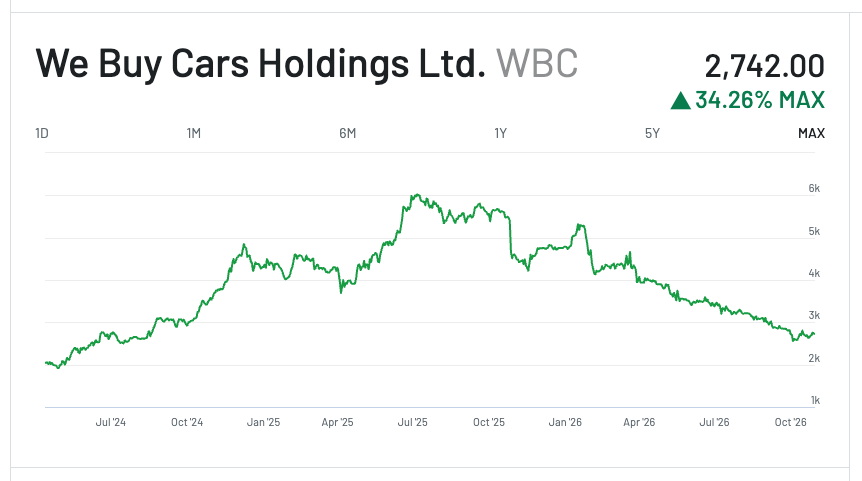
WeBuyCars has fallen out of favour with investors, with the JSE-listed company’s share price down 42.79% year-to-date.
This decline equates to a loss in market value of R8.62 billion, with shareholders feeling the pain of a company struggling to adapt to the rise of affordable Chinese cars.
The lower prices offered for new Chinese vehicles have lured away traditional secondhand car buyers and forced other carmakers to adapt.
As such, prices have fallen across the board, squeezing WeBuyCars’ margins as it battles to keep market share and move its stock.
This is a far cry from the unfettered growth that the company enjoyed in recent years, with it going from strength to strength until recently.
An analysis from Coronation earlier this year showed that WeBuyCars had the fastest organic growth of any South African business on the JSE from 2019 to 2025.
Its organic growth outpaced Shoprite, Boxer, and even Johann Rupert’s Richemont.
While it was off a low base, WeBuyCars also operates in a stagnant economy and a high-stigma market. Growing a physical business by 30% annually is a tough ask.
This pushed WeBuyCars’ valuation through the roof, with it catching the eye of Transaction Capital in 2020.
Transaction Capital snapped up 49.9% of the company for R1.8 billion and would later buy a further 25% for R1.6 billion.
After the parent company ran into severe financial challenges, WeBuyCars was unbundled to raise cash and listed separately on the JSE.
The company closed its first session on the JSE on 11 April 2024 with a market capitalisation of R8.5 billion.
This valuation would soar as WeBuyCars’ strong growth continued, as South African consumers came under pressure amid elevated inflation and interest rates.
It reached a peak market capitalisation of R24.24 billion towards the end of 2025, with it being one of the best-performing shares on the JSE.
Chinese cars ruin the party
All the while WeBuyCars was enjoying unfettered growth, new Chinese brands were taking over the new car market in South Africa.
Initially, this was not seen as a threat to WeBuyCars, as it had no exposure to this market and would be able to capitalise as Chinese cars entered the secondhand market.
However, towards the end of 2025 and in early 2026, it became clear that new Chinese cars were being offered at such low prices that they were competing directly with secondhand sellers.
Given the choice between a new Chinese car packed with features and a secondhand vehicle, South Africans began opting for new cars.
Combined with lower inflation and interest rates, new cars were becoming more affordable, and WeBuyCars had to adapt.
Data from Standard Bank showed that young South Africans who traditionally bought secondhand vehicles are increasingly buying new Chinese vehicles.
Standard Bank said young buyers are actively choosing new Chinese vehicles over used cars from traditional brands to access new technology and high-spec cars at a lower price point.
Across young South Africans, financed purchases of Chinese cars grew by 423% between 2021 and 2025. They now represent 11% of all vehicles bought by under-35s.
The bank pointed out that young South Africans can get a Chery Tiggo 4 Pro on a financed deal of R312,000 with a monthly repayment of R5,867, without a balloon payment.
This is competitive with used-car prices, particularly given the high-spec models offered by Chery and other Chinese brands.
WeBuyCars responded by adjusting its pricing strategy. Effectively, it cut prices and took a hit on its margins to maintain its sales volumes.
The company revealed that this also enabled it to gain market share from its peers, which would be extremely valuable once the cycle turned.
WeBuyCars said it expects the rise of Chinese cars to become a long-term growth driver for the company as these cars filter into the secondhand market.
This will enable WeBuyCars to compete on a more comparable basis with new Chinese vehicles and expand its overall pipeline of used cars.
However, as some Chinese models enter the secondhand market, it has become clear that they might boost WeBuyCars’ sales, but they will not address its margin pressure.
TopAuto reported that CMH’s data show that Chinese cars entering the used-car market have experienced severe depreciation.
CMH said that owners selling their Chinese cars are discovering that the depreciation on their cars is far more than expected.
“The influx of Chinese/Asian brands that were introduced into the market at discount prices some four to five years ago is now at the recycle stage,” CMH said.
“However, the sharp depreciation in value of these vehicles has surprised owners and forced them to hold on for longer, until the trade-in values align with the residual amounts owed to banks.”
This keeps prices low in the secondhand market and has prevented the anticipated influx of stock of Chinese cars to WeBuyCars from happening.






Conversation
1 commentsThe only way for them to survive is to offer lower prices on cars and sell them at lower prices.