Dis-Chem goes from hero to zero


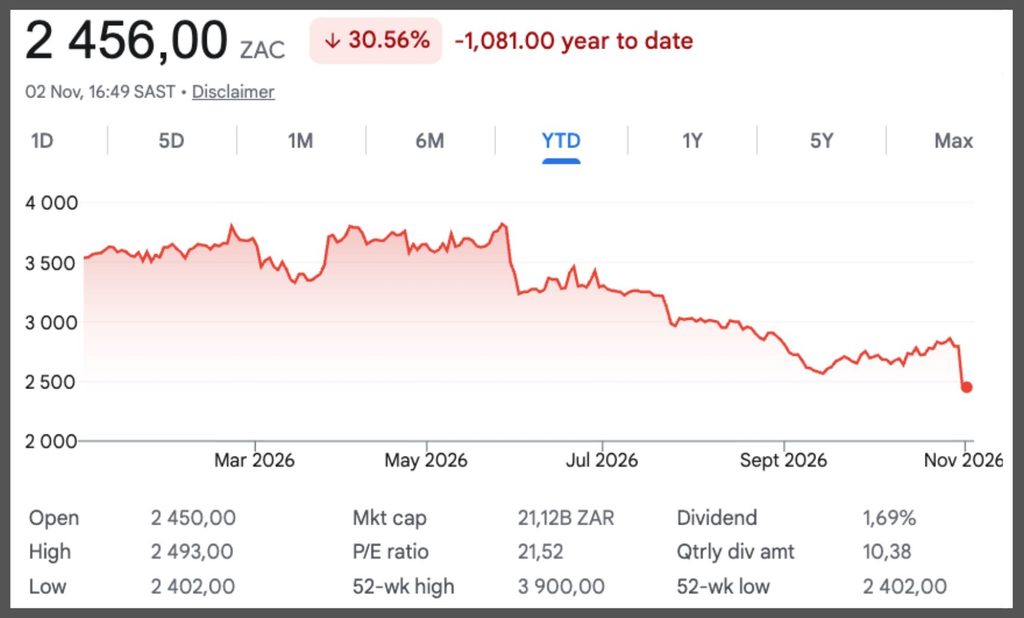
Dis-Chem’s shares fell by 12.45% the day after it released its interim results, extending its year-to-date decline to 30.6%.
This came after the company’s shares rallied in October 2025 following the launch of its overhauled Better Rewards loyalty programme.
Analysts believe that while the retailer saw impressive market share gains from this revamped programme, it came at too high a cost.
This is because Dis-Chem’s results for the first half of its 2027 financial year revealed strong top-line growth, but earnings came under pressure.
Its revenue grew by 8% to R22.97 billion, but interim profit was down 12% to R580.58 million.
While its total income margin rose to 31.4%, Dis-Chem’s earnings per share declined by 13.3%.
The company also recorded strong market share gains in its core focus areas, with its slice of the healthcare and medical market growing to 45.1%.
Dis-Chem CEO Rui Morais explained that this outcome was strategic, with the retailer having front-loaded many of its biggest investments for the year in the first half.
Major investments in the six-month period included IT advancements, store roll-outs, and its Better Rewards loyalty programmes.
Dis-Chem attributed much of its growth to the loyalty programme, which grew its customer base by 27% to 8.2 million members.
The programme passed R1.5 billion in value back to customers through discounts in the first half of the year.
This saw Dis-Chem’s front-shop volume grow by 5.5%, outpacing the total market’s 0.1% growth.
“The revenue growth, market share gains, and improved retail total income margin highlight the sustainability of the Better Rewards program,” Dis-Chem said in its results.
“The Better Rewards programme serves the dual purpose of supporting business growth while offering customers value at the till as they remain constrained due to the current economic climate.”
However, this was not enough to win over investors. Dis-Chem released its interim results near market close on Thursday, 29 October, and on Friday, 30 October, its share price plummeted.
Dis-Chem shares slid 12.45% on Friday. While it recovered somewhat (0.8%) on Monday, 2 November, the retailer’s stock remains down 30.6% in 2026 to date.
Analyst opinion
Benguela Global Fund Managers’ head of research, Victor Seanie, told BusinessDayTV that Dis-Chem’s results were a classic case of “revenue is vanity and profit is sanity”.
He explained that Dis-Chem’s revenue growth was impressive, at 8%, nearly double the top-line growth of its main competitor, Clicks, over the same period.
However, while Clicks’ profit remained flat in the six months through August 2026, Dis-Chem’s declined by 12%.
“Profit is that ‘sanity factor’, and Clicks’ cash flow is superior to Dis-Chem’s and it has a stronger balance sheet,” he said.
“I think investors were disappointed by the bottom-line figure that they saw, and if we look at their free cash flow, it was weaker at the same time.”
“We see a lot of outflow of working capital that wasn’t managed that well, but these are things that have been the story of the game since the company was listed.”
Seanie said that while Dis-Chem’s market share gains were also positive, they came at too high a cost.
In the same interview, Merchant West Investments equity analyst Bianca Lakha said Dis-Chem’s substantial share price drop reflected investors’ reaction to various factors.
She said it is important to remember that, when Dis-Chem first announced its overhauled Better Rewards loyalty programme, its shares rallied.
At the same time, Clicks’ share price plunged in response to the news. Lakha said the market punished Clicks for not reacting fast enough to its main competitor’s promotional activity or defending its market share well enough.
“With these results, since it’s a longer period of results that we have had since Better Rewards was launched, the market was expecting to see a lot more market share gains,” she said.
“Yes, they did gain market share, but I don’t think it was sufficient. The way we’re seeing it is almost as if Dis-Chem is buying market share but can’t keep it.”
“We need to start seeing more evidence that this market share is going to be kept within Dis-Chem and that they don’t have to keep spending to keep customers coming through the door.”