Top South African university makes R5.7 million a day by investing in stocks and bonds



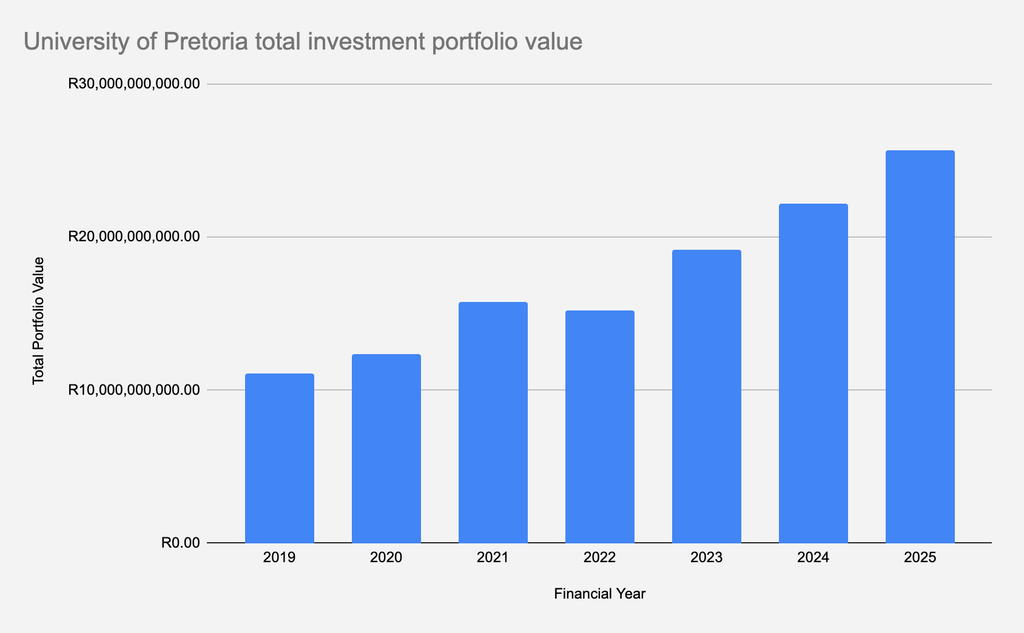
The University of Pretoria’s investment portfolio has appreciated by an average of R5.7 million every day for the past seven financial years.
This leaves the university with an investment portfolio with a total value of R25.66 billion at the end of its 2025 financial year.
The portfolio has performed well during this period, with a compound annual growth rate of 12.67% from 2019 to the end of 2025.
This fund is used strategically by the university to cover short-term liabilities and provide immediate liquidity in the case of sharp revenue loss or delayed payments from students or the National Student Financial Aid Scheme (NSFAS).
Some elements of the portfolio are also ring-fenced to provide life assurance for employees and post-retirement medical aid benefits for eligible staff and future retirees.
The university’s council mandates that its reserves serve as an institutional safety net in the event of severe revenue loss.
Thus, the fund is mandated to enable the university to maintain its core academic and research activities for 18 to 19 months in the event of no revenue.
All the while, the fund has to grow its capital over the long run to ensure that it can cover future liabilities and provide reserves once inflation has eroded the purchasing power of the rand.
Interest and dividend income earned from the portfolio are recognised in the university’s income statement and are free to be used by the council as it wishes.
These funds are often channelled into supporting the university’s operating budget or the upgrading of facilities and the provision of student bursaries.
The investment portfolio has become an important part of supplementing the university’s budget and covering delays in NSFAS payments or government transfers.
It has also enabled the university to invest in maintaining its world-class facilities and adding to its infrastructure over the years.
The University of Pretoria remains one of South Africa’s best higher education institutions after 118 years of operation.
While it opened in 1908 with only 32 students and 4 professors in a single house, it now has 55,650 enrolled students across undergraduate and postgraduate programmes.
How the fund is managed
The university’s investment portfolio is overseen by an investment committee, which ensures it can cover short-term liabilities while generating strong long-term returns.
This policy does not actively invest in select shares or instruments, but rather sets the risk parameters, exposure limits, and monitors asset-class diversification.
The investment committee effectively oversees the multi-manager funds used to invest capital in assets that match its mandate.
They also ensure the portfolio is not over-exposed to any individual fund manager to avoid concentration risk.
Across its specialised mandates, the university uses between 23 and 25 different portfolio managers across 11 to 13 local asset managers and 12 foreign managers.
The university’s fixed-income portfolio is managed by Ninety One, Coronation, and Futuregrowth, which is a part of Old Mutual.
Its equity portfolio follows a similar structure, with the university investing through asset managers and effectively running a multi-manager fund of its own.
Post-employment retirement funds are managed independently by boards of trustees, with their umbrella provident fund administered by Momentum.
There are various sub-portfolios to meet specific mandates and, in particular, liability time lines and risk profiles.
This includes a substantial money market portfolio to cover short-term obligations of two years or less. This prioritises high liquidity and strict capital protection.
The university’s medium-term capital portfolio focuses on covering longer-term liabilities that extend from three to five years.
This has to balance liquidity needs with returns above inflation to maintain purchasing power.
The role of the long-term capital portfolio is to meet obligations over a period longer than five years.
This aims for capital growth and strong investment returns and is largely invested in foreign and local equities.
Assets are actively rebalanced across these portfolios on a 15-month basis to support the university’s budgetary needs and support infrastructure projects.






Conversation
2 commentsShows what can be done if the claws of the filthy ANC aren’t in the cookie jar.