Your payments data has answers about your business performance. Now your whole team can ask for them


By Dewald Muller, Head of AI + SaaS at Stitch
Large businesses have more payments data than they can use.
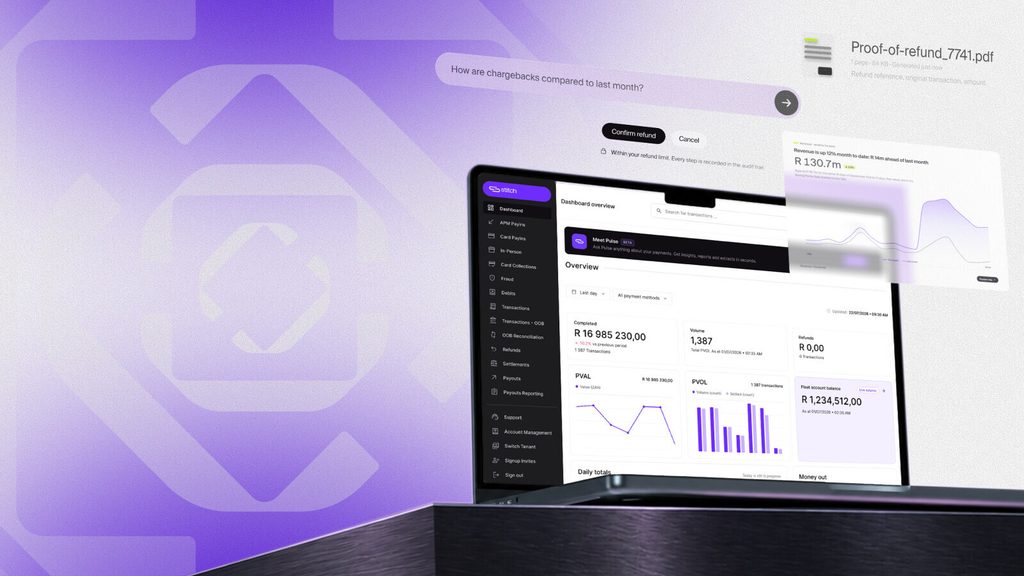
Pulse Analytics, a new AI-powered analytics tool and agent from Stitch, lets anyone from the CFO to the support desk ask that data a question in plain language and act on the answer the same day.
Ask a senior executive at a large retailer, insurer or telecoms company how much revenue the business lost to failed payments last month. The honest answer is often “let me get back to you”.
The data exists. Every payment leaves a record of when the customer tried to pay, how, through which bank, and whether it worked.
But turning that record into an answer usually means a request to the data team, a place in the queue and a spreadsheet that arrives days later. By then the question has often moved on.
Pulse Analytics, launched today by payments company Stitch, is built to close that gap. It’s an AI agent that works on a company’s own payments data.
Anyone in the business can ask it a question in plain language and get a useful answer in seconds.
What it does
It briefs. Every morning, each user gets a short summary written for their role. It covers what moved in the business, the likely cause and what it means in rands.
A finance director and a head of store operations care about different things, so they see different briefs.
It answers. Questions that used to need a data request now take seconds, such as which bank’s card approvals dropped last week and what that cost.
Any answer can be exported to Excel or CSV, or formatted for a board pack.
On the front line, a support agent can paste in a transaction ID and ask where a customer’s refund is.
Pulse Analytics replies with the date it was paid, the bank, the bank reference and when the money should arrive, along with proof of refund ready to send to the customer.
It watches. Users can ask Pulse Analytics, in one sentence, to monitor any metric, customer, store or event. When something changes, it alerts the right person and includes the likely cause.
It acts. Pulse Analytics can process refunds and payouts within each user’s existing permissions.
Any answer can also become a chart or a live dashboard with a single prompt.
What that looks like in practice
Consider a national retailer whose single store performance dropped dramatically on a Tuesday afternoon.
Today, that drop might surface in a report a week later, but the why will take much more time to understand.
With Pulse Analytics, the payments lead is alerted within minutes, with the likely cause and the estimated impact in rands. The head of e-commerce sees it in the next morning’s brief.
The support team can answer customers who call about declined payments, for example, with the details in front of them.
The problem gets fixed the same day instead of being explained at the month-end review.
The bigger change is who gets to use the data.
The person closest to a problem is usually the one who can fix it fastest, and that’s rarely someone in the data team.
Payments data should be working harder for you
Payments data holds insights that impact every department in the business.
This data already exists for any business that processes payments. It’s time your data worked harder for you.
Pulse Analytics will soon be available to every Stitch payments client, with each business’s full payment history included, so teams can ask about past performance from day one.
Businesses that don’t yet process payments with Stitch can book a demo at stitch.money.






Comments