New car sales versus interest rates in South Africa


Interest rates had a significant influence on new vehicle sales in South Africa over the last five years, with a direct correlation between higher interest rates and lower car sales.
When the Covid-19 pandemic hit South Africa, the South African Reserve Bank (SARB) aggressively reduced interest rates to cushion the economy.
However, numerous factors, including supply chain problems, caused high inflation rates globally, and South Africa was not spared.
As inflation picked up globally and domestically, the Reserve Bank started an interest rate hiking cycle, which lasted until 2023.
The repo rate – the rate at which the South African Reserve Bank lends money to the banks – peaked at 8.25% in May 2023.
The SARB held the repo rate at 8.25% from May 2023 until September 2024, when it cut interest rates to 8.00%. This was the start of the rate-cutting cycle.
Over the next year, the Reserve Bank cut rates by 25 basis points during four Monetary Policy Committee (MPC) meetings. This reduced the interest rate to the current 7.00%.
Interest rates have a direct influence on people’s ability to afford credit and buy expensive items, like houses and cars.
When Interest rates are increased, capital becomes more expensive. This causes the entire economy to pay higher payments on its loans.
Simply put, it makes it more expensive to borrow more money to buy houses and vehicles due to the elevated borrowing costs.
This was seen in South Africa’s car market. During periods of rising interest rates, fewer vehicles are purchased as consumers have less disposable income.
During the period of interest rate increases from November 2021 to July 2024, this trend is evident.
Initially, the monthly passenger vehicle sales continued to increase. However, after interest rates reached a certain level, the monthly vehicle sales plummeted.
The graph below shows a smoothed time series of South Africa’s repo rate, along with the reported local monthly passenger vehicles sold.
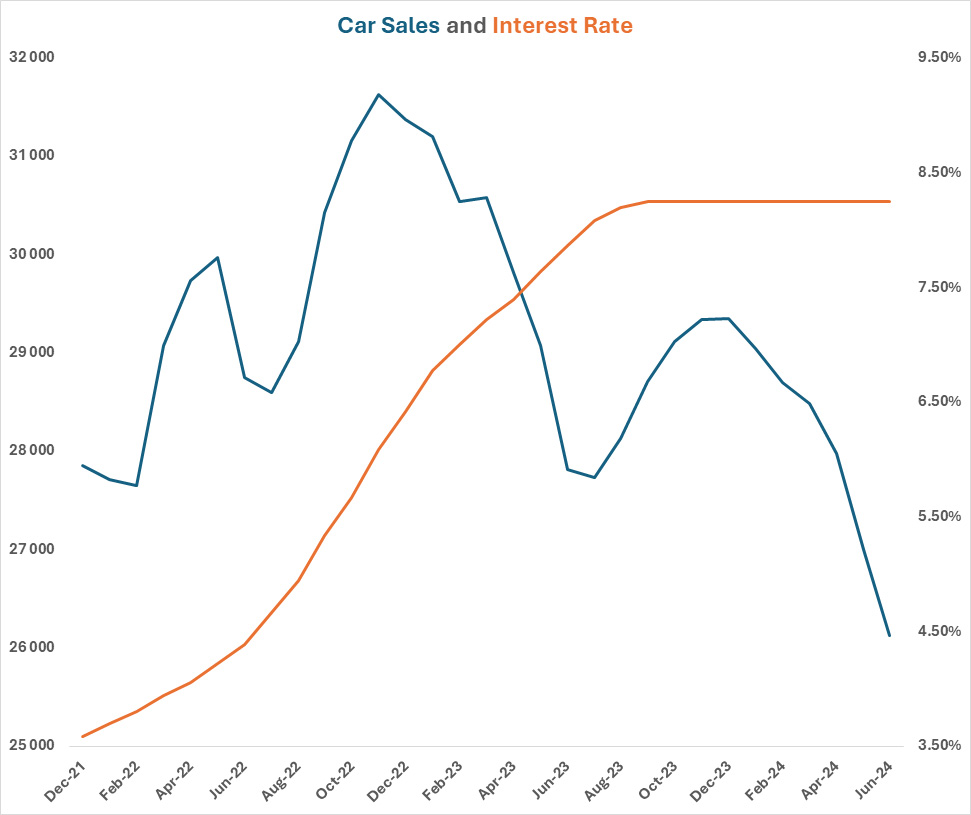
Car sales increased as interest rates started to decline
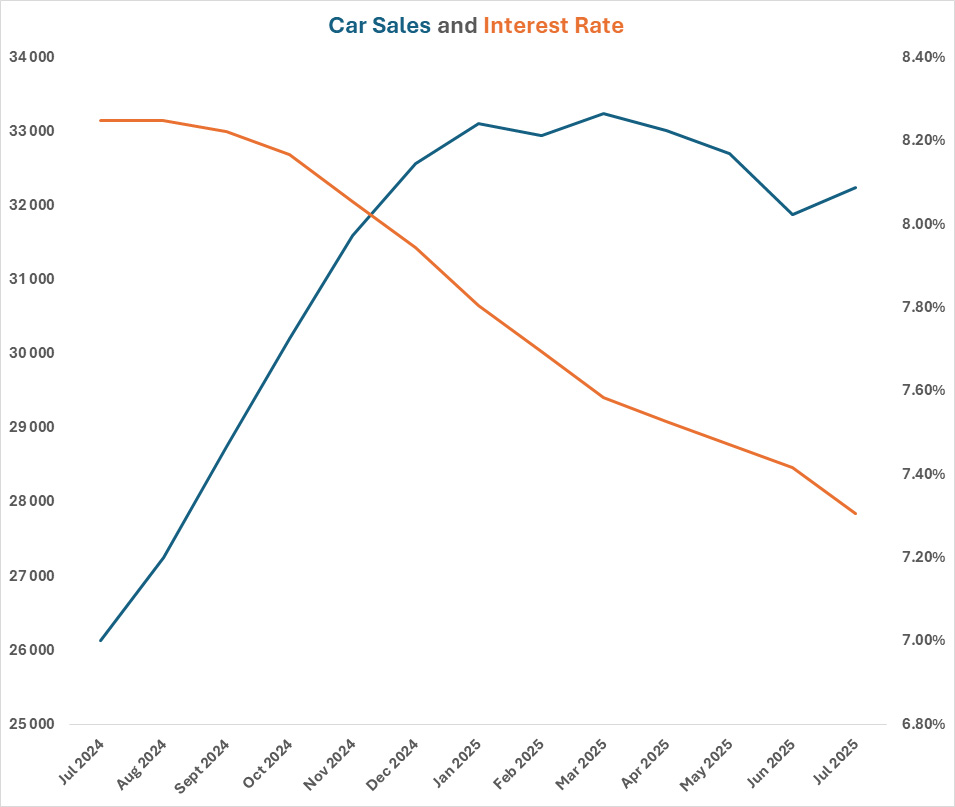
As soon as interest rates started to decline in South Africa, car sales began to increase as it became more affordable to buy a vehicle.
Lower interest rates made financing less expensive and also left consumers with more disposable income.
The National Association of Automobile Manufacturers of South Africa (Naamsa) data on new vehicle sales show this trend.
In July 2025, 36,248 passenger vehicles were sold in South Africa. This is the highest number of cars sold since 2017.
The graph below shows a smoothed time series of interest rates and vehicle sales since July 2024, when interest rates were cut.




Comments