South African consumers feel VAT hike pain


South African consumer confidence has plunged to its lowest level since 2023, putting the country’s economic recovery at risk and threatening government finances.
Momentum Investments chief economist Sanisha Packirisamy explained that this shock was a result of the government’s proposed two percentage point hike to VAT in the initial February Budget.
This hike has since been walked back to a one percentage point hike spread across two years, which may unwind the sharp drop in consumer confidence slightly.
However, any potential VAT hike poses a significant risk to consumer spending, which has driven South Africa’s meagre economic growth in the past few years.
Momentum Investments expects household consumption to grow by 1.8% in 2025 and 2% in 2026, bolstered by improved credit conditions, employment gains, and two-pot withdrawals.
Packirisamy warned that factors such as renewed weak consumer sentiment, elevated interest rates, and a potential VAT hike alongside bracket creep could significantly impact spending.
These factors are already impacting consumer confidence, which is closely linked to real household expenditure.
Consumer confidence plunged to negative 20 points in the first quarter of 2025 from negative six in the fourth quarter of 2024.
The Bureau of Economic Research (BER), who administers the index, attributed the sharp drop to the initial two percentage point VAT increase proposed in the 2025 Budget that was not table in February.
This is because the consumer confidence survey was conducted shortly after the budget was postponed, between 24 February and 7 March 2025.
Given that the VAT increase was later halved and staggered over two years, the deterioration in sentiment would likely have been less severe if the survey had been conducted after the revised budget on 12 March 2025, Packirisamy said.
However, the impact a VAT increase will have on spending will still be significant, as it is the most keenly felt tax for the majority of South Africans.
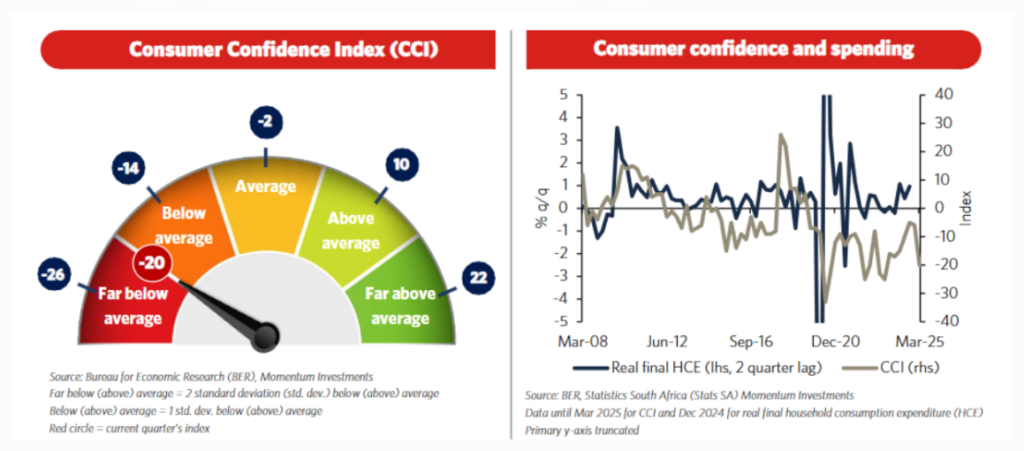
Crucially, a reduction in consumer confidence is likely to translate into slower spending growth, which will impact the local economy.
Household consumption and investment growth are expected to drive higher economic growth of 1.6% in 2025 and 2% in 2026, as consumer spending makes up around 60% of local GDP.
The impact of a potential VAT hike on consumer confidence was compounded by periods of elevated load-shedding during the first two months of the year and increased tension between South Africa and the United States.
As such, the sub-indices that took the biggest sentiment knock were the economic outlook (negative 32 from negative nine) and expected household finances (negative one from 11).
Richer South Africans were not spared from the decline in sentiment, with the high-income group in the survey that earns over R20,000 per month experiencing the steepest decline in confidence.
They were followed by the middle-income group, which earns between R5,000 and R20,000 per month.
Packirisamy explained that these groups will feel the VAT hike the most, and they will be impacted by bracket creep, whereby personal income tax brackets are not adjusted for inflation.
These South Africans are also the most concerned about foreign relations and the potential impact of increased tension with the United States.
Packirisamy also said that these groups might have also been worried about discussions of a wealth tax in South Africa as an alternative to the VAT hike.
In contrast, lower-income households saw a much shallower decline in sentiment due to plans to increase social grants and employment initiatives targeting low-skilled workers.
Richer South Africans are also more heavily laden with debt, making them highly sensitive to elevated interest rates.
With expectations of a shallower and shorter rate-cutting cycle, these individuals will be stuck with higher debt-servicing costs for longer.
This is also likely to have a negative impact on their confidence levels and spending.





Comments