Changes to Discovery medical aid on the cards


Discovery is looking to attract younger South Africans to its medical aid and health insurance products to offset the natural ageing of its client base, which has raised costs it has had to pass on to individuals.
This was revealed during Discovery’s latest interim results presentation, which outlined some of the key drivers behind the consistent increases in contributions over the past few years.
CEO Adrian Gore explained that one of the major challenges Discovery Health Medical Scheme faces is the sustained increase in the cost of healthcare.
South Africa has relatively high medical inflation, which was recorded most recently at 11% per annum.
Gore explained that the are three key drivers of this. One of which is medical tariffs, which are linked to inflation and have risen consistently over the past decade.
Another is the increased investment into technology to develop new pharmaceutical drugs to tackle complex diseases or slow down ageing.
The final driver of high medical costs in South Africa is demographics, with open medical aid schemes having to deal with the increased ageing of their client bases and increased chronicity.
This third factor is the one area in which Gore thinks Discovery can make significant changes to reduce the cost of coverage and, thus, limit contribution increases.
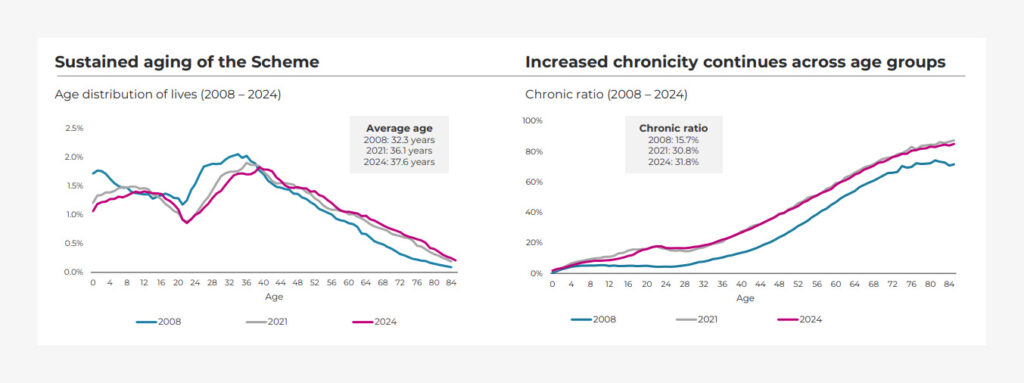
Gore explained that Discovery’s client base has consistently aged despite South Africa’s young population, with the average age of its medical scheme members rising from 32 in 2008 to 38 in 2024.
This pushes costs and contributions higher, mainly due to the increased medical expenditure needed at an older age. In effect, Discovery has to raise prices to ensure it can cover this increased cost.
Another issue with the scheme’s sustained ageing is the rise in the chronic ratio, which measures the share of Discovery’s client base that needs to purchase chronic medication.
As individuals age, this ratio rises as more chronic medication is required, once again pushing up costs that need to be passed on to clients.
These two factors can be seen in the graph below.
Discovery is already implementing new strategies to combat this steady increase in cost, such as trying to attract younger people to its medical scheme.
Gore explained to Daily Investor in an interview following his presentation that, while South Africa has a very young population, the vast majority only get medical aid once they are older.
“The point I was trying to make in the presentation was that the South African population is actually very young. We should not have issues with getting younger people onto medical aid schemes,” Gore said.
“The medical scheme environment, with an open enrollment community, means that people often do not join until they are older and sicker.”
“So, you have this natural selection rate, which raises the cost of providing medical scheme coverage.”
The good news is that this is reversible, and Discovery is working hard to get younger individuals to join its scheme.
“You can either reverse it through product offerings, which we are doing, or you can reverse it through regulation changes that force people to join when they are young.”
Gore explained that regulatory changes will be very difficult to achieve and are not within Discovery’s control, pushing it towards creating new product offerings to attract younger clients.
At the centre of these new product offerings is giving clients better benefits at lower prices by using technology.
“Using all the technology we have, we are not beginning to offer products that are focused within certain benefit structures at cheaper price points.”
Gore said Discovery’s new Active Smart plan is at the core of this, with it being very competitively priced at R1,350 a month.
“We see that at that level, we are getting very good traction. So, it is not rocket science.”
Another way in which Discovery is using technology to limit cost increases is by using artificial intelligence to personalise health prompts.
Launched in early 2025, Personal Health Pathways aims to provide personal health prompts to make Discovery clients healthier, reduce their medical expenditures, and thus limit contribution increases.
Currently, around 2.1 million Discovery Health Medical Scheme clients are eligible for this service, which has driven 348,000 next-best actions and awarded over R7.9 million worth of rewards so far.
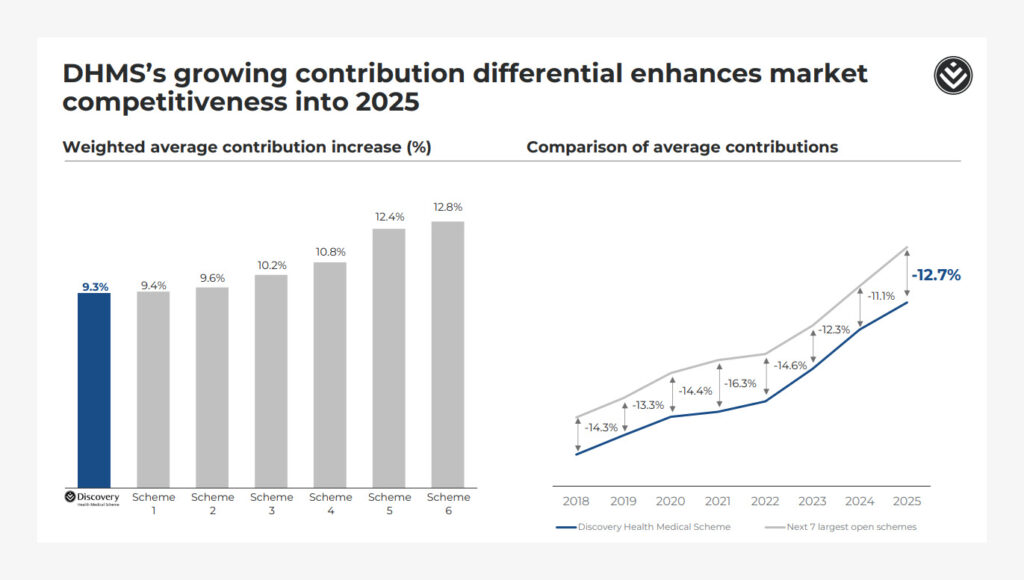
Discovery has managed to limit contribution increases relatively successfully in recent years, with its price increases compared to the market in the below graphs.






Comments