Bad news about inflation and interest rates in South Africa


The decline in South African inflation below the bottom end of the Reserve Bank’s 3% to 6% target will likely be temporary as large electricity tariffs and medical aid increases drive prices higher.
Old Mutual Wealth investment strategist Izak Odendaal explained that the impact of increased global uncertainty and a potentially shallower cutting cycle in the US would compound this.
Consumer inflation fell through the bottom end of the 3% to 6% target range in October for the first time since February 2021, when the pandemic played havoc with global prices.
That disruption would soon push prices in the opposite direction, with inflation surging globally and locally in 2022 and 2023.
Before that, inflation also briefly dipped below 3% in 2010, again in the wake of a global dislocation, this time due to the financial crisis and the wild swings in the oil price.
Inflation also fell through the floor in 2004, hitting 0%, after the rand appreciated from R11 per dollar to R6 between 2002 and late 2004.
This time, the main driver has been the sharp decline in goods inflation, particularly food and fuel prices.
Goods inflation fell to 1.4% year-on-year in October. Conversely, goods inflation was also mostly responsible for the spike in headline inflation above the target band in 2022.
Goods prices make up 49% of the SA consumer price index, and services make up the rest. Service inflation is stickier and moves more slowly.
It is also more closely linked to domestic demand, while goods prices are largely set in international markets.
The good news is that service inflation has been trending lower, dipping to 4.3% in October, but hefty electricity tariff and medical aid increases still need to be reflected.
In other words, Odendaal said that October’s sub-3% inflation reading will likely be temporary.
The Reserve Bank’s Monetary Policy Committee (MPC) members unanimously decided to lower the repo rate from 8% to 7.75%, maintaining the gradual pace of rate cuts.
The Reserve Bank’s forecast expects inflation to average 4% next year, before hovering around the 4.5% target in 2026 and 2027. The Bank’s economic growth forecasts are broadly unchanged, with growth rising to 2% by 2027.
This remains a conservative outlook compared to many private-sector forecasters. The MPC statement describes the risks to its growth outlook as “balanced”, meaning if the forecast is wrong, it can be wrong in both directions.
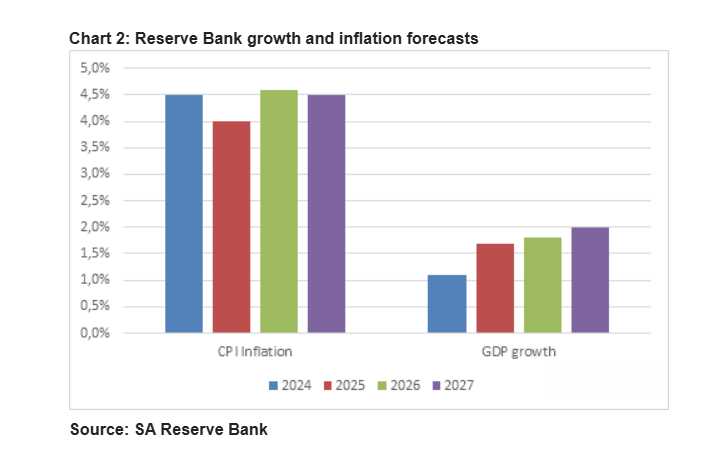
The statement also views the risks to its inflation outlook as balanced, with both administered price increases locally and global uncertainty placing upward pressure on prices.
Governor Lesetja Kganyago’s post-announcement comments placed a lot of emphasis on factors that could place upward pressure on inflation, including electricity tariff increases locally, but more importantly, increased global uncertainty following the US election.
The statement noted that “new inflation pressures and heightened uncertainty” suggest diminished policy space for central banks internationally.
Kganyago was referring to the gap between interest rates in the US and elsewhere, particularly in South Africa.
If this gap widens due to the Federal Reserve cutting less than other major central banks, capital will tend to flow to the US, and the dollar will gain.
A stronger dollar means weaker currencies elsewhere and potentially higher inflation. Therefore, central banks in those other currencies may scale back planned rate cuts to avoid excessive currency moves.
The South African Reserve Bank, in particular, is always nervous about the possibility of a disorderly decline in the rand, which could lead to higher inflation.
Odendaal said the current exchange rate level, around R18 per dollar, is not a concern, but the rapid decline following the US election will have raised some eyebrows.
Due to this fear, local interest rates are unlikely to be cut significantly any time soon as the Federal Reserve’s forecasted rate cuts have greatly diminished.
The decline in inflation we saw during 2023 and most of 2024 has stalled out somewhat. This is something the Federal Reserve will pay close attention to, but for now, has taken the view that the disinflationary trend will continue to zigzag lower.
The Fed will likely cut a few more times but will proceed cautiously. It knows the Trump administration’s policies could be inflationary, but it cannot respond preemptively to plans that have not been implemented yet.
For one thing, there is usually a lag between policy changes and their impact on the real economy, and these policies might not be implemented immediately or at all.
There is a risk that there is a quiet period on the inflationary front where complacency builds on the part of investors and the Fed.
What we do know is that market expectations for rate cuts have been scaled back considerably, Odendaal said.
Futures markets price in a fed funds rate of 3.8% by the end of 2025, significantly higher than the 2.8% priced at the time of the jumbo September rate cut. This can be seen in the graph below.







Comments