Big Mac Index: The South African rand should be worth R9.15 per US dollar


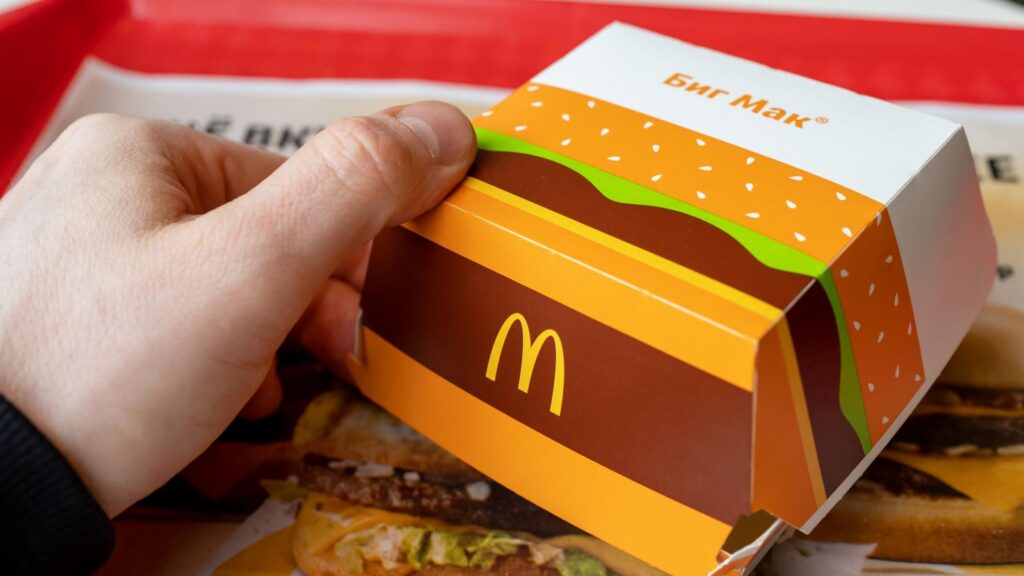
The Big Mac Index implies that South Africa’s rand is 44% undervalued against the US dollar, with the local currency supposed to be worth R9.15/USD.
South Africa’s rand has consistently traded below its purchasing power parity (PPP) value due to the country’s risk perception.
The sovereign credit rating plays a big role in this regard, with South African assets currently considered below investment grade, or ‘junk status’.
Developed by a writer at The Economist magazine, the Big Mac Index provides insight into the purchasing power disparities between countries.
Created in September 1986 by Pam Woodall, the Big Mac Index has since become a widely cited economic tool to measure whether currencies are “correctly” valued relative to one another.
It is based on the PPP theory, which states that, over time, market exchange rates between countries should adjust so that an identical basket of goods and services costs the exact same amount in both countries.
The index uses a single product – a McDonald’s Big Mac, in this case – that is standardised and available in countries all around the world.
Woodall chose the Big Mac because it is a recognisable product available in 100 countries and highly standardised, with nearly identical specifications regardless of where in the world it is made.
Since the Big Mac also represents the entire supply chain behind it, it is a surprisingly accurate “mini-basket” that can be seen as representative of the broader local economy.
The Big Mac Index works by calculating an implied exchange rate by comparing local Big Mac prices and measuring it against the actual market exchange rate.
In South Africa’s case, a Big Mac at the local McDonald’s costs R56.90, which is $3.49 when converted to US dollars.
This is 44% cheaper than the US baseline of $6.22, implying that the rand is 44% undervalued against the United States dollar.
Using the PPP theory, if burgers cost the same everywhere, a Big Mac in South Africa should cost R9.15, and the rand should be valued at R9.15/USD.
This implies South Africa’s currency is far weaker than the PPP theory would predict. This can be seen in the table below.
| Metric | Figure |
| Price of a Big Mac in South Africa in rands | R56.90 |
| Price of a Big Mac in South Africa in US dollars | $3.49 |
| US Big Mac price baseline | $6.22 |
| South Africa Big Mac price vs the US baseline | -44% |
| Market exchange rate | R16.32/USD |
| Implied exchange rate (PPP) | R9.15/USD |
The rand’s fair value
While the Big Mac Index is a useful tool to compare the value of global currencies, it does not reflect all of the factors that led to a particular currency’s market value.
In South Africa’s case, the rand’s value against the United States dollar is influenced by wage differences, commodity prices, and the risk perception of both countries.
A currency is greatly influenced by its country’s sovereign credit rating, which tells investors how much or whether a country is a “good investment”.
South Africa’s sovereign credit rating is currently BB according to S&P Global and Fitch Ratings, and Ba2 per Moody’s.
Even after recent rating upgrades from these firms, this means South Africa remains in so-called “junk status”, meaning below investment-grade.
In simple terms, this implies that South Africa’s government is seen as having a higher risk of failing to pay back its debts. Buying local bonds is viewed as a speculative investment.
This high-risk perception has a significant impact on the rand, as it discourages investment and capital flow into South Africa.
South Africa’s currency is also highly volatile, earning it the nickname ‘The Rattler’ among many traders, and is highly susceptible to external shocks and geopolitical tensions.
This is because the rand is one of the most-traded and most liquid emerging-market currencies, often serving as a global proxy for risk sentiment.
Considering all of these factors, many economists peg the rand’s fair value, its theoretical value based on economic fundamentals, at between R16/USD and R16.50/USD.
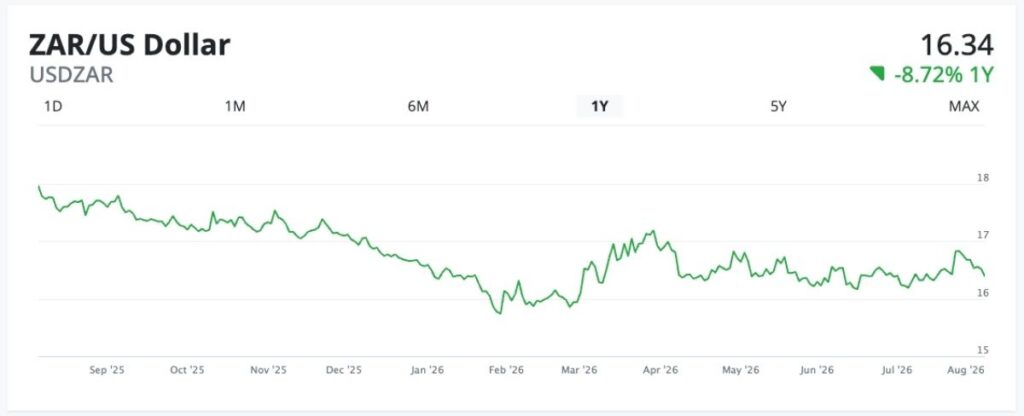
The rand is currently trading at this level – R16.40/USD at the time of writing – meaning it is close to or at its fair value. The rand’s performance against the US dollar over the past year can be seen in the graph below.
Dawie Roodt’s fair value for the rand
Efficient Group chief economist Dawie Roodt told Daily Investor that he pegs the rand’s fair value at between R15.50 and R16.50 to the United States dollar.
He arrived at this value through a combination of two methods: looking at the Big Mac Index or PPP approach, and looking at historic trends in the rand’s valuation.
“The rand is always undervalued, but the rand tends to be approximately 50% undervalued based on purchasing power parity,” he explained.
“That 50% undervaluation of the currency is currently between say R15.5 and R16.5 to the US dollar.”
However, he explained that even at R15.50/USD, the rand is still an undervalued currency. The “correct” value of the currency, according to Roodt, is R9 to the US dollar.
Positively, Roodt said there are many factors underway that are currently supporting the rand.
Most notably, he pointed to the Reserve Bank’s move to a lower inflation target of 3%, combined with lower inflation in South Africa.
“A very important thing happened last year when inflation targets were reduced to 3%, and actually inflation started to fall as well, and with that inflation expectations as well,” he said.
“Subsequently, the inflation rate went up, but that’s because of external factors. Within a year or so, inflation is likely to start falling again to within or close to the target of 3%.”
Roodt said the single most important factor in supporting the rand is ensuring that monetary policy is conducted in a way that supports the exchange rate.
“Broadly speaking, that is exactly what monetary policy is doing at the moment,” he said. “From a monetary policy point of view, from what the Reserve Bank is doing, they’re doing an excellent job.”
Another supportive factor is implementing measures to foster stronger economic growth, which Roodt said will require policy changes.
He pointed to changes such as the repeal of Expropriation without Compensation and Black Economic Empowerment policies. This, he said, will lead to stronger economic growth and a stronger currency as well.
 Loading ...




Comments