Top South African CEO drove executives into townships to cut 14,000 jobs after a six-month strike


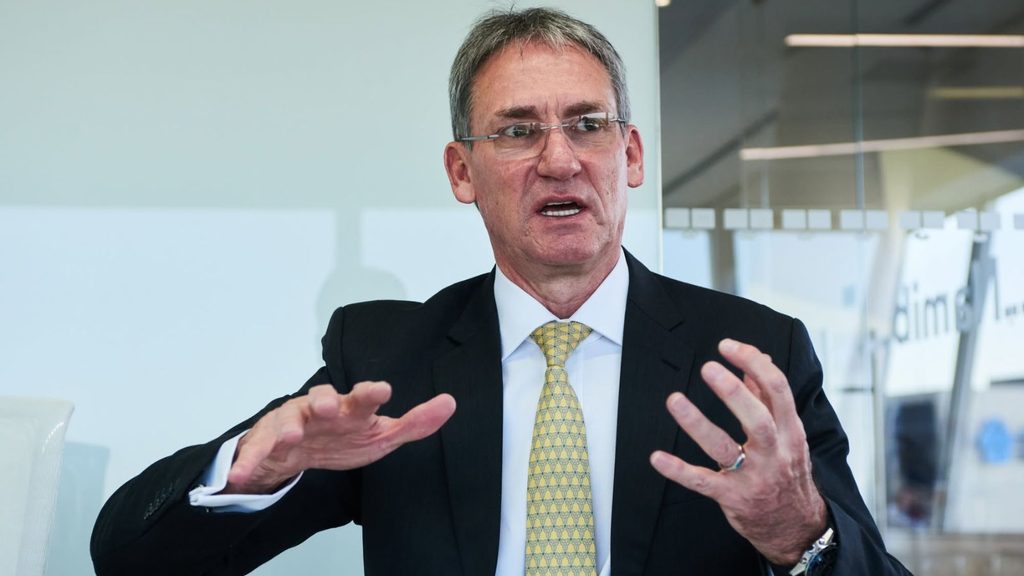
Mining stalwart Chris Griffith drove his executive team when he led Anglo American Platinum (Amplats) through worker townships, making them realise how devastating job cuts can be.
This episode in Griffith’s career took place during the restructuring of Amplats following the 2012 Marikana tragedy and amid collapsing commodity prices.
Griffith recalled to Investec that this moment was make or break for Amplats, with it facing bankruptcy if it did not adapt to lower platinum prices.
As the world’s largest platinum producer, Amplats’ looming bankruptcy sent shockwaves through the industry and South Africa’s entire economy.
Today, as a company separate from Anglo American, it is valued at R330 billion on the JSE, where it trades under Valterra Platinum.
Luckily for Amplats, Griffith was just the man for the job, being an Anglo lifer until then and having worked in nearly every job at the company.
Griffith was the latest in a long line of Anglo and Amplats executives who began as graduate trainees and climbed the ranks.
Before getting near the C-suite, Griffith gained experience working in every single job he could do underground at Amplats’ mines.
He was a notch cleaner, miner, developer, and stopper before he worked his way up to managing the Amandelbult mine in his early 30s.
This mine alone employed 15,000 people and was the crown jewel in Amplats’ portfolio, accounting for a large share of its total production.
Running Amandelbult and working in mines gave Griffith valuable experience and skills that would prove vital when he was running Amplats as a whole.
His tenure leading the miner would be amongst the most challenging in its history, with platinum prices plummeting in the aftermath of the Great Financial Crisis.
While it is a precious metal, platinum is primarily used in industrial applications, particularly in catalytic converters to reduce vehicle emissions.
This makes the price of platinum sensitive to economic growth through demand for new vehicles, which plunged after 2009.
Falling prices were coupled with the Marikana tragedy in 2012, where the South African Police Service shot and killed 34 striking mineworkers.
This increased tension between mineworkers and management across South Africa, putting Griffith in a very tough spot when needing to restructure Amplats.
“This was a very difficult time for South Africa and particularly for platinum mining. Most commodities recovered after the financial crisis. That was not the case for platinum,” Griffith said.
“Then Marikana happened. That was very bad for morale amongst the workforce and impacted our customers who were buying our products.”
Saving Amplats by cutting 14,000 jobs

Amplats was heading for bankruptcy, and Griffith was away working at Kumba Iron Ore, where he had his own run-ins with the government.
“After the Marikana tragedy, I was asked by Cynthia Carrol, who was Anglo’s CEO, to come back to Amplats and take over as its CEO,” Griffith said.
“Amplats had gone to market with a R10 billion rights issue in 2010, and by 2012, we were fast on our way to needing more cash. Amplats was basically bankrupt.”
Due to low platinum prices, 60% of the industry was making a loss and, as the largest producer, Amplats was oversupplying the market.
It was clear to Griffith that this was not an ordinary mining cycle of oversupply and low prices that would be followed by undersupply and high prices.
Rhodium had collapsed from $10,000 an ounce to $600 an ounce and never recovered. This took 20% out of Amplats’ profit margin.
“There was a big switch taking place at the time in the auto catalysts from platinum and rhodium to a much more palladium-based system,” Griffith explained.
“So palladium demand increased and went from $400 to $800, so you can see the whole price mix changed. We had to change how we operated.”
“We had to take supply off the table. This was something that had never happened in the platinum industry in South Africa before, where we had to shut off production to bring supply in line with demand.”
This only meant one thing – job cuts. As production was taken offline, there would be no need for thousands of jobs at Amplats.
“We entered into the longest strike in mining history in South Africa that lasted six months. We had to hold the line to reset relationships with labour,” Griffith said.
This was when Griffith took his executive team around to where Amplats’ workers lived, to give them an understanding of what they were doing and the effect it would have.
“I took my executive team around in a minibus to the places where some of our employees lived and showed them that these are our people,” Griffith said.
“We were going to put 14,000 people out of work. We had to understand what that would do. We had to provide solutions to help them find new work.”
Amplats ultimately shut down two mines, and 14,000 employees left. This saved the company R3.6 billion in annual costs.
The company cut production to bring supply in line with demand and greatly improved the efficiency of its remaining mines.
It doubled production at Mogalakwena, making it the most profitable operation in the country, by improving productivity.
“That was a very, very difficult time. Dealing with a six-month strike and having to put people out of work, then we had to restructure the business of Amplats,” Griffith recalled.
“A year or two down the line, as things normalised, we had produced more platinum with 15,000 fewer people in the business, showing how much we’d improved productivity.”
 Loading ...





Comments