How much the average government employee is paid in South Africa


The average government employee in South Africa earns R551,230.77 a year, putting the 1.3 million civil servants in the top 5% of earners in the country.
This was revealed in the annexures to the Finance Minister’s Medium-Term Budget Policy Statement (MTBPS) on 21 October, which showed a significant improvement in South Africa’s finances.
South Africa’s debt burden as a percentage of GDP has peaked at 78.4% and is beginning to decline for the first time since 2008.
This is vital for future credit ratings upgrades, putting the country on track to reach investment-grade status in the coming years.
Investment-grade status enables large global pension funds to invest in South African assets, as many of their mandates prevent them from having major exposure to “junk” assets.
More importantly, reducing the debt burden gives South Africa’s government fiscal space to boost infrastructure investment and respond to external shocks.
A declining debt burden will translate into falling debt-servicing costs, which absorb R441.5 billion of state spending. This will free up significant capital for investment.
While the overall picture looks good, there are still risks for the National Treasury to navigate in the coming years.
These include geopolitical instability and other external shocks. However, the largest risk to the budget remains the public sector wage bill.
The National Treasury has worked hard to limit its growth in recent years, with spending on public sector wages reaching R716.6 billion in 2026/27.
Across 1.3 million public servants, this translates into an average salary of R551,230.77 per annum.
This average is skewed by high earners within the public service, such as the President, ministers, provincial leaders, and director-generals.
The National Treasury’s data excludes the CEOs of state-owned enterprises such as Eskom, Transnet, and Denel.
This is because their salaries are paid by the company, not by the state itself.
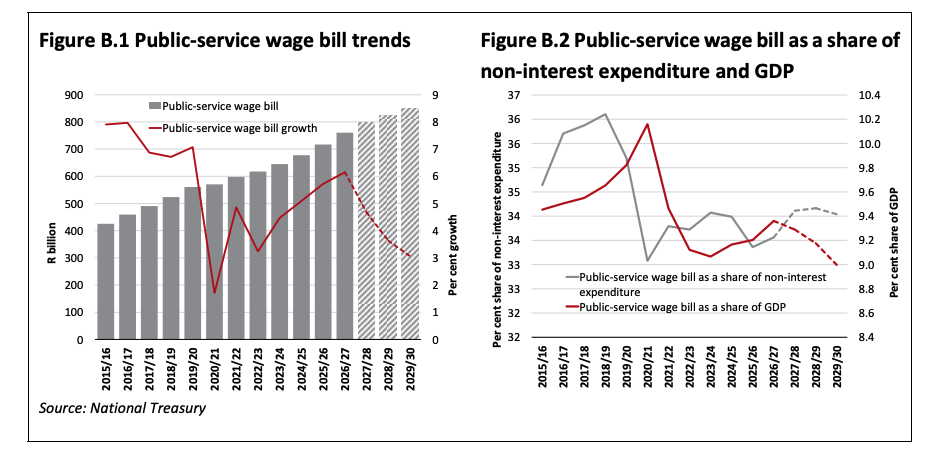
South Africa’s public sector wage bill has grown in absolute terms over the past decade, as shown in the graph below.
Crucially, however, it has stabilised and begun to decline as a share of overall spending and the economy.
Treasury has its eyes on government wages
National Treasury’s data show that compensation of employees accounts for the largest share of non-interest expenditure, at 33.4% of the country’s budget.
This makes its growth a significant problem for the Treasury, which is seeking to increase the share of government spending directed towards infrastructure rather than consumption.
South Africa also has a smaller public service as a share of the total employed population than many OECD countries.
However, they are paid disproportionately well relative to the size of South Africa’s economy, due to significant wage growth from 2008 to 2021.
“Containing growth in the public-service wage bill is critical to the state’s medium-term fiscal strategy,” the Treasury said in the full MTBPS.
“The state must attract and retain skilled professionals to execute its developmental mandate and deliver critical frontline services, while ensuring long-term fiscal sustainability.”
This has led to targeted reforms to “rejuvenate and professionalise the workforce”, while also cutting costs and reducing fraud.
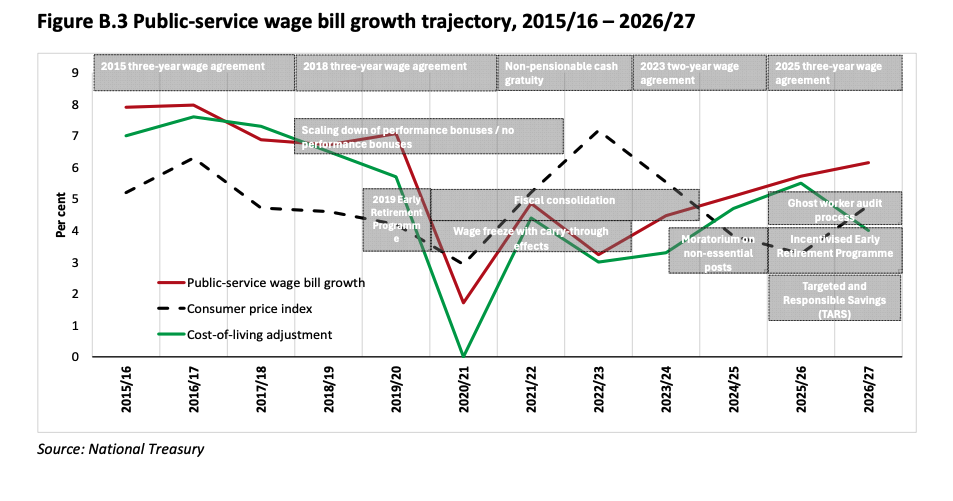
Between 2015/16 and 2020/21, the public-service wage bill grew at 6.4% per annum, significantly increasing its share of expenditure.
From 2020, the National Treasury began implementing early containment measures, such as scaling down performance bonuses and an early retirement programme.
This resulted in a slowing growth rate and was capped by a public-service wage freeze for the 2020/21 financial year.
Since then, the Treasury has ratcheted up its containment measures on the public-service wage bill, with performance bonuses halted in 2022/23.
This was coupled with a hiring freeze on non-essential posts and the beginning of an audit into “ghost workers” and other payroll irregularities.
These initiatives have significantly slowed growth in the public-service wage bill and ensured that it declines as a share of overall spending.
However, this poses significant challenges for the state in pursuing its developmental agenda, as the government’s workforce reflects its priorities.
Most employees are in labour-intensive, frontline functions such as education and health. Overall, these two sectors and social development, police, defence, and home affairs account for 88.3% of state employees.



Conversation
1 commentsGiven that the average annual formal sector gross income sits at ~R367,000 pa and the Total workforce average gross income sits at ~R168,000 – R192,000 pa, one has to conclude the public sector is overpaid.