South Africa’s rand plummeting towards R17 against the US dollar


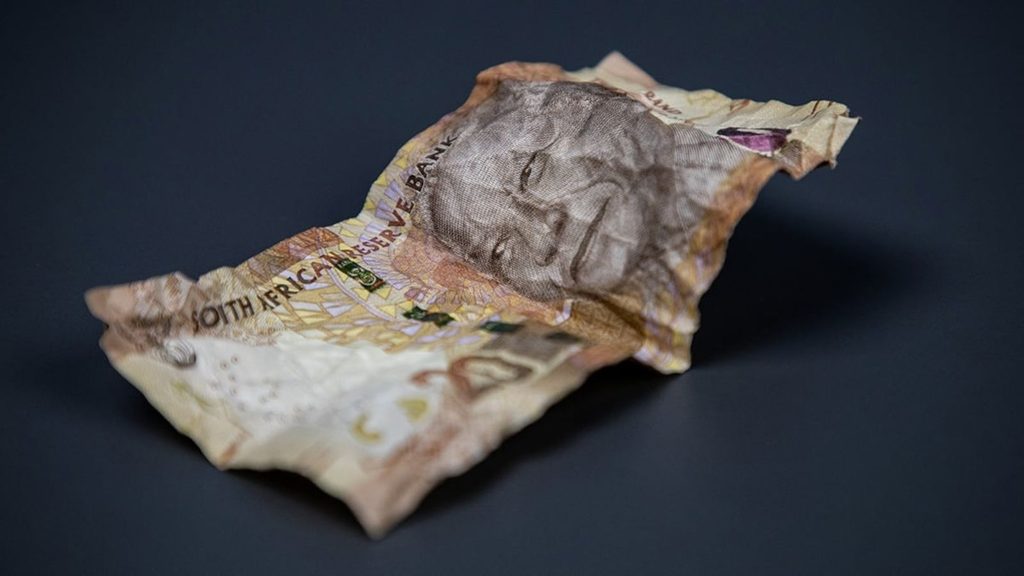
The rand has been highly volatile over the past month and is now feeling the pressure of higher risk aversion. The local currency has suffered four consecutive weekly losses of roughly 4.5%.
A risk-off approach in global financial markets has weighed on emerging market bonds and currencies, with South Africa seeing R12.7 billion in net sales of its debt since the end of September.
Now, the balance of risks for the rand remains skewed to the topside, with a break above R16.80/USD potentially opening the way towards the R17.00/USD handle.
Investec chief economist Annabel Bishop explained that the rand has been highly volatile over the past month.
“The rand saw noticeable volatility, dropping below R16.00/USD early in the month before the escalation in the Middle East war, then rising to around R16.40/USD on the US interest rate hike,” she said.
The rand saw marked weakness following the US Federal Reserve’s decision to hike interest rates, which Bishop attributed to concerns over energy prices and inflationary impacts.
However, she also pointed out that weak global fiscal metrics have seen a more marked reaction to higher interest rates than at other times.
This was particularly true in the US bond market, with yields now at a two-decade high.
“The investor sell-off has leached into G7 bond markets, with the rise in investor risk aversion negatively impacting emerging market bonds and currencies,” she said.
South Africa, she said, has seen R12.7 billion in net sales of its debt since the end of September.
“SA bond yields have seen marked deterioration, at 9.0%, from below 8.0% earlier in the year on the favourable Budget in February,” Bishop said.
She explained that local bond yields lost ground amid escalating inflation and interest-rate concerns, as well as risk-off sentiment in global financial markets.
Another factor putting pressure on the rand is lower commodity prices, with September seeing a 5.8% month-on-month drop.
All of these factors have negatively impacted the rand, which is now trading at R16.69 against the greenback on the morning of Monday, 5 October.
TreasuryOne currency strategist Andre Cilliers said the balance of risks for the rand remains skewed to the topside, with the local currency having suffered four consecutive weekly losses of roughly 4.5%.
He attributed the rand’s weakness to a stronger dollar, elevated US yields, and weaker emerging-market carry demand.
Cilliers warned that a break above R16.80 against the US dollar could open the way for the rand to reach the R17.00/USD handle.
Bond market protection
Bishop explained that while rising bond yields and net debt sales have put the rand under pressure, South Africa has seen relatively modest foreign sales of local bonds.
This, she explained, has limited the rand’s weakness, providing a buffer for the local currency.
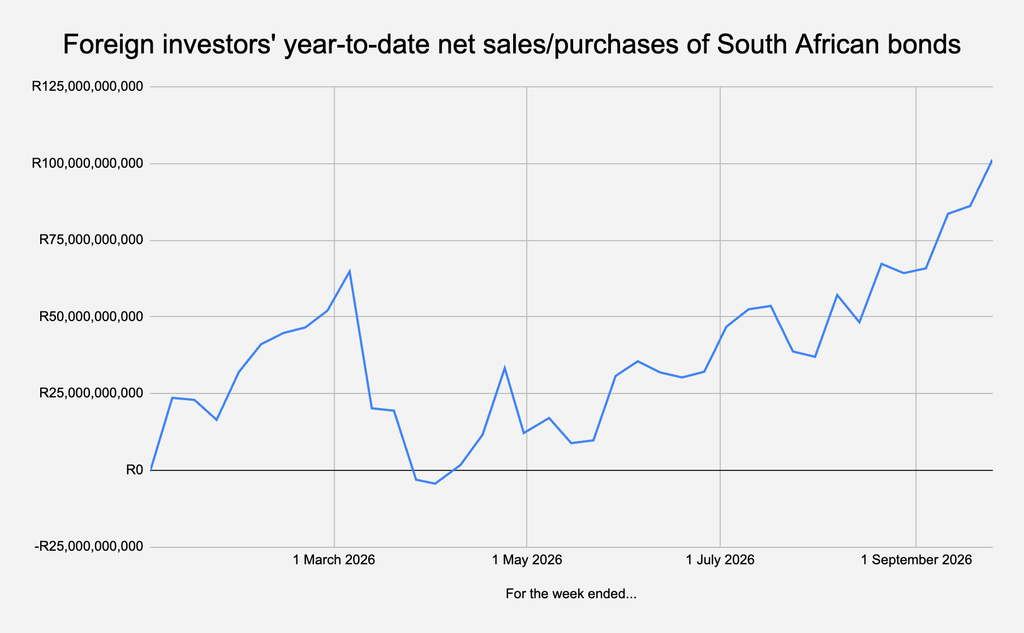
Based on JSE data for the week ended 25 September, foreign investors have bought R101.24 billion in South African bonds in 2026 to date.
This is down significantly from R161.99 billion this time last year, representing a 37.5% drop.
However, foreign investors are still recording net purchases, rather than sales, which is more than could be said earlier in the year.
Foreign investors have been net buyers of South African bonds since April, when year-to-date net sales were last recorded.
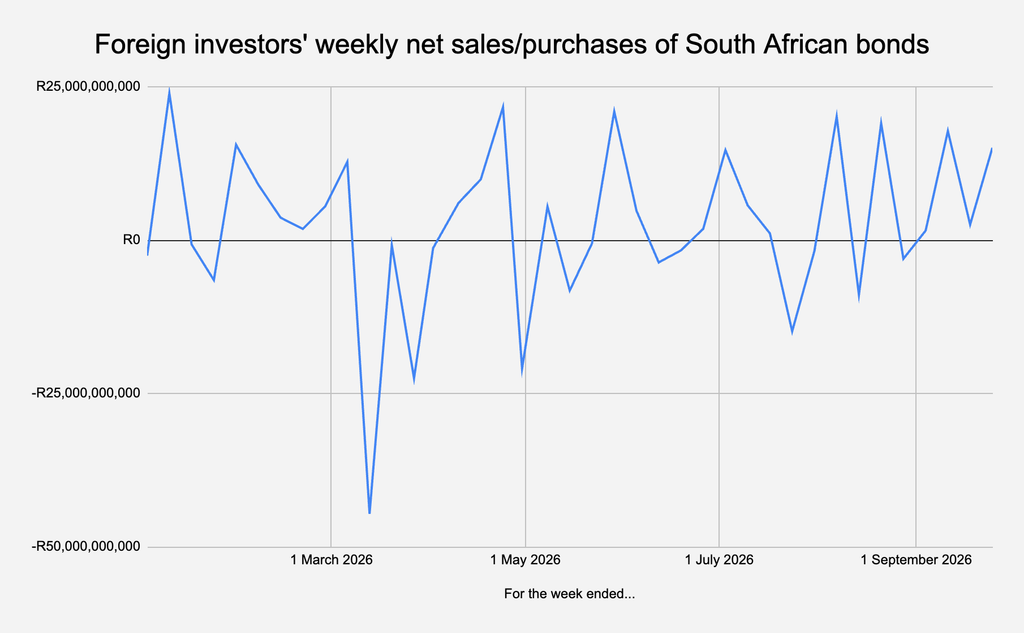
While there have been some weeks in the red, particularly in May, June, July, and August, September saw net foreign purchases of South African bonds every week.
Despite this positive news in the local bond market, South Africa runs a risk of foreign investors becoming net sellers if global risk-off sentiment prevails.
In the September 2026 Monetary Policy Review, Reserve Bank Governor Lesetja Kganyago said domestic reforms are critical to protecting the local bond market.
“Because of the adverse global environment, domestic reforms are our best growth option. This covers structural interventions, such as improving productivity in the transport and energy sectors,” he said.
“It also includes the macroeconomic goals of sustainable debt and permanently lower inflation.”
He explained that, as both developing and developed economies must contend with higher debt and elevated inflation, South Africa’s macro fundamentals are becoming a differentiating factor.
Kganyago said domestic reforms have lowered South Africa’s risk premium and have protected the country from the global bond selloff.