Tables turn on South Africa’s rand


South Africa’s rand has staged one of its strongest runs since the outbreak of the Iran war over the past month.
However, the rand’s rally was primarily driven by a weaker dollar, softer United States economic data, and a firmer gold price – all factors that have now turned from tailwinds to key risks.
The dynamics behind the rand’s strength were outlined by Abax Investments portfolio manager Nkosinathi Nsibande.
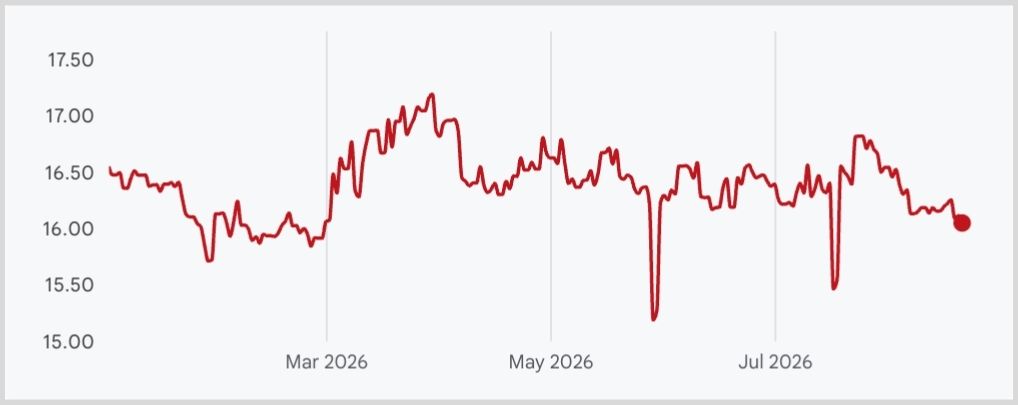
Nsibande pointed out that the rand came down from a peak of R16.98 against the United States dollar to a range of R16.10/USD to R16.25/USD, its strongest levels since early March.
This represents a remarkable comeback for the rand, which started the year off strong but came under severe pressure from the war in the Middle East.
Before the US launched its attack on Iran on 28 February 2026, the rand was trading at its strongest level in years, hovering just below the R16/USD level.
However, when the war broke out and the conflict intensified, oil prices surged, and markets took a risk-off approach that hammered riskier emerging-market currencies like the rand.
The rand reached its worst level so far in 2026 on 30 March, when it shot up to R17.19 against the US dollar.
However, at the beginning of July, the rand stabilised at around R16.35 to R16.45 against the US dollar.
Nsibande explained that the July Monetary Policy Committee (MPC) meeting threw markets a curveball, which impacted the rand.
Going against economists’ predictions for another 25 basis point hike, the MPC voted to hold the repo rate at 7.00% in a split 4–2 decision.
“The immediate reaction was violent: the rand sold off up to 2.5%, the curve bear-steepened (longer-term bonds underperformed), and hike expectations were swiftly rolled to September,” Nsibande said.
The decision came as a surprise, as the market had fully priced in a 25 basis point hike on the back of CPI inflation hitting 5% in June, exceeding the Reserve Bank’s target.
However, Governor Lesetja Kganyago framed the pause as a “wait-and-see” approach. He pointed to the need for monetary policy to look past energy shocks.
The rand rallies
The reaction to the MPC’s July decision initially pushed the rand weaker, but global markets quickly provided a tailwind. Nsibande identified a shock US July payrolls print as the pivot point.
The US saw a 23,000 contraction in payrolls, far worse than the expected 80,000 gain. This triggered an aggressive dovish repricing of the Federal Reserve.
Markets priced out near-term interest rate hikes in the United States, as they expected the Fed would prioritise protecting the economy over taming higher inflation.
Nsibande said implied probabilities for a September US interest rate hike collapsed from 52% to 32%, dragging the dollar index below the psychological 100 mark to its weakest point since May.
“That broad dollar weakness became the ultimate driver for higher-yielding emerging market assets, and the rand was perfectly positioned to ride the wave,” he said.
While it was riding this wave, the rand received another tailwind from commodity dynamics and some solid domestic anchors.
Nsibande said gold’s bullish reversal above $4,400 per ounce underpinned South Africa’s terms of trade.
At the same time, Brent crude’s earlier slide toward $80/bbl relieved the imported inflation drag and the resulting passthrough effects.
July also saw the release of South Africa’s trade statistics, which revealed an R18 billion June trade surplus, resilient bond inflows, and a slow but steady improvement in fiscal credibility.
These developments benefited the rand, which ended July trading at R16.06 against the greenback.
Despite some volatility in August, the rand has held relatively steady, trading at R16.06 on 21 August.
However, looking ahead, Nsibande said the near-term setup is far more finely balanced.
He noted that the Brent crude oil price is back above $91 per barrel following renewed tensions in the Strait of Hormuz and the lapsed US–Iran peace deal.
The gold price has also cooled slightly off its highs, and the dollar has stalled near 99.
“With South Africa’s July CPI coming out softer at 4.3% (vs 4.5% expected), the currency is currently consolidating around R16.20/USD,” he said.
“Ultimately, this rally has been driven far less by domestic factors and almost entirely by a weaker dollar, softer US data, and a firmer gold price.”
He warned that these market dynamics are now shifting from a tailwind to a key near-term risk.






Comments