Digital rand in South Africa


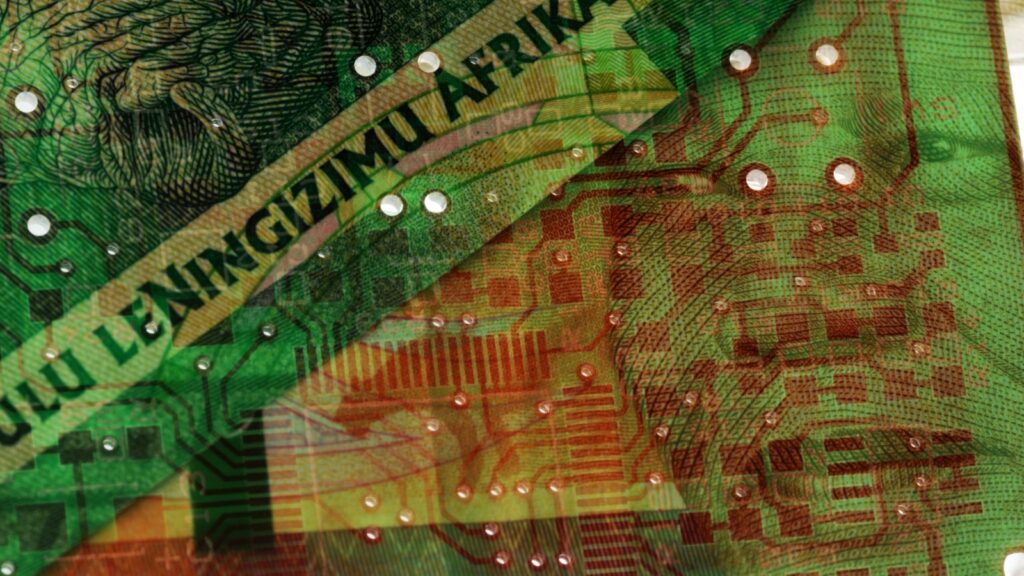
The South African Reserve Bank (SARB) has no defined timeline for the implementation of a retail central bank digital currency (CBDC).
While the bank told Daily Investor it continues to closely monitor developments, it said there is no immediate case for implementing a CBDC.
A CBDC is a digital twin of the paper money typically issued by a central bank. It is official and government-backed, but only exists digitally rather than on paper or metal.
These types of currencies have potentially significant benefits for countries and consumers, as they enable significant innovation around money.
In particular, CBDCs have the potential to make digital transactions real-time and extremely cheap as they remove middlemen who facilitate transfers.
These currencies also enable increased safety and financial inclusion, with money being held directly with the central bank.
This significantly reduces the risk of a run on a bank and allows people who do not have a traditional bank account to participate in the digital economy.
However, CBDCs come with significantly greater state control over money in a country, as they are programmable.
Money can be ‘coded’ to be able to be spent only on certain goods or services. While this can prevent fraud, it also curtails individual freedom.
This also means that all transactions will leave a digital paper trail, enabling governments to track exactly what individuals spend and potentially freeze an account.
A significant issue with CBDCs is the potential impact on commercial banks and the broader economy.
If all money is held in accounts with the central bank, there is very little need to leave cash in a commercial bank. This prevents these institutions from lending money to drive economic growth.
The Reserve Bank is relatively late to the party. Countries such as the Bahamas and Nigeria have already launched their own CBDCs.
Nigeria’s eNaira can be used alongside physical cash to pay for goods and services, with no need for a bank account as the money is held in an eNaira Speed Wallet.
Reserve Bank waiting it out

While these developments continue at a strong pace, the Reserve Bank said it prefers watching from the sidelines before making any changes to South Africa’s currency.
“The SARB has concluded that there is no compelling immediate case for introducing a retail CBDC in the short to medium term,” it told Daily Investor.
“Instead, the SARB’s current priority is to continue strengthening the existing payments ecosystem.”
The Reserve Bank has experimented with CBDCs in a controlled environment through Project Khokha 1 and 2, which tested various elements of a digital rand.
The first set of experiments demonstrated that a distributed ledger technology (DLT) network can perform transactions between banks.
This technology managed to settle transactions while keeping them completely private. However, this came at the cost of excessive complexity and inefficiency.
The second round of experiments focused on how a CBDC would work in the retail environment if it replaced the role of the rand in transactions.
This proved far more fruitful, reducing inefficiencies and enabling greater transparency in financial markets.
The Reserve Bank said it provided regulators with greater oversight, made settlement easier, and gave the central bank real-time operational data.
While its experiments show that a CBDC can work in South Africa and will have benefits for consumers, it has raised significant legal problems.
It is unclear what legal status a CBDC would have and how it would be treated by the authorities, given South Africa’s relatively strict settlement laws.
The Reserve Bank also noted that a CBDC would be practically unusable in the current environment, given the demands it would place on incumbent institutions.
Apart from this, there also appears to be little interest in such technology in South Africa, with the bank saying that uptake could prove to be a significant challenge.
It hinted at basic challenges that much of the country would face in using a CBDC, such as a lack of access to the internet and, in some cases, electricity.





Comments