Government finally doing what it promised every year for the past decade


South Africa’s debt burden as a share of GDP has stabilised and will decline in the current financial year after the government posted its third consecutive primary budget surplus.
This will be the first time that the country’s debt pile will not grow as a share of its GDP since the government posted a full budget surplus in 2008/09.
The stabilisation comes after a decade of false promises from the National Treasury, where it promised a flattening of debt as a share of GDP for every financial year.
These promises go back to 2013, when then-Finance Minister Pravin Gordhan promised a stabilisation in the debt-to-GDP ratio.
Notably, none of these claims from the National Treasury was supported by International Monetary Fund (IMF) data over the same period.
The IMF regularly forecasted a continued rise in South Africa’s debt-to-GDP ratio amid rising government spending and slowing economic growth.
This turned out to be far more accurate, with South Africa’s debt-to-GDP ratio surging from 26% in 2008/09 to over 77% at the end of the 2025 financial year.
Now, it appears as though the Treasury’s claims of a stabilisation in the debt load and its gradual decline in the future are credible.
The National Treasury has implemented a painful process of fiscal consolidation under Finance Minister Enoch Godongwana.
This is combined with limiting growth in government spending to below inflation and raising additional revenue through enhanced compliance with SARS.
It has also included increases to the General Fuel Levy, several years of non-adjustment to the personal income tax brackets, and a revenue boost from two commodity booms.
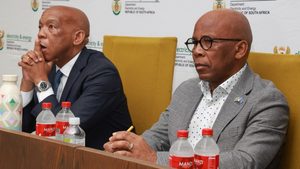
National Treasury Director-General Duncan Pieterse revealed that South Africa posted a bigger-than-expected primary surplus of 1.1% of GDP in the last financial year.
This was South Africa’s third consecutive primary budget surplus and came with a smaller full budget deficit of 4.3% of GDP. The primary budget surplus strips out debt-servicing costs.
A primary budget surplus effectively means the state is covering its expenditure through tax revenue, negating the need to issue additional debt to fund its operations.
This, over time, results in the growth of the debt pile slowing and eventually declining, which is what is happening now in South Africa.
Pieterse said that government debt as a share of GDP has stabilised and is forecasted to decline in the current financial year and for the foreseeable future.
The graph below, courtesy of Codera Analytics, shows the repeated claims from the National Treasury to stabilise the state’s debt, followed by its actual growth – besides 2026.

Going from junk to jewel
The stabilisation of South Africa’s debt burden marks a major milestone in the country’s efforts to improve its financial health.
South Africa had been heading towards a debt spiral, where new debt is issued to pay back older loans and interest payments.
This threat is not off the table, with South Africa still having to pay high debt-servicing costs, which absorb over 20% of all tax revenue.
Worryingly, the interest rate South Africa pays to service its debt is still higher than its nominal economic growth rate.
This means that debt-servicing costs will compound at a faster rate than the economy, from where the state collects its revenue. Ultimately, the government will hit a wall if this continues.
The National Treasury under Godongwana has put South Africa in a position to avoid a debt spiral and the hitting of the wall.
This has been painful, but is yielding results. However, for the process to be completely successful, the country’s economy will have to grow at a faster rate.
A faster-growing economy generates additional tax revenue without the need for tax rate hikes or continuously intensifying compliance.
It also increases the economy’s capacity to fund the government’s spending, effectively boosting the GDP element of the debt-to-GDP ratio.
The Treasury’s next challenge will be to boost economic growth without a corresponding rise in state spending and debt accumulation.
It plans to do this through encouraging private investment in fixed assets, such as infrastructure, equipment, and machinery.
This type of investment, often measured as gross fixed capital formation or fixed investment, is a long-term driver of economic growth.
In fast-growing emerging economies, such as China, India, and Indonesia, fixed investment to GDP hovers between 25% and 30%.
South Africa, meanwhile, has remained between 13% and 15% for the past decade, translating into an annual growth rate of 1% compared to 4.5% for the average emerging economy.
The National Treasury’s work has been rewarded by credit ratings agencies, with S&P Global upgrading South Africa’s credit rating in November 2025.
This has been followed by Fitch upgrading its outlook for the country’s credit rating, indicating that the next move will be a positive one.
South Africa remains far away from investment grade, which will unlock significant investment for the country. However, it is steadily clawing its way back.






Comments