Government watching R17 billion vanish into thin air


The National Treasury is effectively giving up around R17 billion in revenue by granting South Africans some relief at fuel pumps through a reduction in the General Fuel Levy (GFL).
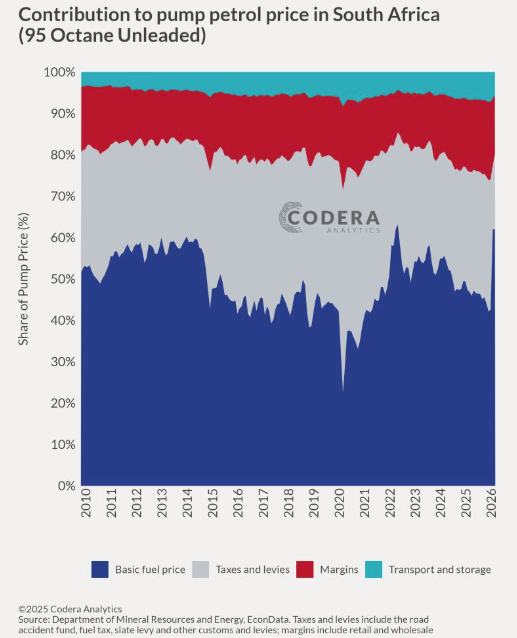
Codera Analytics revealed that this reduction has resulted in the contribution of taxes and levies on the retail price of 95 octane petrol falling from 50% to around 18%.
It must be noted that the declining share is also partly due to the sharp rise in the contribution of the Basic Fuel Price to the retail price of petrol and diesel.
The Basic Fuel Price is calculated by combining the international price of oil and the rand-dollar exchange rate. It is effectively the cost South Africa pays to import fuel into the country.
Finance Minister Enoch Godongwana cut the GFL by R3 in April to soften the blow of rising fuel prices on South Africa.
He has since extended the relief throughout May, increasing the GFL cut for diesel, and ensured the relief will partially carry through into June.
While the relief is necessary, economists have warned that it is likely to come with a significant impact on the government’s tax revenue.
Efficient Group chief economist Dawie Roodt warned previously that the government will have to make up for the lost revenue through increased enforcement from SARS or tax hikes in other areas.
“I think reducing the fuel levies is not a good idea. Remember, the fiscal accounts are in deep trouble. This is just cheap politics,” Roodt said.
“In the end, what is going to happen is that there will need to be an increase in other taxes to make up the shortfall, or the state will have to spend less.”
“I think reducing the fuel levies is not a good idea. Remember, the fiscal accounts are in deep trouble. This is just cheap politics.”
“In the end, what is going to happen is that there will need to be an increase in other taxes to make up the shortfall, or the state will have to spend less.”
The decline in revenue from the GFL cut and its two-month extension is likely to be compounded by slower economic growth and, thus, lower revenue from other taxes.
New SARS Commissioner Dr Johnstone Makhubu said the revenue service is worried about meeting the R2.13 trillion target set for it in the current fiscal year.
“We see an April that is not alarming. But, I’m sure I can bet my last dollar that in May, the impact is going to show,” he told Bloomberg.
Makhubu said the National Treasury’s cut to the GFL will result in R17 billion in revenue not being collected, which will be difficult to make up.
A bigger concern is what happens to the economy, which Makhubu said underpins around 86% of revenue collection.
“If that sneezes, no matter what you do with the other 14%, 15%, it’s not going to be enough to cover the fractures that you see in the economy and the shocks that are in the environment,” he said.
Finding additional revenue
SARS is likely to enhance its compliance efforts to squeeze additional revenue out of individuals and companies to try to cover part of the shortfall.
It is also planning to crack down on the illicit economy in South Africa to expand the tax base and bring additional revenue into the state’s coffers.
However, an easier solution lies in diverting the additional corporate income tax expected to come from mining companies, Old Mutual Investment Group senior analyst Sisamkele Kobus said.
Mining companies in South Africa have benefited significantly from rising precious metals over the past 18 months, generating increased revenue and, thus, paying more tax.
Kobus estimated that this will result in an overrun of around R40 billion in the current financial year, which the National Treasury has been hesitant to pencil in.
The National Treasury was relatively conservative in the 2026 Budget regarding the expected overrun, as it was reluctant to give false hope and potentially encourage misuse of existing funds.
Kobus said the government can absorb the R17 billion decline in revenue at a stretch, though it will likely have to scratch around to cut spending in certain areas.
It will be nearly impossible for it to extend the relief for a substantial period of time without finding additional revenue.
OMIG’s data indicates that additional tax revenue from the mining industry is likely to cross R40 billion in the current financial year.
This would ordinarily significantly boost the state’s financial health, enable it to post a wider primary surplus, and stabilise its debt burden.
However, Kobus explained that this time around, there will be some temptation to offer further relief to South African consumers amid elevated oil prices.
Were the state to use the R40 billion overrun from the mining industry to offer relief to South Africans, it could extend the R3 cut to the fuel levy by six months.
This situation would have a neutral impact on the state’s finances, effectively shifting the overrun towards the fuel levy relief.
As a result, it would not have to tap its buffers or capital markets or move money around from other areas of the budget.




Comments