Taking R2 trillion from South Africans and giving it to the government


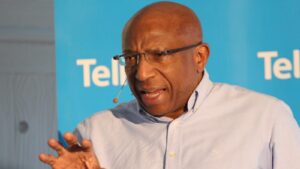
On 1 April 2026, South African Revenue Service (SARS) Commissioner Edward Kieswetter announced that they had collected R2.01 trillion in tax revenue.
He added that, over the past seven years, under his leadership, revenue collections have grown at a compound annual growth rate (CAGR) of 6.8%.
South Africa’s tax-to-GDP ratio of 25.9% was the highest in history, which means the government took more money from citizens than ever before.
Since 1997, R25.1 trillion has been collected, of which R11.5 trillion was collected in the last seven years.
Kieswetter said that collecting over R2 trillion is not an accident, but the result of 14,500 employees performing millions of activities to achieve this record.
“Every rand helps build a capable state that honours the social contract and enables the state to deliver for all South Africans,” he said.
Kieswetter is widely credited with fixing South Africa’s broken revenue service after years of state capture, corruption, and mismanagement.
He implemented a strategy focused on restoring institutional integrity, modernising technology, and rebuilding the organisational culture.
He successfully shifted the internal culture back to the belief that SARS funds democracy and provides healthcare and education for the poor.
Through these actions, he improved tax collections. “I did this for poor South Africans who cannot get private healthcare or education,” he said.
“We are transforming the lives of people. Poor people cannot get private services. They have nowhere to go. Those are the people I work for.”
“I am filled with immense pride that, together with the help of the people at SARS, we have given our best to the nation.”
Kieswetter will step down as SARS Commissioner on 30 April 2026 and will be replaced by Dr Ngobani Johnstone Makhubu.
South Africans are worse off now than in 2018

The premise of Kieswetter’s argument is that the money is more valuable in the hands of the government than in the private sector to help poor people.
He said that collecting more tax money would improve the lives of poor South Africans who rely on the state for healthcare, education, and security.
However, the data tells a different story. Objective measurements showed that South Africans are now worse off than they were eight years ago.
Unemployment increased, more people rely on social grants to survive, absolute poverty increased, and public healthcare deteriorated.
In 2018, before Kieswetter became SARS commissioner, South Africa’s unemployment rate was 27%. In 2025, it fluctuated between 31% and 33%.
Over the last seven years, South Africa has experienced poor economic growth, lagging well behind other developing countries.
In 2018, South Africa’s Gross Domestic Product (GDP) per capita was $7,044. In 2025, it was approximately $6,667.
Because the economy grew more slowly than the population, South African citizens became poorer.
The professions which many unskilled South Africans rely on for an income, domestic servants and gardeners, declined significantly.
In 2018, there were approximately 984,000 domestic servants and 260,000 domestic gardeners. In 2025, it declined to 850,000 and 215,000, respectively.
Higher unemployment means far more people rely on social grants to put food on the table. In fact, there are now far more grant recipients than income taxpayers.
In 2018, 17.8 million people received social grants. It ballooned to 28 million in 2025, including 19.2 million standard grant recipients and 8.7 million SRD grant recipients.
Former President Thabo Mbeki said that the fact that South Africa has so many people on social grants is not something to boast about.
“It is an indictment of the fact that we have failed to build an economy that can provide these people with the means to look after themselves,” he said.
Increasing taxes can hurt the economy and, in turn, citizens

Many economists have explained that higher taxes can hurt a country’s economy and hurt the working class.
Nobel Prize-winning economist Milton Friedman argued that higher taxes are a drag on the economy by distorting incentives and diverting capital away from productive use.
He explained that by taxing income and investment, the government is essentially taxing the desire to work and innovate. “If you tax something, you get less of it,” he said.
He added that high taxes drive away entrepreneurs, doctors, and engineers to countries where their labour is better rewarded.
“I am in favour of reducing taxes under any circumstances, for any excuse, for any reason whatsoever,” he said.
Renowned economist Thomas Sowell agreed, saying high taxes keep money out of the hands of those who actually create things.
Therefore, taxes take money from highly productive people, like business owners, and give it to highly unproductive people, politicians.
He said that high tax rates slow down economic growth, which, in turn, results in fewer jobs and less upward mobility for those at the bottom.
Efficient Group Chief Economist, Dawie Roodt, also argues that while high taxes target the rich, they ultimately hurt the poor.
For this reason, he advised South Africans to do whatever they can, within the law, to pay as little tax as possible.
“One rand in your pocket is worth much more than one rand in the pocket of the civil servants and the government,” he said.
All these economists highlighted that the private sector is much better at capital allocation than the government. This drives economic growth.
In South Africa, which is rife with corruption and mismanagement, money given to the government is often wasted or stolen.
This explains why, despite a significant increase in tax revenue, the country has higher unemployment, worse healthcare, and a security crisis.
It would have been more productive for South Africa to leave more tax money in private hands, where it would have been more productive.
This is an opinion piece by Daily Investor’s Editorial Desk.
Tax collections versus economic performance: 2018 vs 2025
| Tax Measure | 2018 | 2025 | Change |
| Total tax collected | R1.217 trillion | 2.010 trillion | +65% |
| Average income tax | R71,153 | R103,267 | +45% |
| Economic Measure | 2018 | 2025 | Change |
| GDP per capita | $7,044 | $6,667 | -5% |
| Unemployment | 27.10% | 31.40% | +16% |
| People on social grants | 17.6 million | 28 million | +59% |
| Debt-to-GDP ratio | 56.70% | 78.90% | +39% |
South African tax collections


South Africa’s economic performance






Comments